Youth sports motivation strategies: 12 examples for coaches and parents
Published 6 August 2026

The most effective youth sports motivation strategies are process-focused goal setting, effort-centred feedback, autonomy through structured choices, mastery climate drills, cooperative peer activities, and visualisation. Start with these six and you will see a measurable shift in engagement within weeks.
Here is what to try first:
- Set process goals, not outcome goals (“complete five clean passes” rather than “win the match”)
- Praise effort and technique, not talent or results (“brilliant focus on your footwork today”)
- Offer structured choices so athletes feel ownership (“do you want to practise corners or set pieces first?”)
- Build a mastery climate where personal improvement beats comparison with teammates
- Use short cooperative drills that reward group success rather than individual ranking
- Introduce visualisation as a two-minute pre-session habit
The sections below give you exact scripts, ready-to-use drills, and age-specific templates so you can apply each tactic this week.
Table of Contents
- Why intrinsic motivation is the engine, not the fuel
- 12 proven youth sports motivation strategies with examples and scripts
- How to adapt these strategies by age group
- Ready-to-use session structures that embed motivation
- How to measure whether your motivation strategies are working
- How a UK club can operationalise these strategies at scale
- Key takeaways
- The thing most coaches get wrong about motivation
- Levelup360hq puts these strategies into daily practice
- Useful sources and further reading
Why intrinsic motivation is the engine, not the fuel
Intrinsic motivation — the drive that comes from personal satisfaction, curiosity, and the pleasure of improving — is the strongest predictor of long-term consistency in sport. Extrinsic rewards (trophies, praise from adults, league tables) can spark short-term effort, but over-reliance on them risks frustration and burnout when the rewards dry up or the results disappoint.
The practical framework behind most evidence-based youth sports motivation strategies is Self-Determination Theory (SDT), which identifies three psychological needs every young athlete must feel met:
- Autonomy: “I have some say in what I do.”
- Competence: “I can see myself getting better.”
- Relatedness: “I belong to this team and my coach cares about me.”
When all three are present, motivation becomes trainable rather than a fixed personality trait. The coach’s job is to design sessions that feed all three needs simultaneously.
The shift in language is the fastest lever. Compare these two responses to the same moment:
Extrinsic: “Well done — top scorer again!” Process-focused: “Your movement off the ball created that chance. That’s exactly what we worked on.”
The second version tells the athlete what they did that worked, which they can repeat. The first just tells them the scoreboard liked them today.
12 proven youth sports motivation strategies with examples and scripts
1. Set process goals, not outcome goals
Outcome goals (“finish top of the league”) sit outside an athlete’s control. Process goals (“keep my defensive shape for the full second half”) sit entirely within it. Controllable goals help athletes manage effort and sustain pacing across training and competition, particularly as they develop self-regulation.
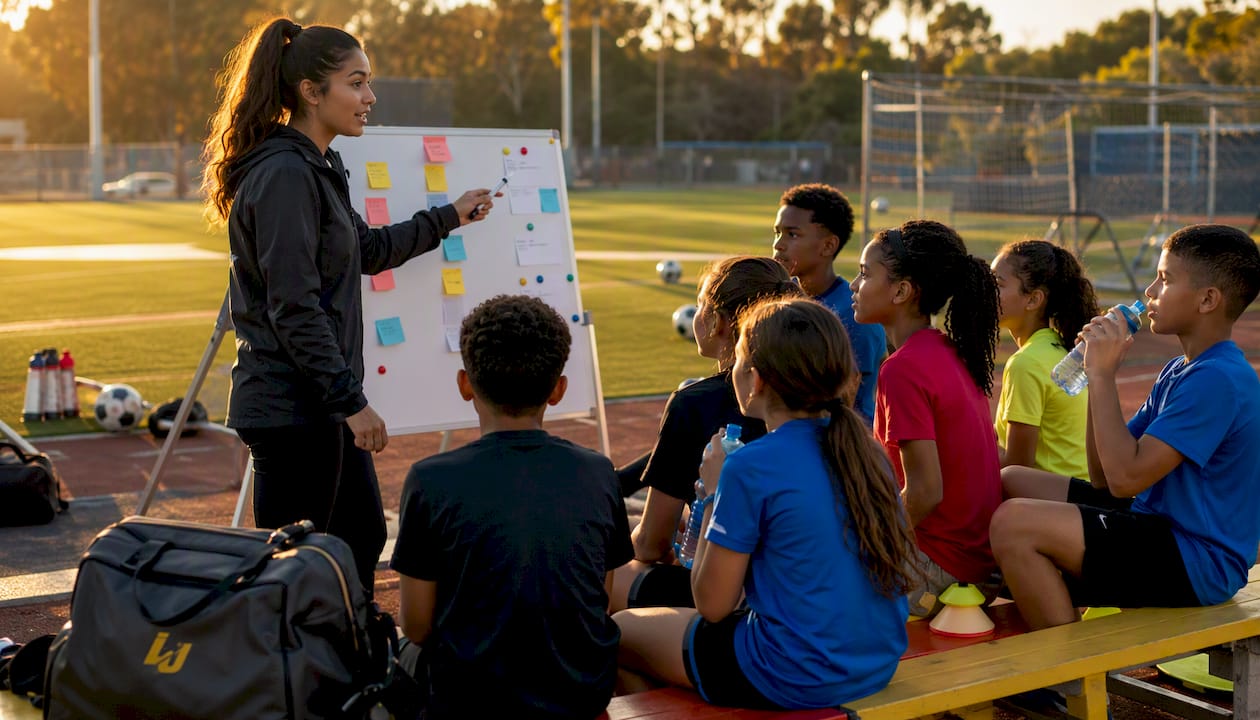
Say this: “Your goal today is to call for the ball at least three times in each half.” Not this: “Just score more than last week.”
Drill (5 minutes): At the start of each session, each athlete writes one process goal on a sticky note and hands it to the coach. At the end, the coach reads them back and athletes self-rate 1–5 on whether they achieved it.
Age note: Ages 5–11: keep goals to one simple action (“stay in position”). Ages 12–18: encourage athletes to write their own goals and explain their reasoning.
2. Give effort-focused feedback, not talent praise
Praising talent (“you’re a natural”) creates fragile confidence that collapses at the first setback. Praising effort and technique (“you kept your head up under pressure — that’s a skill you’ve been building”) creates resilience. Individualising feedback and rewarding improvement rather than raw performance is one of the most consistently recommended coaching behaviours in applied sport psychology.
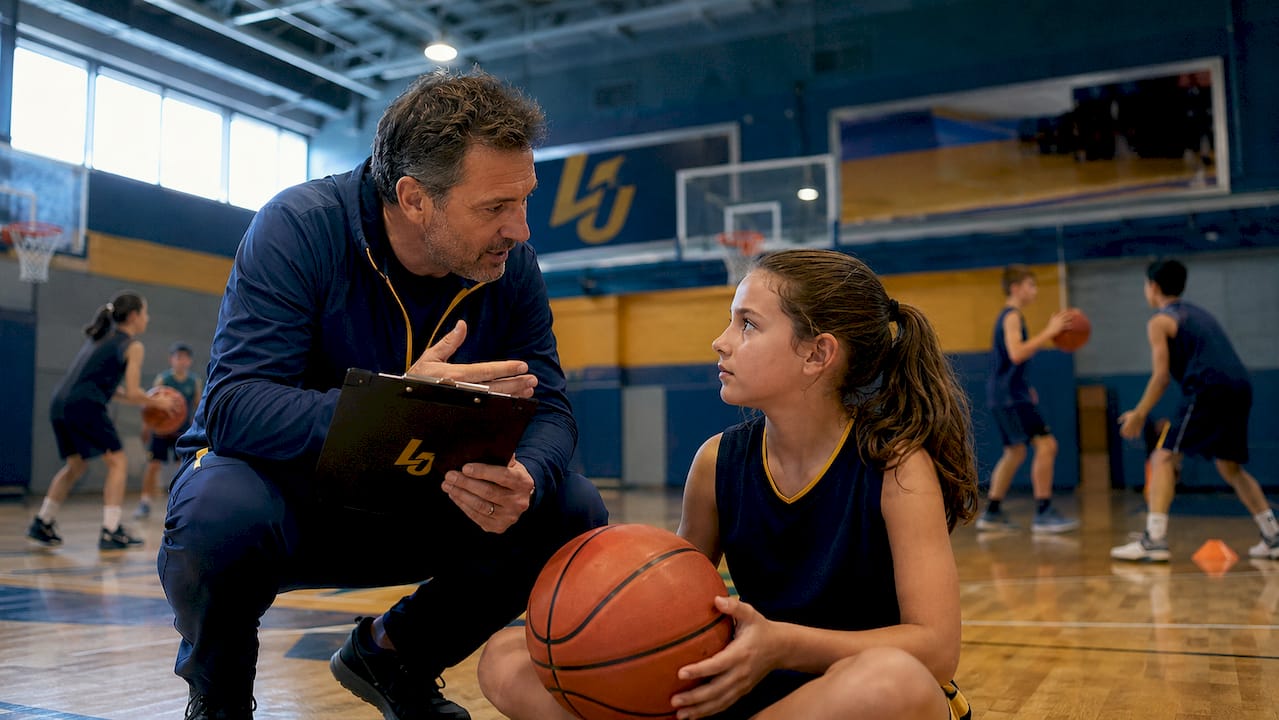
Say this: “You tracked back every time they broke forward. That takes real discipline.” Not this: “You’re just naturally quick — that’s why you caught them.”
Drill (2 minutes): After any small-sided game, each player names one thing they did well (technique or effort, not score). The coach confirms or gently redirects.
Age note: Younger children need immediate, specific feedback (“nice pass — you looked up first”). Teenagers respond better to a brief one-to-one conversation than public praise.
3. Replace negative language with success-seeking instructions
Positive, success-seeking language directs an athlete’s attention toward what to do, not what to avoid. “Don’t look down” puts the image of looking down in the athlete’s mind. “Keep your eyes on the ball” gives them a clear target behaviour.
A practical language audit: for one session, count every “don’t” or “stop” instruction you give, then rewrite each one as a positive directive.
Say this: “Drive through the ball with your laces.” Not this: “Don’t scuff it.”
Say this: “Stay tight to your marker.” Not this: “Stop losing them.”
Age note: This applies at every age, but it matters most with children aged 5–11, whose working memory is limited and who process negative instructions less reliably than positive ones.
4. Build a mastery climate, not a performance climate
A mastery climate measures success by personal improvement; a performance climate measures it by comparison with others. Scholarly analysis of adultification in youth sport warns that win-centric pressure applied too early is a primary driver of drop-out. Small-sided, skill-appropriate activities that reward progress over ranking keep athletes engaged far longer.
Practical steps:
- Post personal-best charts rather than league tables on the noticeboard
- Celebrate “most improved” as loudly as “top performer”
- Design drills where the team beats its own previous score, not a rival team’s score
Drill (10 minutes): “Beat your best” relay. Each athlete records their time or score on a first attempt, then tries to beat their own mark on a second attempt. No cross-athlete comparison is posted.
Age note: Ages 5–11: use sticker charts tracking personal bests. Ages 12–18: use a simple spreadsheet or app-based tracker so athletes own their own data.
5. Give athletes structured choices to build autonomy
Autonomy does not mean a free-for-all. It means offering two or three genuine options within a structured session so athletes feel agency. Environments that support autonomy increase intrinsic drive because athletes stop feeling like passive recipients of instruction.
Say this: “We have fifteen minutes. Do you want to work on set pieces or defensive shape first?” Not this: “Right, we’re doing set pieces. No arguments.”
Drill (5 minutes): “Choice card” warm-up. Print three warm-up options on cards. Athletes vote by standing next to their preferred card. The majority wins, but every athlete has had a voice.
Age note: Ages 5–11: limit to two choices to avoid decision fatigue. Ages 12–18: involve athletes in planning a full session segment once a month.
6. Use cooperative drills to build relatedness
Team belonging is one of the three SDT needs, and it is often the one coaches neglect in favour of individual skill work. Structured cooperative drills, where the group succeeds or fails together, build the social bonds that keep athletes showing up even when personal performance dips.
Say this: “The whole team scores a point every time we complete ten passes without losing the ball. Let’s see if we can beat last week’s record of six.” Not this: “Whoever loses the ball does ten press-ups.”
Drill (15 minutes): Rondo with a team target. Set a collective pass-completion target rather than identifying who loses the ball. Celebrate when the group hits the target; debrief together when they fall short.
Age note: Younger children enjoy simple “everyone wins together” formats. Teenagers benefit from peer-led debrief: ask a different player each week to lead the post-drill discussion.
7. Use visualisation and mental rehearsal
Positive self-talk and mental imagery increase an athlete’s sense of control over effort and fatigue, particularly during competition. Two minutes of structured visualisation before a session costs nothing and builds the habit of mental preparation.
Script (coach reads aloud, 90 seconds): “Close your eyes. Picture yourself at the start of today’s drill. See your feet in position. Feel the ball at your feet. Now picture yourself making the first clean pass — see where it goes, feel the contact. Open your eyes.”
Drill: Run this script before any technically demanding drill for four consecutive weeks. Ask athletes to rate their confidence before and after on a 1–5 scale and track whether scores rise.
Pro Tip: Pair visualisation with a physical trigger, such as touching both knees before a free kick or taking one deep breath before a serve. The trigger becomes a portable confidence cue athletes can use in matches without a coach present.
Age note: Ages 5–11: keep imagery concrete and brief (“picture the ball going into the net”). Ages 12–18: introduce process imagery (“picture your body shape, your breathing, your decision”).
8. Reframe setbacks as learning data
How a coach responds to failure shapes whether an athlete treats mistakes as information or as evidence of inadequacy. The goal is to make the debrief feel like problem-solving, not judgement.
Say this: “What happened there? What would you do differently? Let’s try it again.” Not this: “That was sloppy. You need to concentrate.”
Drill (5 minutes): “Mistake moment” card. Each athlete writes one mistake from the session on an index card and one thing they will try differently next time. Cards go into a box; the coach reads a selection at the start of the next session as “learning from last week.”
Age note: Teenagers are particularly sensitive to public failure. Keep mistake debriefs private or small-group wherever possible.
9. Involve parents in reinforcing motivation at home
Coaches set the climate at training; parents set it everywhere else. When parents default to asking “did you win?” after every session, they inadvertently reinforce a performance climate that undermines the mastery work happening on the pitch.
Parent script after a session: “What was the hardest thing you tried today? Did you get any better at it by the end?”
Not: “Did you score? Did you play well?”
Clubs can run a short (20-minute) parent briefing at the start of each season to share these scripts. Framing it as “how to have the best conversations after training” lands better than “here’s what you’re doing wrong.”
Age note: Parents of under-11s have the most influence on post-session mood. With teenagers, less is often more: a brief “how was it?” and genuine listening beats an interrogation.
10. Balance competition and fun to sustain long-term engagement
Competition is not the enemy of motivation; joyless, adult-driven competition is. The research on mastery climates and adultification consistently shows that fun and skill-appropriate challenge are the two factors most strongly associated with continued participation past the age of 13.
Practical balance:
- Run one purely fun, low-stakes game per month with no coaching interruptions
- Let athletes invent a rule variation for one drill per half-term
- Celebrate creative play, not just correct play
Age note: Ages 5–11: fun is the primary motivator; competition is secondary. Ages 12–18: athletes can handle more competitive pressure, but only when they have already built a strong sense of competence.
11. Build self-motivation through reflection habits
External encouragement gets athletes to training. Self-motivation keeps them there when results are poor, the weather is grim, and the coach is unavailable. Building the habit of self-reflection turns external feedback into internal drive over time.
Weekly reflection prompt (30 seconds, end of session): “Rate your effort today 1–5. What is one thing you got better at? What will you focus on next session?”
Visible, measurable improvement is one of the most consistent levers for sustaining motivation in young athletes. When athletes track their own micro-improvements, they stop waiting for a coach to tell them they are progressing.
Age note: Ages 5–11: use a simple smiley-face scale. Ages 12–18: a brief written log or app entry works well and builds metacognitive habits useful beyond sport.
12. Use reward framing that protects intrinsic motivation
Rewards are not inherently harmful, but how they are framed matters enormously. A reward that signals “you did this for the sticker” undermines intrinsic drive. A reward that signals “this badge recognises the specific skill you have built” reinforces it.
Say this: “This badge marks the fact that you’ve now completed twenty clean headers in training. You earned it through repetition.” Not this: “Best player gets a medal at the end of term.”
Drill: Design a badge or milestone system where every athlete can earn recognition by hitting personal skill benchmarks, not by outperforming teammates. Every athlete in the squad should be able to earn a badge in any given month.
Age note: Younger children respond well to tangible, immediate rewards (stickers, stamps). Teenagers often prefer recognition that has social currency: a shout-out in a team app feed, a player card upgrade, or a coaching role in a junior session.
How to adapt these strategies by age group
The strategies above work across age groups, but the delivery needs adjusting. A 7-year-old and a 16-year-old are not just different sizes; they are at fundamentally different developmental stages.
| Dimension | Ages 5–11 | Ages 12–18 |
|---|---|---|
| Attention span | 10–15 minutes per task | 20–30 minutes per task |
| Goal complexity | One simple action goal | Multi-step process goals |
| Feedback style | Immediate, specific, warm | Brief, private, honest |
| Autonomy level | Two structured choices | Co-design one session segment per month |
| Motivation trigger | Fun, novelty, belonging | Competence, peer respect, visible progress |
| Drop-out risk | Boredom, adult pressure | Social comparison, lack of perceived ability |
| Parent involvement | High: post-session scripts matter most | Lower: give space, but keep communication open |
Conversation template, ages 5–11 (coach): “You really kept trying even when it was hard. That’s what good players do. What shall we try next?”
Conversation template, ages 12–18 (coach): “I noticed you adjusted your positioning in the second half. What made you decide to do that? Did it work?”
Parent template, ages 5–11: “You looked like you were having fun out there. What was your favourite bit?”
Parent template, ages 12–18: “How did you feel about your own performance today? Anything you want to work on?”
Teenagers are particularly sensitive to social comparison and perceived competence. Reducing public ranking and increasing private, specific feedback during this stage is the single most protective adjustment a coach can make.
Ready-to-use session structures that embed motivation
These three microplans embed the motivational principles directly into practice time. No extra equipment needed.
10-minute mastery starter
- Athletes arrive and write one process goal on a sticky note (2 min)
- Coach leads a 90-second visualisation script (see Strategy 7)
- “Beat your best” individual skill drill: each athlete records their baseline score, then attempts to beat it (6 min)
- Athletes self-rate effort 1–5 and hand in their sticky note (2 min)
20-minute cooperative skill block
- Warm-up with “choice card” (3 min, see Strategy 5)
- Small-sided cooperative drill with a team target (12 min, see Strategy 6)
- Peer feedback round: each athlete tells a partner one specific thing they did well (3 min)
- Coach delivers one group process observation, no individual criticism (2 min)
30-minute full session with mastery debrief
- Process goal setting (3 min)
- Technical skill block with “beat your best” scoring (12 min)
- Small-sided game with cooperative scoring rule (10 min)
- “Mistake moment” card activity (3 min, see Strategy 8)
- Reflection prompt: effort rating + one improvement + next session focus (2 min)
Turning a competitive drill into a cooperative mastery task: take a standard shooting drill where athletes compete for the most goals and replace the scoring with a team target (“let’s see if we can score fifteen between us before the whistle”). The skill demand is identical; the social dynamic shifts from comparison to collaboration.
Pro Tip: Peer feedback is most effective when you give athletes a sentence starter: “One thing I noticed you did well was…” Without a prompt, most young athletes default to “it was good” and the learning moment is lost.
How to measure whether your motivation strategies are working
Motivation is not invisible. These five KPIs give you a concrete read on whether the climate is shifting.
| KPI | How to measure | Target range |
|---|---|---|
| Session attendance rate | Track weekly; note unexplained absences | Stable or rising over 6 weeks |
| Self-rated effort (1–5) | End-of-session card | Average above 3; trend upward |
| Voluntary extra practice | Count athletes who stay late or ask for extra reps | Any increase from baseline |
| Enjoyment rating (1–5) | Monthly anonymous card | Average 4 or above |
| Skill benchmark progress | Coach-rated or timed drill score | Improvement in most athletes over several weeks |
Monitoring cadence:
- Weekly micro-check: collect effort and enjoyment cards at session end; scan for outliers
- Monthly review: compare attendance and skill benchmarks against the previous month
- End-of-season reflection: sit with athletes and parents to review the full picture
What to expect:
- 2 weeks: language shifts (fewer “don’t” instructions, more process goals) are noticeable; athletes may seem surprised by the change in tone
- 6 weeks: attendance stabilises; self-rated effort scores begin to rise; some athletes start setting their own goals without prompting
- 12 weeks: visible skill improvement in the majority of athletes; peer feedback becomes more specific; drop-out conversations reduce
A one-sheet tracker needs five columns: date, athlete name (or initials for privacy), effort score, enjoyment score, and one coach note on a specific behaviour observed. Keep it simple enough that a volunteer coach can complete it in three minutes at the end of a session.
How a UK club can operationalise these strategies at scale
The gap between knowing a strategy and embedding it into every session is where most clubs stall. A grassroots football club in the East Midlands, for example, might have twelve volunteer coaches running sessions across four age groups. Verbal briefings get forgotten; printed handouts get lost. The strategies need to live inside the tools coaches already use.
Here is a practical implementation template:
- Process goals: build a weekly goal-setting prompt into the session plan template so every coach runs it, not just the motivated ones
- Effort-focused feedback: run a 20-minute language audit workshop at the start of the season; coaches pair up and count each other’s “don’t” instructions during a drill
- Mastery climate: replace any cross-athlete ranking display with personal-best boards; update them weekly
- Cooperative drills: include one cooperative scoring variant in every session plan as a default, not an optional extra
- Visible progress: give every athlete a way to see their own improvement data, whether that is a paper chart or a digital tracker
Platforms like Levelup360hq are built specifically to make this infrastructure practical at club scale. Features such as XP-driven challenges and tier progression reinforce effort and skill development rather than raw results. Live player cards give athletes visible, real-time evidence of their own improvement, which directly feeds the competence need in SDT. Badge systems tied to skill benchmarks (rather than match outcomes) operationalise mastery-climate principles without requiring coaches to redesign every session from scratch. Video assessment workflows with approval steps mean coaches can deliver individual, private feedback efficiently, even across large squads.
For relatedness, team challenges and the platform’s social feed give athletes a shared space to celebrate group progress. For autonomy, coaches can offer athletes choice menus within the platform’s session management tools.
UK safeguarding note: any platform used with under-18s should have parental consent mechanisms, secure video approval workflows, and age-appropriate privacy controls in place before launch. Check with your club welfare officer and local governing body before going live.
Pro Tip: Roll out one feature at a time. Start with process goal tracking in week one, add the badge system in week three, and introduce video assessment in week six. Volunteer coaches who try to adopt everything at once typically revert to old habits within a fortnight.
Key takeaways
The single most effective shift any coach or parent can make is to replace outcome-focused language with process-focused feedback, because that one change feeds all three SDT needs simultaneously.
| Point | Details |
|---|---|
| Intrinsic motivation lasts | Effort-focused praise and mastery goals build resilience that extrinsic rewards cannot sustain alone. |
| Language is the fastest lever | Replacing “don’t” instructions with positive directives changes athlete behaviour within sessions, not seasons. |
| Age-appropriate delivery matters | Under-11s need immediate, warm, simple feedback; teenagers need private, specific, honest conversations. |
| Measure what you manage | Track attendance, effort scores, and enjoyment ratings weekly to catch disengagement before it becomes drop-out. |
| Levelup360hq operationalises it | XP challenges, skill-based badges, and live player cards embed mastery-climate principles into daily club practice. |
The thing most coaches get wrong about motivation
Most coaches treat motivation as something athletes either have or lack. The research says otherwise: it is an environment you build, session by session, word by word.
The strategies in this article are not complicated. Process goals, effort praise, cooperative drills, a two-minute visualisation script. None of them require specialist training or expensive equipment. What they require is consistency, and that is harder than it sounds when you are a volunteer coach with forty minutes to set up cones before fifteen children arrive.
The honest advice: pick one strategy this week. Just one. Replace three “don’t” instructions with positive directives, or run the “beat your best” drill once, or try the end-of-session reflection card. Do it for four weeks before adding anything else. The clubs and parents who see the biggest shifts are not the ones who overhaul everything at once; they are the ones who make one small change and stick to it long enough to see the evidence.
If you run a session using any of these approaches, keep a brief diary for a month. Note what you said, how athletes responded, and whether attendance or effort shifted. That four-week log will tell you more about what works with your specific group than any general guide can.
Levelup360hq puts these strategies into daily practice
Knowing the strategies is one thing. Having the infrastructure to run them consistently across a full squad, every week, with volunteer coaches, is another problem entirely.
Levelup360hq is built for exactly that gap. Rather than asking coaches to remember to run a reflection card or manually update a personal-best board, the platform embeds motivational mechanics directly into the session workflow. XP-driven challenges reward effort and skill progression. Skill-based badges give athletes visible, specific recognition tied to what they have actually practised. Live player cards show real-time improvement data, so athletes can see their own progress without waiting for a coach to tell them. Video assessment tools with approval workflows make individual feedback practical even across large squads.

For clubs running multiple age groups across football, cricket, netball, or rugby, the white-label platform means every team benefits from the same motivational infrastructure under your club’s own branding.
Book a demo at Levelup360hq to see how the player cards, badge system, and XP challenges work in practice, or explore the full platform to understand how it fits your club’s structure.
Useful sources and further reading
The evidence behind these strategies draws on developmental sports psychology, applied coaching research, and UK-relevant safeguarding guidance. The sources below are worth bookmarking.
- Optimal development of youth athletes (PMC) — peer-reviewed research on pacing, self-regulation, and controllable goal setting; directly applicable to session planning for all age groups.
- Motivating young athletes — Applied Sport Psychology (AASP) — practical coach guidance on individualised feedback, language audits, and cooperative drills; one of the most cited practitioner resources in the field.
- The role of motivational support in youth athletes — SPORT TK — academic analysis of Self-Determination Theory applied to youth sport training environments; useful background for coaches designing need-supportive sessions.
- Adultification and mastery climates in youth sport — journal research on how win-centric adult pressure drives drop-out and how mastery climates protect long-term participation.
UK safeguarding reminder: before using any digital platform with under-18s, confirm that parental consent procedures, data privacy controls, and secure video workflows meet the requirements of your local governing body and your club’s welfare officer. The NSPCC’s Child Protection in Sport Unit is the primary UK reference point for clubs.
Recommended
Turn potential into a player card.
LevelUp360 tracks every match, builds your child's player card, and shows their development over time.
Get started free