Youth Sports Loyalty Programs: How to Build One That Keeps Kids Playing
Published 4 November 2026

A youth sports loyalty program is a points-and-recognition system that rewards young athletes (and often their families) for showing up, trying hard and staying with the club season after season. It is not a retail rewards card. The best ones pay out for attendance, effort and good teammate behaviour, not just wins, and they turn those points into badges, privileges and small, age-appropriate rewards. This guide shows how to design one, what to reward, what to avoid and how to tell whether it is working.
TL;DR
- Reward what every child can control: attendance, effort, completing evaluations and positive behaviour, rather than talent or results alone.
- Keep the rules simple. If the mechanics need a three-minute explanation, they are too complicated.
- Match rewards to age: wristbands for younger children, kit and experiences for teenagers, recognition for parent volunteers.
- Build safeguarding in from day one, using SafeSport resources and your governing body’s rules.
- Measure returners from one season to the next, not just sign-ups.
Table of Contents
- What a loyalty program means in youth sport
- Why recognition beats a pure results focus
- What to reward: a points model that works for every child
- Badges, leaderboards and rewards by age
- Recognising athletes fairly across ages, abilities and sports
- Safety and safeguarding come first
- Measuring whether it works
- Our perspective
- Running it in one platform
- A simple launch plan
- FAQ
- Sources
What a loyalty program means in youth sport
In retail, loyalty means spending: you buy, you earn points, you redeem a discount. In sport fandom it is often similar, although some programs take a different route. NASCAR’s fan rewards scheme, for example, took an action-based approach rather than a monetary one, with points for digital check-ins, trivia and other activities.
Youth sport borrows that action-based idea and changes the goal. The currency is engagement, and the aim is retention: getting a child to come back next season, and the one after. Parents are part of the picture because they register, pay, drive and volunteer, but the child is the person you are trying to keep playing.
That goal matters because kids leave. Project Play’s survey work found that the average child plays a sport for under three years, quitting by around age 11, most often because it stopped being fun. A loyalty program is one of the tools a club has to keep the fun, the friendships and the sense of progress visible.
Why recognition beats a pure results focus
It is tempting to build a scheme around goals scored, matches won and rankings. Most children are not playing for that. In the Aspen Institute’s 2025 national survey, 48% of current players named having fun and 47% named playing with friends among their favourite things about sport, while 24% cited winning and 12% a college scholarship or roster spot.

The same survey found that among young people who have never played organised sport, 43% say fun and 37% say exercise would motivate them to start. The takeaway for a club: low-stakes, social, enjoyable programming draws children in, and a loyalty program that celebrates belonging fits what most of them want.
There is also a coaching link. One study cited by Project Play found that 5% of children with trained coaches quit the following year, against 26% otherwise. A loyalty program works best when it reinforces good coaching rather than substituting for it: the points should reflect what your coaches already teach and notice.
What to reward: a points model that works for every child

A useful reference is the MLSE LaunchPad program described by Canada’s Sport Information Resource Centre. It awarded points for attendance, attendance streaks or perfect attendance, multi-sport engagement, completing evaluations, positive participation and prosocial skills, and it explicitly did not award points for talent or sport performance. That design means a nervous beginner can earn as much as the star of the team.
A starter points menu for a US club might look like this:
| Behaviour | Example points | Why it helps |
|---|---|---|
| Attending a session | 10 | Builds the habit of showing up |
| Attendance streak (for example four weeks running) | 25 bonus | Rewards consistency |
| Completing a skills self-check or evaluation | 15 | Gets athletes involved in their own progress |
| Encouraging a teammate (coach-nominated) | 20 | Reinforces positive culture |
| Trying a second sport or a new position | 20 | Supports multi-sport development |
| Volunteering (parents) | 30 | Recognises the adults who keep the club running |
The point values are illustrations to adjust for your own club, not a standard. What matters is that the totals are reachable by effort alone.
When competition points make sense
Some sports already run points systems tied to results. USTA’s Net Generation PlayTracker, for players aged 5 to 10, awards play points for participation and win points for results. In green-ball Junior Team Tennis and Junior Circuit events, singles wins earn 100 points and doubles wins 50, and points help decide progression between competition levels. If you run a competitive pathway, keep that track separate from your engagement program so that effort and character are rewarded on their own terms.
Badges, leaderboards and rewards by age
Badges work because they are specific. SIRCuit suggests digital recognition for a particular life skill, an act of positivity or moving up to a higher participation level, with leaderboards used for friendly recognition and rewards that include merchandise and earned privileges.
A few badge ideas that fit this approach:
- Ever-present: attended every session in a month.
- Team glue: nominated by a teammate for encouragement.
- Two-sport athlete: tried a second sport during the year.
- Reflective player: completed every self-assessment this season.
- Club helper: helped set up or pack down equipment.
Match the reward to the age
SIRCuit’s examples of redemptions show how much age matters: wristbands and bracelets for ages 6 to 10, water bottles and T-shirts for ages 11 to 14, and for older youth, experiences such as a sponsor-donated movie night, special-event admission or choosing the food at an end-of-season dinner.
Rewards also work better when they feel meaningful rather than purely financial. One European club-merchandise guide makes the point that a limited club sticker can feel more emotional than a generic voucher. The same source says the mechanics should be easy to grasp, with QR codes, digital badges and stickers as simple options. If you need a three-minute explanation, simplify.
Don’t forget the parents
Guidance for youth and amateur organisations also recommends rewarding parent volunteers and recognising player development. Parents who feel noticed are more likely to volunteer again, and a club with willing volunteers can run more sessions for more children.
Recognising athletes fairly across ages, abilities and sports
Fairness is the make-or-break design question. A programme that favours the fastest or most confident children will push others out, which is the reverse of its purpose.
The USOPC’s American Development Model promotes inclusive, developmentally appropriate activity, multi-sport participation, fun and engagement at every level, and quality coaching. Its implementation guide says feedback and evaluation should reflect the athlete’s age, stage, ability or skill level, with ongoing feedback at regular intervals such as quarterly, or before, during and after the season.
In practice that means:
- Set age bands. An under-8 gets simple stickers and coach praise; an under-16 can handle levels, streaks and a visible leaderboard.
- Compare athletes with their own past. A personal best in attendance or effort is a better headline than a rank against others.
- Make leaderboards optional or team-based for younger groups, so nobody is publicly last.
- Use the same criteria across sports where you run more than one, so a netball player and a footballer are judged on the same engagement behaviours.
- Review quarterly. Check who is earning, who is not and ask why. Silent children are a signal.
Safety and safeguarding come first
Any program that involves children, digital profiles and messaging needs safeguarding built in, not added afterwards. In the US, the U.S. Center for SafeSport offers education such as SafeSport for Kids (ages 5 to 12) and SafeSport for Youth Athletes (ages 13 to 17), and some national governing bodies set firm requirements. USA Gymnastics, for instance, requires member clubs to maintain a safety program with prevention policies and required background screening and SafeSport training for certain adult participants.
Check what your own governing body requires before you launch, and apply the same standards to anyone who can see or comment on children’s profiles. Practical rules that follow from this:
- Keep recognition about behaviour and effort, never about bodies or appearance.
- Limit who can message young athletes, and keep communication visible to other adults.
- Get parental consent before showing a child’s name, photo or ratings to a wider audience.
- Make sure coaches’ nominations for points are transparent and reviewed by a second adult.
Measuring whether it works
A loyalty program that is not measured is just a prize cabinet. The National Recreation and Parks Association’s measuring-progress worksheet points to a useful set of indicators: registrations, first-time participants, returners from one season to the next, conversion from clinics to youth sports registration, and post-season satisfaction, segmented by gender and demographics.
For a club, a simple dashboard would show:
| Measure | What it tells you |
|---|---|
| Season-to-season return rate | Whether children are staying |
| Average attendance per athlete | Whether the habit is forming |
| Share of athletes earning at least one badge | Whether rewards reach everyone |
| Points earned by age group and gender | Whether the design is fair |
| Post-season satisfaction (children and parents) | Whether it feels fun |
Set your baseline from last season before you launch, then compare. Be patient: retention shows up over a full season cycle, not in a fortnight.
Our perspective
Most clubs we speak to already do the hard part: they care about their athletes. What they lack is a way to make that care visible. A child who attends every week, helps a teammate and finishes every self-assessment deserves a record of it, and so do the parents watching.
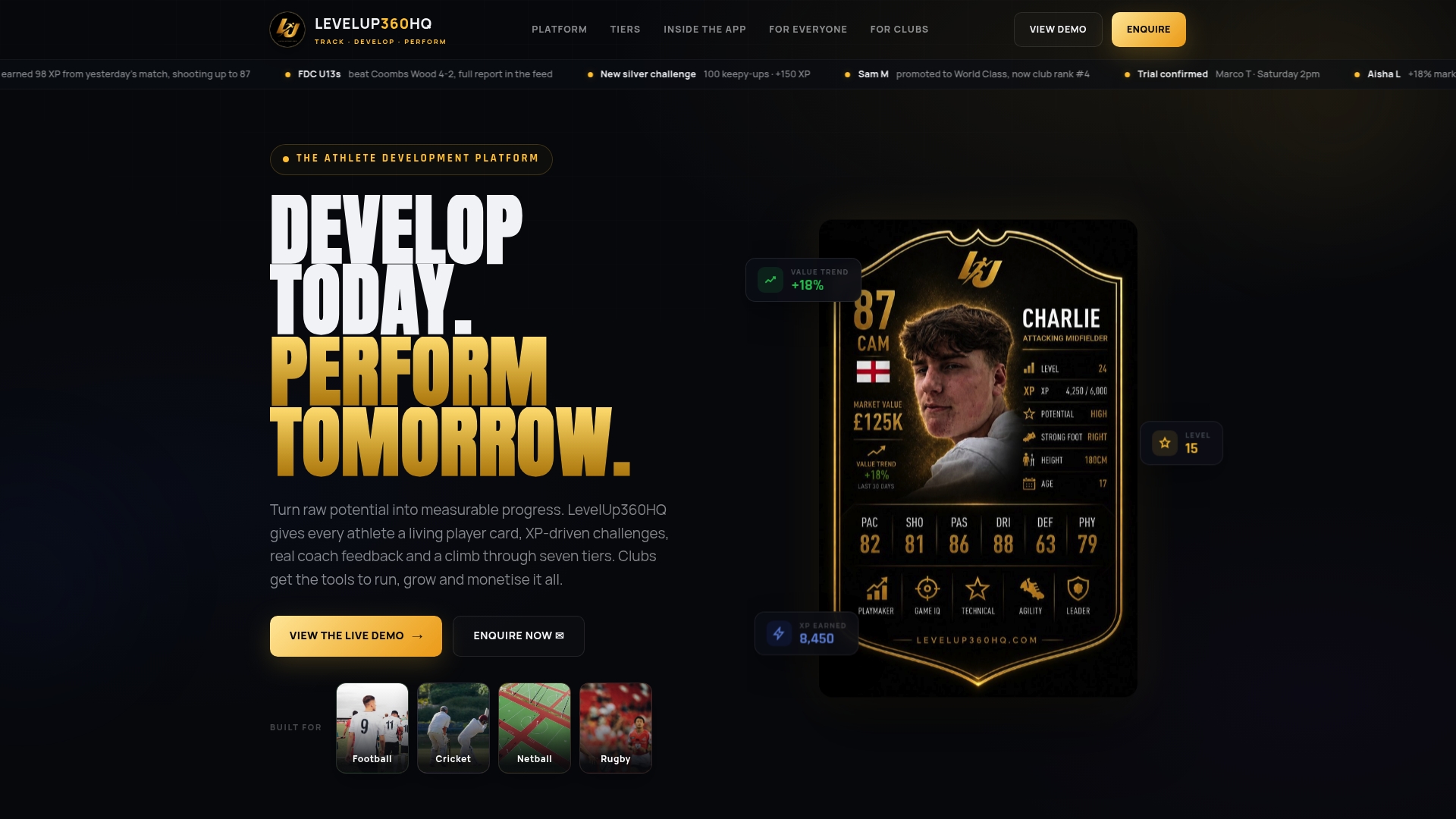
That is why we built LevelUp360HQ around live player cards, XP-driven challenges, tier progression and badges. The athlete owns their development, the coach approves the evidence, and the club gets a single place to run sessions, memberships and a store. We designed it so that engagement counts, because a leaderboard that only celebrates the best player teaches most children that it is not for them.
Our view is that a loyalty program should be part of how a club runs day to day, not a separate spreadsheet. When recognition, coaching workflows and club administration sit in one system, the points mean something, and the club can see who is thriving and who is drifting.
Chris
Running it in one platform
If you want the points, badges and club admin in one place, LevelUp360HQ is built for that. Athletes get live player cards with ratings, XP challenges and tier progression. Coaches get video assessments, approval workflows and session management. Clubs get white-label branding, CRM, subscription management and store integration, across football, cricket, netball, rugby and other sports.
Pricing is published: the Pro plan is £49 per month, with an active athlete platform fee of £1.50 per month per active athlete. A revenue share applies on integrated payments, and no price is published for it. You can see the details and try the prototype, or explore the platform first.
A simple launch plan
- Define the goal. Choose one outcome, such as raising season-to-season return rates.
- Pick five to seven behaviours to reward, mostly attendance, effort and character.
- Set age bands and a reward list for each, including a no-cost recognition option.
- Write the rules on one page. If a nine-year-old cannot explain it back, rewrite it.
- Check safeguarding against your governing body’s requirements and SafeSport resources.
- Launch with one team or age group, gather feedback from children, parents and coaches, then widen.
- Review each quarter and publish the results to families.
FAQ
What is a youth sports loyalty program?
It is a system that gives young athletes and their families points, badges or privileges for engagement: attending, trying hard, completing evaluations and behaving positively. The aim is to keep children involved from one season to the next. Unlike retail loyalty, it rewards actions rather than spending.
What rewards suit different ages?
SIRCuit’s examples suggest wristbands and bracelets for ages 6 to 10, water bottles and T-shirts for ages 11 to 14, and experiences such as a movie night or choosing the end-of-season meal for older youth. Recognition, such as badges and shout-outs, costs nothing and works at every age. Adjust to your own families and budget.
Should points reward winning?
For an engagement program, we would not base points mainly on results. Only about a quarter of current players in the Aspen Institute survey named winning as a favourite thing about sport, while nearly half named fun and friends. Keep competitive points in a separate pathway if your sport uses them.
How do I know if the program is working?
Track how many athletes return the next season, average attendance, the share earning at least one badge and post-season satisfaction, split by gender and age. Compare against last season’s figures. Look for movement over a full season rather than a few weeks.
Sources
- Facilities: New NASCAR fan loyalty program moves away from…, Sports Business Journal
- The Digital Gamification of Youth Sport Engagement, SIRCuit
- Aspen Institute national survey of youth and sports: 15 key findings, Project Play
- Survey: Kids quit most sports by age 11, Project Play
- Youth Sports Playbook: Train All Coaches, Project Play
- The Net Generation PlayTracker, USTA
- Fan retention through merch, Coaching Area
- Sports Loyalty Programs: How to Reward Fans, PassKit
- ADM Implementation Guidebook, USOPC
- Safety program requirements, U.S. Center for SafeSport (USA Gymnastics 2025 MAAPP)
- Measuring Progress worksheet, NRPA
Turn potential into a player card.
LevelUp360 tracks every match, builds your child's player card, and shows their development over time.
Get started free