Why UK academies need gamified training tools
Published 11 August 2026

UK sports academies that adopt gamified athlete-development platforms now gain a measurable edge: higher player engagement, MDT-ready performance data, centralised safeguarding records and new commercial revenue channels that spreadsheets and paper registers simply cannot deliver. The practical recommendation is to pilot a platform that integrates live player cards, video assessment and real-time analytics, with Levelup360hq, the Sport England safeguarding framework and EPPP reporting requirements all factored in from day one.
- Gamified platforms raise engagement and retention across age groups
- MDTs gain role-specific dashboards that cut analysis paralysis
- Safeguarding records (DBS, incident logs, welfare notes) sit in one auditable system
- Subscription, store and event tools open commercial revenue streams
Key takeaways
Gamified athlete-development platforms deliver measurable gains for UK academies when they integrate player progression, MDT workflows, safeguarding records and commercial tools in a single system.
| Point | Details |
|---|---|
| Engagement moves first | Active user and module completion rates typically shift within 4–8 weeks of launch. |
| MDT dashboards cut meeting time | Centralised visualisations prevent analysis paralysis and move MDT conversations from data review to decision-making. |
| Safeguarding must be built in | DBS tracking, incident logs and parental consent workflows need to be native features, not add-ons. |
| Pilot before you scale | A 6–12 week pilot with defined KPIs and an MDT champion reduces adoption risk significantly. |
| Levelup360hq | Covers player cards, video assessments, CRM, payments and safeguarding records in one platform with full data ownership. |
Table of Contents
- Why gamified training tools matter for UK academies
- What features should every UK academy demand from a platform?
- What does the evidence actually say about gamified athlete training?
- How to roll out a gamified platform in your academy
- Which KPIs tell you whether the platform is working?
- Pitfalls and red flags to watch for during procurement
- How gamified platforms support UK safeguarding and compliance
- What should academy leaders do right now?
- A practitioner’s view on what actually changes
- Levelup360hq gives academies the full picture from day one
- Sources
Why gamified training tools matter for UK academies
The case for gamified athlete-development platforms is not theoretical. A Premier League Academy mobile-first project used narrative-led design, virtual kit and digital sticker mechanics to drive engagement across 10,000–12,500 players, delivering EPPP life-skills content as a SCORM package for LMS tracking. This scale shows what familiar game mechanics can do when applied to content players would otherwise skip.
The core benefits for UK academies break down clearly:
- Player engagement: XP challenges, tier progression and leaderboards give athletes a visible stake in their own development, not just a coach’s verbal feedback
- Skill acquisition: Gamified, interactive training systems can quantify technical and cognitive performance, making progress concrete rather than subjective
- Talent identification: Measurable benchmarks and leaderboard data surface players who perform consistently, not just those who shine on a given day
- Retention: Athletes who track their own progress through badges and rating improvements are more likely to re-enrol season to season
- Commercial growth: Subscription management, store integrations and event booking tools convert programme delivery into recurring revenue
EPPP academies already know that off-pitch education and life-skills engagement count. Gamification is the mechanism that makes those modules stick for digitally native players.
Pro Tip: When presenting gamification to parents and coaching staff, lead with development metrics — skill ratings, assessment scores, tier progression — rather than leaderboard positions. Parents respond to evidence of growth; coaches respond to data they can act on.
What features should every UK academy demand from a platform?
A platform checklist matters because the market is uneven. Some tools offer leaderboards and nothing else; others bury safeguarding records in a separate system. The features below represent the minimum viable specification for a UK academy operating under EPPP and Sport England guidance.
Athlete-facing features:
- Live player cards with real-time ratings and market values
- XP-driven challenges and tier progression
- Badge systems and leaderboards
- Social engagement feed (activity wall or equivalent)
Coach and MDT features:
- Video assessments with approval workflows
- Session and syllabus management
- Role-based views (coach, physio, welfare officer, parent)
- Exportable reports formatted for NGB and Ofsted evidence packs
Club and compliance features:
- Centralised DBS record tracking, incident logs and welfare notes
- Parental consent workflows
- CRM with subscription and payment management
- Store and event booking integrations
Game-based approaches aligned with EPPP principles require purposeful curriculum design and representative tasks. A platform’s challenge and assessment architecture should reflect that, not just bolt on points to existing drills.
Pro Tip: Before signing any contract, confirm the platform exports data in formats your existing LMS, EPPP reporting templates and finance system can ingest. A closed ecosystem that traps your player data is a procurement red flag, not a feature.
What does the evidence actually say about gamified athlete training?
The honest answer is: promising, with caveats. A case study on gamified football development platforms found they can motivate players, assist talent identification and quantify cognitive performance, but accessibility and the need to integrate with coach-led practice remain genuine constraints. A practical example: 7 Academy reported measurable cognitive and decision-making gains after integrating interactive technology with coaching, including the selection of one player for a professional trial following a talent identification event.
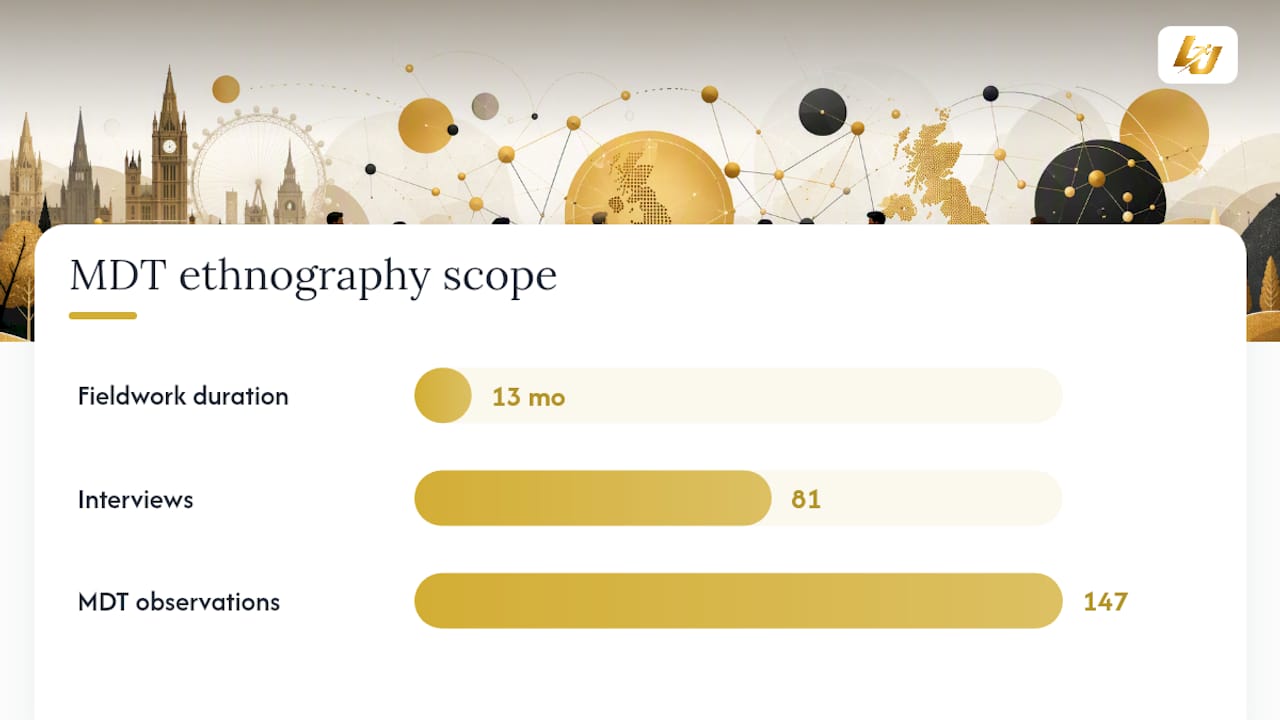
The MDT picture is more complex. Ethnographic research conducted over 13 months in an English Premier League Category One academy, covering 81 interviews and 147 MDT meeting observations, identified five themes shaping how technology gets accepted: the rhythm of the season, staff diversity, partnerships and conflict, instability, and operational MDT factors. Staff turnover and the compressed pre-season window are the two adoption killers most platforms ignore.
“Collecting data is not enough — successful academies use centralised, user-friendly visualisations so MDTs avoid analysis paralysis and can act on player insights.” Frontiers in Psychology
Realistic limitations to plan for:
- Accessibility: not all players have equal device access or digital literacy
- Over-gamification: leaderboards that reward volume over quality distort development priorities
- Task design: game-based approaches require deliberate sequencing and coach dialogue to produce transferable skills, not just points
- Data interpretation: raw platform analytics need an MDT member who can contextualise them
How to roll out a gamified platform in your academy
A phased approach reduces risk and builds staff buy-in before full commercial launch.
Phase 1: Pilot (weeks 1–12)
- Select a single age group or squad as the pilot cohort
- Nominate an MDT champion responsible for platform adoption
- Define three to five KPIs before launch (see the KPIs section below)
- Configure safeguarding fields: DBS records, incident log templates, parental consent workflows
- Run a 90-minute onboarding session for coaches, welfare officers and parents
- Set a mid-pilot review at week six to catch adoption issues early
Phase 2: Evaluation (weeks 10–14)
- Export engagement and assessment data; compare against baseline KPIs
- Gather structured feedback from coaches, players and parents
- Identify any MDT workflow gaps and adjust role-based permissions
Phase 3: Phased roll-out (months 4–9)
- Extend to additional squads, adding commercial features (subscriptions, store, events)
- Integrate with NGB reporting and any existing LMS or finance system
- Schedule a full safeguarding audit of stored records before the new season
The MDT ethnography finding about season rhythm and staff turnover is a practical warning: launch pilots in pre-season, not mid-season, and build simple onboarding that survives staff changes.
Pro Tip: Assign platform admin rights to at least two people. Single-point-of-failure admin is the most common reason a pilot stalls when a key staff member leaves.
Which KPIs tell you whether the platform is working?
Centralised visual dashboards translate multi-disciplinary data into role-specific insights. The table below maps KPIs to data sources and realistic timelines.
| KPI | Data source | Typical timeline |
|---|---|---|
| Active users / module completion rate | Platform analytics dashboard | 4–8 weeks |
| Season-to-season retention rate | CRM / enrolment records | End of season |
| Skill assessment score improvement | Video assessment scores, ratings | 6–12 months |
| Revenue per athlete | Payment / subscription module | 8 weeks post-launch |
| MDT meeting efficiency (time on data review) | MDT meeting logs | 6–12 weeks |
Track engagement metrics first; they move fastest and signal whether the platform has been adopted at all. Development metrics take longer but carry more weight for EPPP reporting and NGB funding conversations.
Pitfalls and red flags to watch for during procurement
Some platforms look complete in a demo and fall apart in daily use. Watch for these:
- Opaque data ownership clauses: if the contract does not explicitly state that your academy owns all player data, walk away
- No safeguarding record integration: a welfare module bolted on as an afterthought is not the same as a purpose-built audit trail
- Poor mobile performance: academy players are mobile-first; a platform that lags on a mid-range Android handset will not be used
- Closed export formats: inability to export reports for Ofsted, NGBs or funding bodies is a compliance liability
- One-size-fits-all challenges: a U10 and a U18 should not face identical XP tasks; age-appropriate design is non-negotiable
- No neurodiversity or accessibility provisions: WCAG compliance and adjustable challenge difficulty matter for inclusive programmes
Pro Tip: In any demo, ask the vendor to show you the safeguarding audit trail with a test incident log, the data export function and the role-based access settings. If they cannot demo all three in under ten minutes, the feature either does not exist or is not production-ready.
How gamified platforms support UK safeguarding and compliance
Sports academy management software centralises DBS check records, medical notes, incident logs and pathway reports in one auditable system, directly supporting Sport England safeguarding expectations and Ofsted evidence requirements. For academies operating under the Children Act 1989 and 2004, having a timestamped, role-access-controlled record of every welfare interaction is not a nice administrative touch; it is a legal expectation.
A compliance checklist for platform selection:
- Centralised DBS expiry tracking with automated renewal alerts
- Incident log with timestamped entries and named welfare officer sign-off
- Parental consent workflows with digital signature capture
- Role-based access (welfare officer sees welfare data; coaches see performance data)
- Encrypted storage for sensitive personal data fields
- Exportable reports for NGB audits and Sport England funding reviews
Academies balancing GCSEs and A-levels alongside 15–25 hours of training per week also need dual-track scheduling and academic attendance records that can be produced for Ofsted at short notice.
Pro Tip: Store the minimum personal data required for each role. Document your retention policy in writing and align it with UK GDPR guidance. A platform that makes data minimisation easy — not just possible — is worth the premium.
What should academy leaders do right now?
Run a 6–12 week pilot with a single squad, clear KPIs and an MDT champion in place before committing to a full licence. The evidence from Premier League academy projects and the MDT ethnography both point to the same conclusion: adoption succeeds when the platform fits existing workflows, not when staff are asked to change everything at once.
Immediate next steps:
- Nominate an MDT champion and a backup admin before the pilot starts
- Confirm the platform meets DBS tracking, incident log and parental consent requirements
- Agree the commercial model (per-athlete fees, subscription tiers, store) before launch
- Set a six-week review date and define what “success” looks like in writing
A practitioner’s view on what actually changes
The biggest shift is not the leaderboard. It is the MDT meeting. Before a centralised platform, a typical weekly review involved a physio with a spreadsheet, a coach with handwritten notes and a welfare officer who had emailed a PDF the night before. With role-based dashboards, everyone walks in looking at the same data. Conversations move from “what happened?” to “what do we do next?”
The season rhythm finding from the MDT ethnography rings true in practice: the platform gets used intensively in pre-season and around selection windows, then dips mid-season when match schedules dominate. Building that rhythm into your KPI calendar, rather than expecting flat engagement year-round, is what separates a sustainable rollout from a pilot that quietly fades.
For supporting young athletes’ mental skills and off-pitch development, the gamified layer matters more than most coaches initially expect. Players who can see their own progress in a format they recognise from gaming are more likely to engage with the welfare and life-skills modules that academies are required to deliver.
Levelup360hq gives academies the full picture from day one
Levelup360hq is built for exactly the workflow described above: live FIFA-style player cards with real-time ratings, XP challenges, tier progression, badge systems and leaderboards sit alongside video assessments with approval workflows, session management and a full CRM with subscription, store and event booking tools. Safeguarding records, DBS tracking and parental consent workflows are built in, not bolted on.
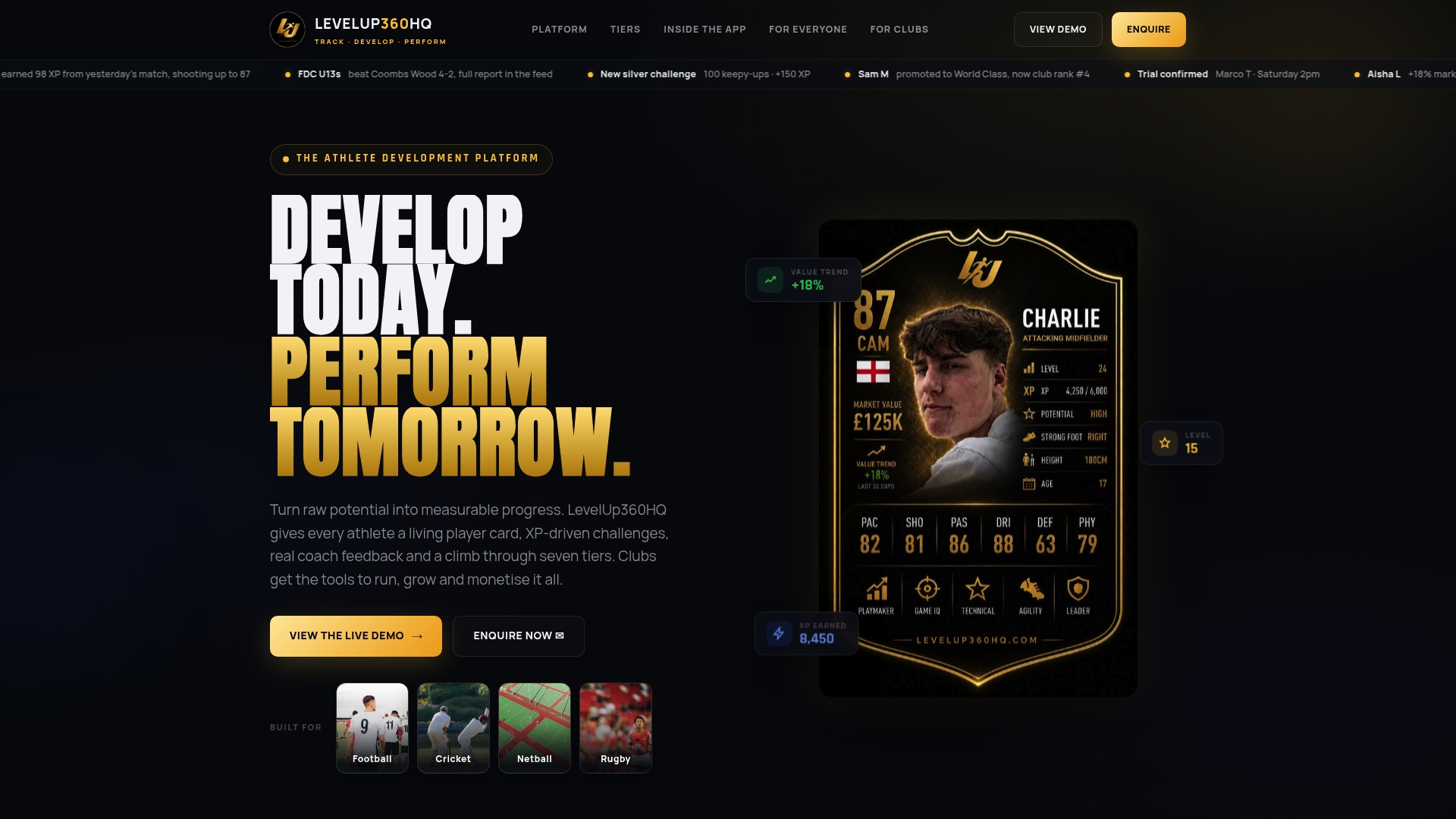
The platform operates on a transparent subscription SaaS model: clubs pay a platform fee plus per-athlete charges, and your academy retains full data ownership. White-label branding means your players see your club, not a third-party product. For academy leaders ready to move from pilot to full programme, book a demo at Levelup360hq or review the full feature set at Levelup360hq before your next season planning meeting.
Sources
- Sports academy software in UK | OpenEduCat
- Mobile-first digital learning for the next generation of professional footballers - Titus Learning
- The relevance of a gamified football/soccer development platform (case study)
- Game‑Based Approaches in football coaching (chapter)
- Avoiding analysis paralysis: centralised visualisation for MDTs (Frontiers in Psychology)
Recommended
Turn potential into a player card.
LevelUp360 tracks every match, builds your child's player card, and shows their development over time.
Get started free