Youth sports tier progression: a guide for UK coaches and clubs
Published 27 July 2026

Youth sports tier progression describes the structured process by which a player advances through defined development phases based on assessed performance, maturity, and readiness. In the UK, the word “tier” carries three distinct meanings, and conflating them causes real confusion for coaches, clubs, and athletes alike.
- Governance tiers (UK Sport / Sport England): compliance and audit levels tied to public funding, not player ability.
- Competition pyramid tiers: the league hierarchy where teams earn promotion or relegation; players move through it by changing clubs, not by individual assessment.
- Performance-pathway tiers: the development phases (Foundation, Youth Development, Professional Development) through which individual players progress based on evidence and readiness.
If you are a club administrator applying for Sport England funding, governance tiers matter most. If you are a coach deciding whether a 14-year-old is ready for the next development phase, performance-pathway tiers are your concern. If you are a scout tracking a player’s club history, the competition pyramid is your frame of reference.
Table of Contents
- What do “tiers” actually mean in UK sport?
- How do players actually move between development tiers?
- What governance do clubs need before running tier progression?
- What should you measure, and how often?
- How does a digital platform support tier progression?
- A practical checklist for coaches and clubs
- What goes wrong, and how do you avoid it?
- The right approach to youth sports tier progression
- Key takeaways
- Why the “ladder” metaphor is doing real damage
- Levelup360hq brings your progression process to life
- Useful sources
What do “tiers” actually mean in UK sport?
UK Sport and Sport England define governance tiers (Tier 1–3) through A Code for Sports Governance. Tier 1 applies to one-off grants typically between £10,000 and £250,000 and sets the minimum mandatory governance requirements. Tier 3, by contrast, applies where funding exceeds £1 million, runs over multiple years, and funds continuing activity. The higher the tier, the more formal the compliance, audit, and board-structure requirements.
The competition pyramid is a separate concept entirely. English men’s football alone has 24 or more competitive tiers, from the Premier League down to local Sunday leagues. Promotion and relegation move teams, not individuals. A player who joins a higher-division club benefits from that environment, but no individual assessment panel decided they were “ready for Tier 6.”
Performance-pathway tiers are where individual player development actually lives. The EFL Youth Development Rules formalise three phases: Foundation (U9–U11), Youth Development (U12–U16), and Professional Development (U17–U21). Each phase carries different participation expectations, training volumes, and academy category classifications (Category 1–4). Table Tennis England’s pathway guide follows a similar logic: entry, development centres, futures squads, and centralised programmes, each with defined standards and increasing support requirements.
How do players actually move between development tiers?
Movement between development phases is rarely a clean step up. The EIS/UK Sport coaching position statement is explicit: pathway coaching is a fundamentally different discipline from elite refinement, and progression is a hyper-dynamic process. Players may move laterally, pause, or exit a pathway depending on maturity and opportunity.
Typical promotion criteria span five dimensions:
- Technical: skill execution under pressure, consistency across positions or disciplines.
- Physical: strength, speed, endurance benchmarks appropriate to the age phase.
- Tactical: decision-making, game understanding, positional awareness.
- Psychological: resilience, coachability, response to setbacks.
- Behavioural: attendance, attitude in training, conduct off the pitch.
No single dimension should dominate. A player who scores brilliantly in fitness tests but shows poor coachability is not ready for the next phase.
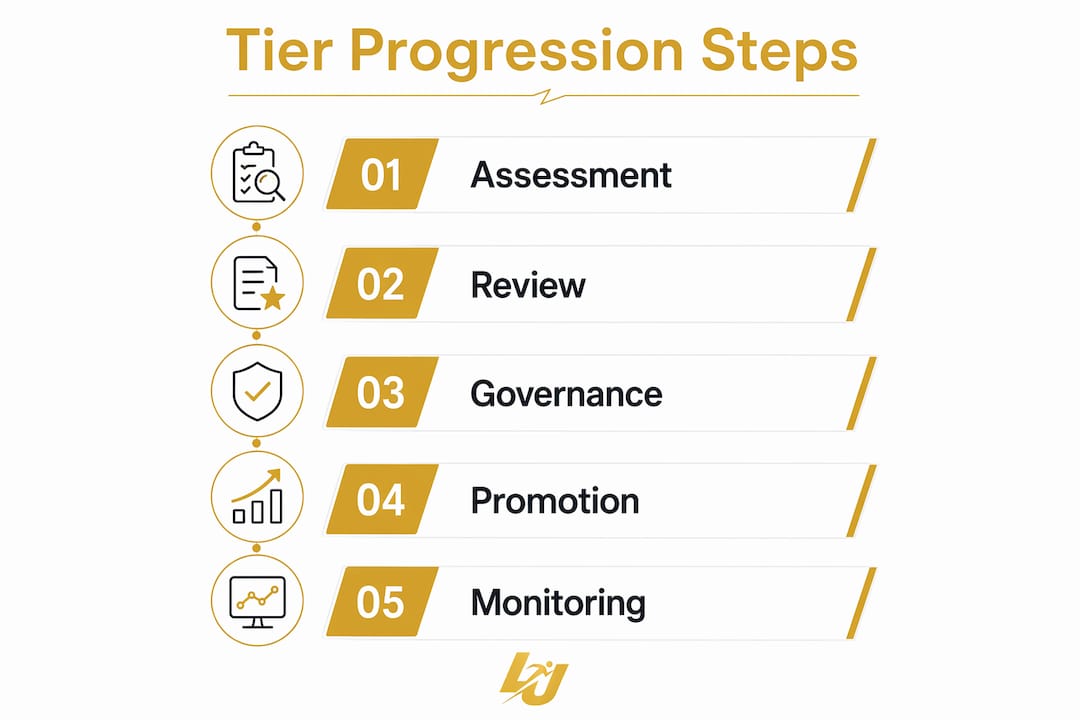
A sound review process involves the lead coach, at least one independent assessor, the athlete, and a parent or guardian for under-18s. Decisions should be documented, with evidence referenced. A rolling 8–12 week review cycle works well for in-season monitoring; a formal end-of-phase panel should sit at the end of each season.

Pro Tip: Watch for relative age effect. A player born in September may appear more physically advanced than a peer born in August of the same year, simply because of a 12-month maturity gap. Weight psychological and technical markers heavily alongside physical ones, and never base a promotion decision on a single fitness test.
What governance do clubs need before running tier progression?
On-field success without institutional foundations is fragile. The scottishathletics Club Development Framework measures clubs across five maturity stages (Emerging, Developing, Established, Advanced, High-performing) and makes clear that documented governance, not league results, determines whether a club can sustain advancement.
Before promoting significant numbers of athletes or seeking an academy category upgrade, clubs should confirm the following:
- DBS checks current for all adults working with under-18s.
- Safeguarding policy written, published, and reviewed within the last 12 months.
- Financial oversight: quarterly reporting, not just end-of-year accounts.
- Codes of conduct for athletes, coaches, and parents, with a grievance procedure.
- Succession planning: key roles documented so the programme survives personnel changes.
- NGB alignment: registered with the relevant Club Development Programme (Clubmark, Focus Clubs, or equivalent).
A club that advances athletes into higher-profile pathways without these foundations in place risks safeguarding failures, funding ineligibility, and reputational damage that no league trophy can offset.
What should you measure, and how often?
| Assessment dimension | Evidence type | Recommended frequency |
|---|---|---|
| Technical skill | Video review, coach rating (1–5 scale) | Every 4 weeks |
| Physical performance | Standardised fitness tests (sprint, endurance) | Every 8 weeks |
| Tactical understanding | Match analysis, coach observation notes | Every 4 weeks |
| Psychological markers | Coachability log, self-assessment form | Every 8 weeks |
| Behavioural indicators | Attendance record, conduct log | Rolling/continuous |
Record-keeping is not optional. Signed review notes, video archives, and Individual Development Plans (IDPs) create the audit trail that protects both the athlete and the club if a promotion decision is challenged. Storing evidence digitally, with version control and access permissions, removes the risk of paper records being lost or disputed.
For athletes managing workload across phases, conditioning guidance on rebuilding explosiveness after breaks or injury is worth integrating into the physical assessment cycle, particularly when a player returns from a layoff mid-phase.
How does a digital platform support tier progression?
Levelup360hq maps directly onto the progression workflow described above. The platform provides:
| Platform capability | Progression need addressed |
|---|---|
| Video assessment tools | Evidence capture for technical and tactical review |
| KPI dashboards | Real-time monitoring of performance markers |
| Approval workflows | Structured coach-to-panel decision process |
| Badge and tier system | Transparent, gamified recognition of phase advancement |
| Live player cards | Athlete ownership of their own development record |
| White-label branding | Club-level governance and identity management |
| CRM and subscription tools | Administrative oversight for academy programmes |
A typical workflow on Levelup360hq runs: coach submits video review and KPI scores → review panel receives notification and approves or defers → decision is logged with evidence → athlete receives badge or tier update → IDP is updated on the athlete’s live player card. Every step is documented, timestamped, and visible to the relevant parties.
The gamified layer matters more than it might initially appear. XP-driven challenges and leaderboards keep athletes engaged with their own data between formal review panels, which reduces the risk of progression feeling like something that happens to them rather than with them.
A practical checklist for coaches and clubs
- Set criteria (Coach, Week 1): Define the five assessment dimensions and weight them for your sport and age phase. Document in writing.
- Communicate expectations (Coach + Club Admin, Week 1): Share criteria with athletes and parents before the review cycle begins. Use a one-page template.
- Gather evidence (Coach, Weeks 1–8): Collect video, test scores, attendance records, and observation notes continuously.
- Schedule the panel (Club Admin, Week 7): Confirm date, invite independent assessor, notify athlete and parent/guardian.
- Run the review (Panel, Week 8–10): Assess evidence against criteria. Record decision with rationale.
- Communicate outcome (Coach, within 48 hours): Deliver decision in person or by video call. Provide written summary.
- Update IDP (Coach + Athlete, within one week): Revise development targets to reflect new phase or continued development goals.
- Monitor and repeat (Coach, rolling): Continue evidence collection for the next cycle.
IDP template headings: Current phase; Strengths (evidence-referenced); Development priorities (max 3); Target milestones; Review date; Athlete signature; Coach signature.
Parent/athlete communication template: “Following [athlete name]'s review on [date], the panel assessed performance across technical, physical, tactical, psychological, and behavioural dimensions. The decision is [outcome]. The next review is scheduled for [date]. Please contact [coach name] with any questions.”
What goes wrong, and how do you avoid it?
Early specialisation pushes young athletes into one sport or position before their physical literacy is broad enough to support it. Mitigation: follow age-grade development principles that prioritise physical literacy and game understanding across phases.
Selection bias occurs when coaches unconsciously favour athletes they know well or who are physically mature. Mitigation: rotate assessors, use blind video review where possible, and weight psychological and tactical markers alongside physical ones.
Poor record-keeping leaves clubs unable to justify decisions if challenged. Mitigation: use a digital platform with timestamped evidence and signed review notes.
Over-reliance on single tests produces false positives. A one-off sprint time is not a development phase. Mitigation: require evidence across all five dimensions before any promotion decision.
Do not proceed with promotion if: the athlete has not been assessed across all five dimensions; a safeguarding concern is unresolved; the club lacks a current DBS check for the receiving coach; or the athlete has expressed reluctance about the move.
Long-term mobility and athletic longevity should also factor into workload planning, particularly when an athlete is being considered for a phase that significantly increases training volume.
The right approach to youth sports tier progression
Youth sports tier progression works best when it is player-centred, evidence-backed, and governed by documented processes. Coaches should assess across all five dimensions, involve athletes and parents in the process, and record every decision. Clubs must have safeguarding, DBS, and financial oversight in place before advancing athletes into higher-profile pathways. Map your KPIs to a digital platform, schedule your first review panel, and use national governing body guidance from UK Sport, Sport England, England Rugby, and scottishathletics as your compliance baseline.
Key takeaways
Youth sports tier progression is only sustainable when governance, evidence, and player-centred assessment work together across all three UK meanings of “tier.”
| Point | Details |
|---|---|
| Three distinct tier types | Governance tiers, competition pyramid, and performance-pathway tiers serve different audiences and must not be conflated. |
| Five assessment dimensions | Technical, physical, tactical, psychological, and behavioural evidence should all be present before any promotion decision. |
| Governance before progression | DBS, safeguarding, financial oversight, and NGB alignment must be in place before clubs advance athletes into higher-profile pathways. |
| Document everything | Signed review notes, video archives, and IDPs protect both athlete and club if a decision is challenged. |
| Levelup360hq for execution | The platform maps video evidence, KPI dashboards, approval workflows, and live player cards directly onto the progression checklist. |
Why the “ladder” metaphor is doing real damage
The most persistent problem in youth sports development is not a lack of criteria. It is the mental model coaches and parents bring to the process. Tier progression gets framed as a ladder: you climb, you stay, or you fall. That framing is wrong, and the EIS/UK Sport position statement on pathway coaching says as much. Development is non-linear. A player who exits an academy at 16 may reach senior representative level at 22 via a county league. A player fast-tracked at 13 may plateau by 17 because the environment prioritised results over development.
The clubs that produce the most consistent long-term athletes are not the ones with the strictest promotion criteria. They are the ones that treat each review as a development conversation rather than a verdict. That shift in framing changes everything: the athlete arrives prepared, the coach arrives with evidence, and the outcome, whatever it is, becomes a starting point rather than a judgement.
Digital platforms help here precisely because they make the process visible to the athlete. When a young player can see their own KPI trends, their badge history, and their coach’s notes, progression stops being something that happens behind closed doors.
Levelup360hq brings your progression process to life
Tier progression built on spreadsheets and paper forms tends to collapse under its own weight within a season. Levelup360hq gives coaches, athletes, and club administrators a single environment where evidence is captured, decisions are documented, and athletes stay engaged with their own development between panels.

Live player cards update in real time as KPI scores change. Coaches submit video assessments directly into approval queues. Badges and tier updates are visible to athletes the moment a panel decision is confirmed. For clubs, white-label branding and CRM tools mean the platform carries your identity, not a generic one. It supports football, cricket, netball, rugby, and more, so a multi-sport club runs one system rather than several.
See the platform in action or explore the full feature set to map your club’s progression process today.
Useful sources
- A Code for Sports Governance (Tier 1) — UK Sport: the mandatory governance baseline for Sport England and UK Sport funded organisations; essential for any club seeking public investment.
- EIS Performance Pathways Coaching Statement — UK Sport / EIS: defines pathway coaching as a distinct discipline and sets out the non-linear nature of player development.
- Youth Development Rules 2024/25 — EFL: the formal rules governing academy phase definitions, age groups, and category upgrade processes in English football.
- Pathway Guide — Table Tennis England & GB Performance Programmes: a clear example of stepwise NGB pathway standards with defined milestones and support levels.
- Club Development Framework — scottishathletics: the five-stage maturity model (Emerging to High-performing) that measures institutional governance, not just on-field results.
- Age-Grade Rugby — Leicestershire Rugby Union: practical guidance on player-centred, development-driven pathways and the risks of early specialisation.
- Developing Player Programme — Yorkshire RFU: regional rugby development guidance emphasising the Talent Development Environment and holistic support services.
Recommended
Turn potential into a player card.
LevelUp360 tracks every match, builds your child's player card, and shows their development over time.
Get started free