Sports club subscription model: a manager's guide
Published 13 August 2026

A sports club subscription model is a recurring-payment arrangement where members pay automatically at a set interval, monthly, seasonally or annually, in exchange for defined access, session credits or services. For club administrators, the immediate payoff is threefold: predictable cashflow that survives the off-season, sharply reduced invoice-chasing admin, and a structural nudge towards better member retention. If you are reviewing this for the first time, the most useful first step is to audit your current member data, then run a 30–90 day pilot with one membership tier before committing to a full rollout.
Quick reasons clubs choose this model:
- Predictable cashflow via Direct Debit or recurring card payments, collected automatically each cycle
- Lower administrative burden because billing is automated rather than chased manually
- Improved retention through continuous access rather than annual lump-sum renewals that members defer
- Clearer member expectations when terms, cancellation rules and what is included are stated upfront, in line with Gov
- Data visibility through platforms such as Levelup360hq, which centralise subscription management, CRM and analytics in one place
Key takeaways
A sports club subscription model delivers stable recurring revenue, lower admin overhead and measurably better retention when it is built on clear tiers, automated billing and a structured 90-day onboarding sequence.
| Point | Details |
|---|---|
| Define your model clearly | A subscription is recurring access billed automatically; a membership confers formal club status. Use the right term in your T&Cs. |
| Pilot before you scale | Run a 30–90 day pilot with 20–50 members to validate pricing, billing and onboarding before a full launch. |
| Track churn first | Churn rate is your earliest warning signal; calculate it monthly and investigate any month above 5%. |
| Comply with UK consumer law | State cancellation rights, the 14-day cooling-off period and automatic renewal terms at the point of sign-up, per the Consumer Rights Act 2015. |
| Levelup360hq reduces rollout friction | The platform handles subscription billing, CRM, analytics and communication automations in one place, cutting admin hours and improving renewal rates. |
Table of Contents
- What is a sports club subscription model, and how does it differ from a membership?
- How to design membership tiers that protect your capacity
- How to set pricing, billing cycles and a simple revenue forecast
- Which payment methods work best for UK sports clubs?
- Designing member perks that deliver value without straining operations
- Onboarding, dunning and a 90-day retention checklist
- Which KPIs should you track for subscription health?
- UK legal and administrative checklist for running subscriptions
- How to implement a subscription model: a 30–90–180 day rollout
- How Levelup360hq supports subscription management for clubs
- Why subscription thinking changes how you run a club
- Levelup360hq helps clubs launch faster and manage smarter
- Sources
What is a sports club subscription model, and how does it differ from a membership?
The terms “subscription” and “membership” are used interchangeably in most club communications, but they describe different commercial arrangements. Getting this distinction right matters because it shapes your terms and conditions, your billing logic and the expectations you set for members.
A subscription is a recurring-access contract. The member pays automatically at a fixed interval and receives defined access or credits for that period. Think of a monthly direct debit that grants unlimited court bookings, or a credit bundle that refreshes every four weeks. The commercial distinction is that subscriptions are primarily about delivery of access or product, billed continuously until cancelled.
A membership, in the traditional sense, confers entitlement beyond access. It may include governance rights (voting at the AGM), a formal club identity (a membership number, a badge), or seasonal privileges that do not renew automatically. A cricket club’s full membership, for instance, often includes a vote on rule changes and a named place in the club register.
Where each model fits in practice:
- Subscription billing suits: casual frequent users paying month-to-month, multi-sport passes, session-credit bundles, and anyone who wants flexibility without a long-term commitment
- Membership language suits: clubs with governance structures, supporter memberships, seasonal passes with defined expiry dates, and situations where the member’s formal status within the club matters
A useful rule of thumb: if the arrangement renews automatically and the primary benefit is access or credits, call it a subscription. If it confers formal club status or governance rights, call it a membership. Many clubs run both simultaneously, with a subscription for facility access and a separate membership for voting rights.
How to design membership tiers that protect your capacity
UK sports clubs commonly offer full, junior and social membership types, and transparency about fees, notice periods and what is included is a baseline expectation. Layering these into a clear tier structure helps members self-select and helps you manage facility load.
Typical tier structure:
- Free / trial: limited access for a defined period (two to four weeks), no booking priority, designed to convert to a paid tier
- Social: off-peak access, limited sessions per month, no priority booking, lower price point; suits occasional users
- Junior: age-restricted, often subsidised, may include coaching sessions and parental consent requirements
- Core / standard: full facility access during standard hours, a set number of bookings per month, standard event access
- Premium / pro: priority booking windows, members-only hours, discounted merchandise, early event registration, possible one-to-one coaching credits
- Pay-as-you-go credits: no recurring commitment, credits purchased in bundles and consumed per session; community clubs often price sessions at £5–£30 depending on facility and sport
Family, concession and student variations sit alongside these tiers rather than replacing them. A family tier typically bundles two adults and up to three juniors at a discount against individual rates. Student and concession tiers mirror the social or core tier at a reduced price, with proof of eligibility required at sign-up.
Pro Tip: Align your unit of sale with what members actually want. Selling training-oriented memberships as session credits rather than time-based access reduces cancellations triggered by unused weeks. A member who has six sessions remaining feels they have value to consume; a member who has paid for a month but missed two weeks feels they have wasted money.
How to set pricing, billing cycles and a simple revenue forecast
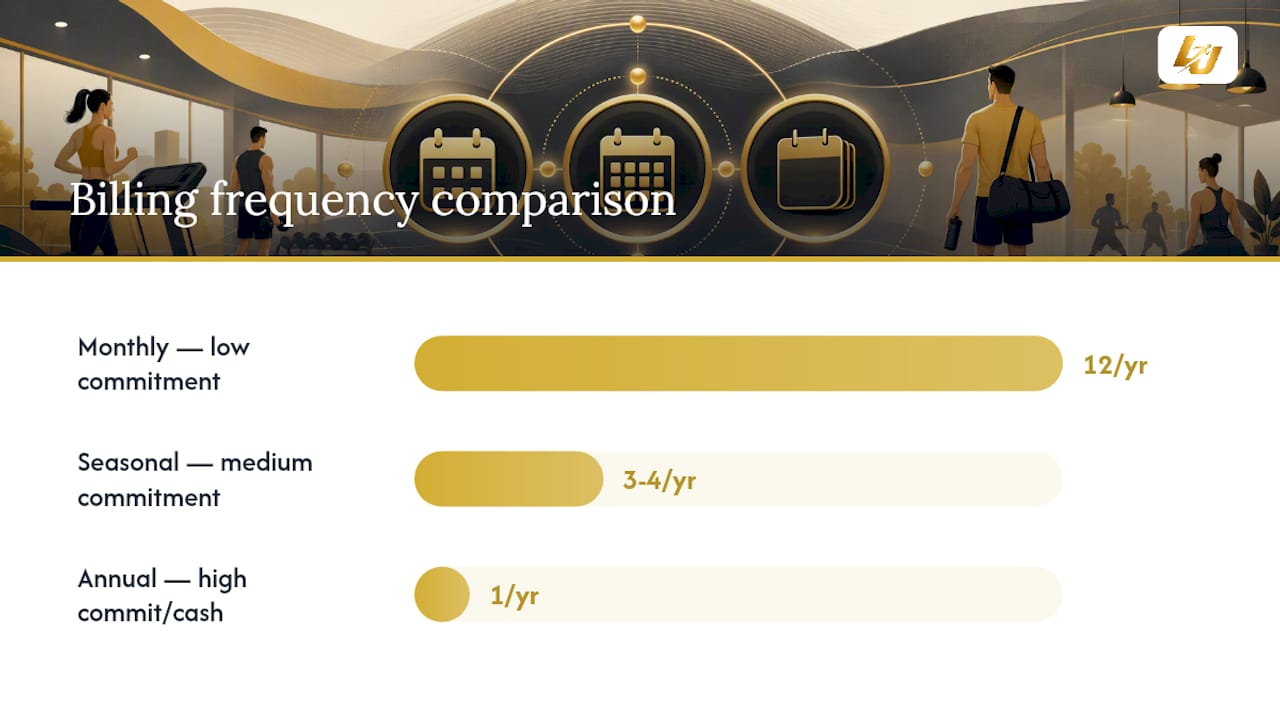
The right billing cadence depends on your sport’s seasonality and your members’ payment preferences. Monthly billing suits year-round clubs and casual users who resist annual commitments. Seasonal billing (typically three or four months) aligns with sport calendars and is common in cricket, rugby and football academies. Annual billing rewards commitment with a discount and maximises upfront cashflow, but it raises the stakes for members who are unsure about long-term fit.
Illustrative pricing and revenue ranges for UK clubs:
| Tier | Monthly fee | Annual equivalent | Notes |
|---|---|---|---|
| Social / off-peak | £15–£30 | £180–£360 | Lower utilisation, good for capacity management |
| Core / standard | £30–£60 | £360–£720 | Main revenue tier for most clubs |
| Premium / pro | £60–£100 | £720 | Priority access, coaching credits included |
| Pay-as-you-go | £5–£30 per session | Variable | No recurring commitment |
| Community club annual | £50–£30 | £50–£30 | Wide range by sport and location |
Pricing validation checklist:
- Calculate your fixed costs per month (facility hire, insurance, staff) and divide by your target active member count to find your cost floor.
- Set your core tier price at least 20% above the cost floor to allow for payment failures and concessions.
- Model two utilisation scenarios: 70% capacity and 90% capacity. Your pricing should be viable at 70%.
- Offer a trial price (first month at 50% or free) only if your conversion data shows trial users become paying members at a rate above 60%.
- Apply family and concession discounts as fixed amounts rather than percentages to simplify billing logic.
- State automatic renewal terms clearly in your sign-up flow, as required under UK consumer law.
- Review pricing annually against cost inflation and competitor benchmarks, not just when you feel financial pressure.
Promotional pricing should have a defined end date and a clear transition to the standard rate. Avoid open-ended discounts that become the default price and are difficult to remove without triggering cancellations.
Which payment methods work best for UK sports clubs?
Automatic payment methods such as Direct Debit and recurring card payments improve collections and reduce the administrative workload of chasing late fees. The right choice depends on your billing cycle and the technical infrastructure you can support.
-
Bacs Direct Debit is the most common method for UK clubs running monthly or quarterly subscriptions. Members authorise a mandate once, and payments are collected automatically. Mandate references must be stored securely, and clubs must give advance notice (typically ten working days) before the first collection and before any change in amount.
-
Recurring card payments via a payment gateway suit pay-as-you-go credit purchases and one-off top-ups. They are faster to set up than Direct Debit but carry higher transaction fees and a greater risk of card expiry causing payment failures.
-
Standing orders are member-initiated and therefore less reliable for clubs, because the member controls the amount and timing. They are acceptable for fixed-fee annual memberships but unsuitable for variable or tiered billing.
-
Open invoices (PDF or email invoices with manual payment) should be reserved for corporate or group memberships where the payer is an organisation rather than an individual. They are operationally expensive at scale.
Handling failed payments: build a staged dunning process into your billing setup. A soft reminder on the day of failure, a second notice after three days, and a final notice after seven days before pausing access is a reasonable cadence. Pausing rather than immediately cancelling preserves the relationship and gives the member a clear path to reinstate. All retry logic and dunning communications should be documented in your terms and conditions.
For clubs evaluating membership page design and offer presentation, clear payment-method disclosure at the point of sign-up reduces disputes and improves conversion.
Designing member perks that deliver value without straining operations
Perks should reinforce usage and community, not function as costly one-offs that drain resources. The most effective benefits are those members encounter regularly, not the headline promises that sound impressive but are rarely redeemed.
High-value, low-cost perks to build in:
- Priority booking windows (24–48 hours ahead of general release) for popular sessions or courts
- Members-only hours during off-peak times, which costs nothing if the facility is otherwise empty
- Digital content: coaching videos, training plans, performance tips delivered via the club app or portal
- Small merchandise discounts (10–15%) on club kit and equipment
- Early access to event registration before general sale
- A members’ social feed or community forum that builds belonging without additional cost
- Badge and recognition systems (such as those built into Levelup360hq’s gamified platform) that reward attendance and progress
Perks to avoid because they are operationally unsustainable:
- Guaranteed one-to-one elite coaching without capacity limits
- Unlimited premium services (physiotherapy, nutrition consultations) bundled into a standard tier
- Heavy physical freebies (kit, equipment) included in every tier without cost recovery
- Guest passes with no limit, which erode the value of paid memberships
Perks tie directly into tier upsell. A social member who regularly hits the booking limit for off-peak sessions is a natural candidate for an upgrade prompt to the core tier. Build those triggers into your CRM so the conversation happens automatically, not when a staff member remembers to have it. Seasonal membership packaging from major clubs illustrates how defined benefit sets with clear expiry dates create urgency and perceived value without open-ended commitments.
The Netflix-style subscription model applied to sports centres makes the same point: value comes from relevance and engagement, not from unlimited access that most members never fully use.

Onboarding, dunning and a 90-day retention checklist
A planned 90-day onboarding sequence, combined with regular engagement touchpoints, reduces early churn. The first 30 days are when most cancellations happen, so front-loading contact and value during that window pays off disproportionately.
90-day onboarding checklist:
Week 1 (setup and welcome):
- Send a welcome email within one hour of sign-up confirming tier, billing date and what is included
- Provide a getting-started guide (PDF or in-app) covering booking, cancellation and contact details
- Trigger a personal welcome message from the head coach or club manager within 48 hours
Weeks 2–4 (engagement):
- Send a check-in message asking how the first session went
- Share a tip or piece of content relevant to their sport or tier
- Invite them to an upcoming social event or beginner session
Months 2–3 (habit formation and community):
- Flag their usage pattern: if they have not booked in 14 days, send a re-engagement prompt
- Invite them to a members-only event or early-access session
- At day 60, send a short satisfaction survey (three questions maximum)
- At day 80, send a renewal reminder if on a seasonal or annual plan
Dunning cadence for failed payments:
- Day 0 (failure): automated soft reminder with a link to update payment details
- Day 3: second notice, slightly firmer in tone, noting that access will pause if unresolved
- Day 7: final notice, access paused, clear reinstatement instructions provided
- Day 14: cancellation processed if no response; exit survey triggered
Segmented communications:
- New joiners: onboarding sequence above
- At-risk members (no booking in 21+ days): re-engagement campaign with a specific offer or event invite
- Infrequent users: content-led emails (tips, highlights, community news) to maintain connection without a hard sell
Which KPIs should you track for subscription health?
The core metrics for a subscription-based club are churn rate, retention rate, lifetime value (LTV), average revenue per member (ARPM), monthly recurring revenue (MRR) and utilisation rate. Track these weekly for operational signals and monthly for strategic decisions.
Simple formulae:
- Churn rate: (Cancellations in period ÷ Active members at start of period) × 100
- Retention rate: 100 minus churn rate
- LTV: ARPM × Average membership duration in months
- ARPM: Total MRR ÷ Total active members
- Utilisation rate: Sessions booked ÷ Sessions available × 100
Example calculation: a club with 200 active members paying an average of £40 per month has an MRR of £8,000. If the average member stays for 18 months, LTV is £720.
Suggested dashboard fields:
- Active members (total and by tier)
- New sign-ups this week / month
- Cancellations this week / month
- Payment failures (count and value)
- Utilisation rate by session type
- Upgrade and downgrade movements between tiers
Retention vs acquisition cost: retaining an existing member is generally 5–9 times cheaper than acquiring a new one. That ratio means even a modest improvement in your 90-day retention rate, say from 70% to 80%, has a larger financial impact than the equivalent spend on new member marketing. Invest in onboarding and re-engagement before you invest in advertising.
UK legal and administrative checklist for running subscriptions
Consumer rights, clear terms and correct insurance coverage are non-negotiable before you take a single recurring payment. The checklist below covers the minimum requirements for UK clubs.
-
Terms and conditions: publish clear T&Cs covering what is included, the billing cycle, price, automatic renewal, and what happens if the club changes its offering mid-term. These must be accessible before sign-up, not buried in a confirmation email.
-
Cancellation and refund policy: under the Consumer Rights Act 2015, members who sign up online have a 14-day cooling-off period. State this explicitly. Define your notice period for ongoing cancellations (typically 30 days) and your refund policy for unused credits or prepaid periods.
-
Data protection: storing payment mandates and personal data requires compliance with UK GDPR. Mandate references, bank details and payment history must be held securely, with a documented retention and deletion policy. Register with the ICO if you have not done so.
-
Insurance and public liability: many leagues and clubs require proof of insurance before a member can participate. Public liability insurance is standard; some sports require additional personal accident or professional indemnity cover. Check with your sport’s national governing body (NGB) for sector-specific requirements.
-
Clear pricing and contract length: the price, billing frequency and minimum contract length must be stated at the point of sale. Avoid pre-ticked boxes for automatic renewal; the member must actively confirm they understand the recurring nature of the payment.
-
Record keeping: club committees should maintain a register of active members, payment history and cancellation records. For incorporated clubs, Companies House filing requirements apply. For unincorporated associations, your constitution will define record-keeping obligations.
Authoritative guidance is available from gov.uk on consumer contracts and from your sport’s NGB for insurance and governance standards.
How to implement a subscription model: a 30–90–180 day rollout
Run a small pilot, validate pricing and booking behaviour, then scale with automated billing and communications. Trying to launch everything at once is the most common reason rollouts stall.
30 days (planning and policy):
- Define your tier structure, pricing and billing cycles.
- Draft your terms and conditions, cancellation policy and privacy notice.
- Choose your payment method (Direct Debit or recurring card) and confirm your payment provider’s PCI compliance requirements.
- Set up your KPI baseline: current member count, average fee, cancellation rate.
- Identify a pilot cohort of 20–50 members who represent your target tier.
60–90 days (pilot):
- Launch the pilot tier with the cohort, using manual or semi-automated billing if your platform is not yet fully configured.
- Run the 90-day onboarding sequence for all pilot members.
- Track churn, utilisation and payment failure rates weekly.
- Collect feedback at day 30 and day 60 via a short survey.
- Adjust pricing, perks or communications based on pilot data before full launch.
90–180 days (full launch and optimisation):
- Migrate all existing members to the new tier structure, with a clear communication explaining changes and any grandfathering of existing rates.
- Activate automated billing, dunning and renewal communications.
- Open new member sign-ups via your website or member portal.
- Review KPIs monthly and set a quarterly pricing review cadence.
- Identify upgrade candidates from utilisation data and trigger upsell communications.
Rollout risks and mitigations:
- Overcapacity: set booking limits per tier from day one; do not wait until peak times reveal the problem.
- Billing failures at scale: test your dunning sequence with the pilot cohort before full launch.
- Staff workload: automate welcome emails, renewal reminders and payment failure notices so staff handle exceptions, not routine communications.
How Levelup360hq supports subscription management for clubs
Levelup360hq is built to operationalise exactly the model described in this article. The platform handles subscription billing, CRM, booking priority windows and analytics in a single environment, which means the KPIs discussed above are visible without building a separate spreadsheet dashboard.
Platform features relevant to subscription management:
- Subscription management with recurring billing integration, supporting monthly, seasonal and annual cycles
- CRM with member profiles, tier history and communication logs
- Session credit tracking and booking priority windows configurable by tier
- White-label member portals so your club’s branding is front and centre
- Analytics dashboard covering MRR, churn, utilisation and payment failure rates
- Communication automations for onboarding sequences, renewal reminders and dunning
- Store integration for merchandise and event bookings, adding revenue streams beyond subscriptions
- Badge, leaderboard and XP systems that reinforce engagement and reduce cancellation triggers
A practical scenario: a medium-sized football academy with 180 members was managing subscriptions via spreadsheets and bank transfers. After adopting an integrated platform, the administrator team reduced billing-related admin hours significantly and saw renewal rates improve as automated reminders replaced manual follow-up. Members received timely onboarding communications and could track their own session credits, which reduced inbound queries to the front desk.
Explore the Levelup360hq platform to see how these features map to your club’s current workflow, or request a demo to walk through the subscription management module with your own tier structure.
Why subscription thinking changes how you run a club
Most club managers come to subscription models looking for a billing fix. What they find, if they implement it properly, is that it changes how they think about operations altogether.
When revenue is predictable, you stop making decisions reactively. You can hire a part-time coach in February because you know what March’s income will be. You can invest in facility improvements because you have a rolling 12-month revenue picture, not a lump-sum guess at renewal time. That shift from reactive to planned management is the real value of a subscription model, and it is underused by most clubs that adopt recurring billing without changing anything else.
The trade-off is real, though. Subscriptions require more upfront work: clear terms, a functioning billing system, a communications plan and someone responsible for monitoring KPIs. Clubs that skip the pilot phase and go straight to a full launch often find that pricing is wrong, capacity assumptions are off, or the dunning process is not configured. The 30–90 day pilot is not optional; it is where you find the problems before they affect 300 members.
Levelup360hq sits in this space as a credible operational tool, not because it solves the strategic thinking for you, but because it removes the technical friction that stops clubs from executing the model they have already designed.
Levelup360hq helps clubs launch faster and manage smarter
Clubs that try to run a subscription model on spreadsheets and email threads hit a ceiling quickly. Levelup360hq gives you the infrastructure to move past that ceiling without hiring a dedicated admin team.

The platform centralises everything the earlier sections of this article describe: automated recurring billing, a CRM that tracks member tier and payment history, booking priority windows configurable by membership level, and communication automations that handle onboarding, renewal and dunning without manual intervention. The analytics dashboard surfaces MRR, churn and utilisation in real time, so you are making decisions on current data rather than last month’s spreadsheet.
For clubs ready to move from manual fee collection to a properly structured subscription model, the practical next step is to book a demo with Levelup360hq and walk through how the platform maps to your existing tier structure and billing cycle.
Sources
The following resources are worth bookmarking as you build or refine your subscription model. Each covers a distinct area of the implementation.
- Sports club members: Structuring access and training for growth - Sports Facility Management Expert
- Sports-clubs-uk
- Clubs and societies | Payment methods
Recommended
Turn potential into a player card.
LevelUp360 tracks every match, builds your child's player card, and shows their development over time.
Get started free