What is skill progression tracking for athletes?
Published 1 July 2026

Skill progression tracking is the systematic process of measuring and visualising an athlete’s improvement across specific skills over time. In sport, it goes by the industry term competency development monitoring, though coaches and athletes widely use “skill progression tracking” to describe the same practice. 44% of core skills are expected to shift within five years, making structured monitoring no longer optional for serious athletes. Platforms like Levelup360hq have built entire development ecosystems around this principle, giving athletes, coaches, and clubs a shared language for measuring growth. Without a tracking system, progress becomes guesswork and training decisions lose their grounding in evidence.
What is skill progression tracking and how does it work?
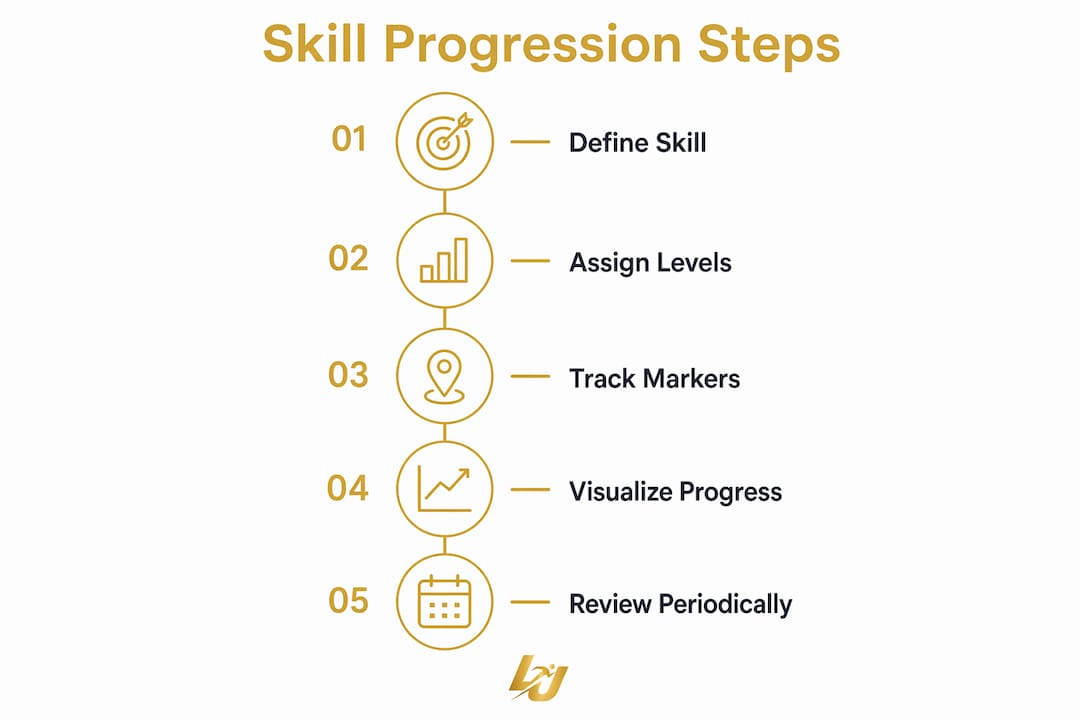
Skill progression tracking is a structured framework for defining specific skills, assigning proficiency levels, and recording changes in those levels over time. It turns the vague feeling of “getting better” into concrete, comparable data. Coaches set a baseline, athletes train against it, and the gap between current and target performance becomes visible and measurable.
The most widely used measurement approach assigns proficiency rating scales on either a 1–5 or 0–100 basis. A 1–5 scale works well for qualitative assessments like passing accuracy or defensive positioning. A 0–100 score suits performance metrics where fine-grained differences matter, such as sprint times or shot conversion rates.
Tracking markers fall into three categories. Input markers measure time spent on a skill. Output markers count completed drills or repetitions. Quality markers assess accuracy, form, or execution standard. Using all three together gives a fuller picture than any single measure alone.
Visual tools sharpen the analysis further. Radar charts and timelines show gaps between current and target proficiency at a glance. A radar chart covering six core skills, for example, immediately reveals whether a footballer’s weakest area is aerial duels or first touch, without needing to read through rows of numbers.
| Proficiency level | Description | Typical skill markers |
|---|---|---|
| 1 – Beginner | Skill introduced, inconsistent execution | Low drill completion, high error rate |
| 2 – Developing | Skill applied with support | Moderate accuracy, improving output count |
| 3 – Competent | Skill applied independently | Consistent output, acceptable quality |
| 4 – Proficient | Skill applied under pressure | High accuracy, strong input commitment |
| 5 – Expert | Skill applied instinctively | Peak output, near-zero error rate |
Tracking mastery of tangible subskills is substantially more motivating than watching a percentage bar creep forward. A cricketer who can see they have mastered the cover drive but still need work on the pull shot knows exactly where to focus next.
Pro Tip: Limit tracking to 2–4 key indicators per skill. More than four creates data noise and increases the chance of abandoning the system entirely.
How does skill progression tracking benefit athletes and coaches?
Structured skill development monitoring delivers measurable gains in both performance and psychology. Athletes who can see evidence of progress stay motivated through difficult training phases. Coaches who hold objective competency data make better decisions about session design, squad selection, and individual development plans.
Skill tracking reduces career anxiety by providing visual confirmation that effort is producing results. This matters enormously in sport, where plateaus are common and self-doubt can derail otherwise talented athletes. A timeline showing steady improvement over eight weeks is a powerful antidote to the feeling of standing still.
94% of talent professionals view upskilling as critical for future success. That figure reflects a broader truth in sport: athletes who track their development actively are better positioned to progress through academies, earn selection, and extend their careers.
Coaches benefit from a different angle. Objective data removes the subjectivity from training conversations. When a coach can point to a proficiency timeline rather than a personal opinion, feedback lands differently and athletes respond with greater buy-in.
Key benefits of structured skill improvement evaluation include:
- Visible momentum. Athletes see concrete evidence of growth, which sustains effort during difficult training blocks.
- Targeted coaching. Coaches allocate session time based on demonstrated gaps rather than assumptions.
- Reduced anxiety. Progress data provides psychological reassurance during performance plateaus.
- Stronger development conversations. Concrete progress evidence strengthens discussions about squad progression and selection.
- Better resource allocation. Clubs and academies direct coaching hours toward the skills with the greatest development gaps.
What are the common pitfalls in tracking skill progression?
The most common reason tracking systems fail is attempting to monitor too many metrics at once. Most tracking failures occur when athletes and coaches build elaborate systems that collapse under their own weight within weeks. Simplicity is not a compromise. It is the design principle that keeps tracking alive over months and seasons.
Skill progression is not linear. An athlete may plateau for three weeks, then make a sudden jump. Day-to-day fluctuations reflect fatigue, environment, and recovery as much as actual skill change. Treating a single bad session as evidence of regression is one of the most damaging errors a coach can make.
The daily log method addresses this directly. A single concise line entered immediately after training, noting what was practised and how it felt, takes under two minutes and prevents the memory lapses that make retrospective tracking unreliable. Over time, these short entries build a detailed picture of training patterns.
Weekly reviews add the layer of pattern recognition that daily logs alone cannot provide. Ten-minute weekly reviews that identify the best and worst sessions of the week, along with one lesson learned, allow coaches and athletes to spot trends that are invisible at the daily level. A footballer who consistently performs poorly on Thursdays may simply be under-recovered from a heavy Wednesday session.
Pro Tip: Run weekly reviews on the same day each week, ideally the day after a rest day. Consistency in timing makes the habit stick and the data more comparable week to week.
Practical lightweight tracking methods used by professional coaches include voice memos recorded immediately post-session, simple numbered ratings on a training card, and short video clips reviewed against a defined skill checklist. The format matters less than the consistency.
How to apply skill progression tracking in sports training
Effective application starts with setting a clear finish line. Vague goals like “improve my passing” produce vague data. Specific goals with deadlines, such as achieving a proficiency level 4 on short passing under pressure by the end of a six-week block, give both athlete and coach a measurable target.
Choosing the right skill signals
The skill signals you track must match the training focus. A rugby player working on lineout throwing needs output markers (successful throws per session) and quality markers (accuracy percentage). Adding unrelated metrics like sprint speed dilutes the focus and makes the data harder to interpret.
Nearly 40% of coaches and clubs still rely on informal, manual approaches such as spreadsheets or paper records. These methods introduce data errors and make longitudinal comparison difficult. Digital platforms built for athlete development solve this problem by centralising data and making visual analysis automatic.
Visual tools that make progress clear
Radar charts work best for multi-skill overviews. A netball player tracking shooting, court movement, defensive positioning, and passing accuracy can see the full shape of their game on a single chart. Timelines work better for tracking a single skill over a long period, showing the rate of improvement and identifying when progress stalled.
Levelup360hq uses FIFA-style player cards with real-time ratings to make skill progression visible in a format athletes find genuinely engaging. XP-driven challenges and tier progression turn the tracking process into a development experience rather than an administrative task.
| Tracking method | Best suited for | Format |
|---|---|---|
| Daily training log | Consistency and session recall | One-line written or voice entry |
| Weekly review | Pattern spotting and trend analysis | 10-minute structured reflection |
| Radar chart | Multi-skill overview | Visual, updated monthly |
| Proficiency timeline | Single-skill longitudinal tracking | Digital or paper graph |
| Digital platform (e.g. Levelup360hq) | Full athlete development monitoring | App-based, real-time updates |
Pro Tip: Review your radar chart at the start of each training block, not just at the end. Seeing the gap at the beginning of a block sharpens focus and increases deliberate practice quality.
Key takeaways
Skill progression tracking works because it converts subjective feelings of improvement into objective, comparable data that athletes and coaches can act on.
| Point | Details |
|---|---|
| Define skills precisely | Vague goals produce vague data; set specific proficiency targets with deadlines. |
| Limit your metrics | Track 2–4 indicators per skill to prevent data overload and maintain consistency. |
| Use daily logs | A single post-training line entry prevents memory lapses and builds a reliable record. |
| Run weekly reviews | Ten-minute weekly pattern reviews reveal trends that daily data alone cannot show. |
| Visualise the gaps | Radar charts and timelines make the distance between current and target proficiency immediately clear. |
Why I think most athletes are tracking the wrong things
Most athletes I have worked with arrive with tracking systems that measure everything except what actually drives improvement. They log session duration, total distance covered, and calories burned. None of those numbers tell you whether your first touch is getting better.
The shift that changes everything is moving from activity metrics to mastery metrics. Tracking how long you trained is measuring input. Tracking whether you can now control a driven pass under pressure is measuring the thing that actually matters. The difference sounds obvious, but the pull toward easy-to-count numbers is strong, and most athletes default to it without realising.
The other mistake I see constantly is treating tracking as a judgement rather than a tool. Athletes abandon their systems the moment they record a bad week, because the data feels like evidence of failure. Tracking is not a report card. It is a map. A map that shows you went the wrong way is more useful than one that only shows the destination.
The coaches who get the best results from skill development monitoring are the ones who review data with their athletes, not at them. When an athlete understands why the data looks the way it does, they engage with the tracking process rather than resisting it. That collaborative approach is where the real performance gains live.
— Chris
Levelup360hq and athlete skill development
Athletes and coaches who want to move beyond spreadsheets have a purpose-built option in Levelup360hq, a gamified athlete development platform that makes skill progression tracking part of the daily training experience.

Levelup360hq combines real-time player ratings, XP-driven challenges, video assessments, and performance analytics into a single platform built for football, cricket, netball, rugby, and more. Coaches manage session workflows and approval processes while athletes own their development through live player cards, badge systems, and leaderboards. Clubs benefit from white-label branding and CRM tools that support programme growth. Explore the platform prototype to see how structured skill monitoring works in practice.
FAQ
What is skill progression tracking in sport?
Skill progression tracking is the structured process of measuring an athlete’s proficiency in specific skills over time using defined rating scales and visual tools. It gives athletes and coaches objective evidence of development rather than relying on subjective impressions.
How do you track skill progression effectively?
Effective tracking uses 2–4 key indicators per skill, combines daily post-training logs with weekly pattern reviews, and visualises progress through radar charts or proficiency timelines. Consistency in recording matters more than the complexity of the system.
What are the main benefits of skill tracking for athletes?
Skill tracking reduces performance anxiety by showing visible progress, improves coaching decisions through objective data, and strengthens development conversations with concrete evidence of growth.
Why do skill tracking systems fail?
Most tracking systems fail because they monitor too many metrics at once, creating reporting fatigue that leads to abandonment. Limiting tracking to a small, balanced set of meaningful signals is the most reliable way to sustain a system long term.
How does Levelup360hq support skill progression tracking?
Levelup360hq provides real-time player ratings, XP challenges, video assessments, and performance analytics that make skill development monitoring part of the everyday training experience for athletes, coaches, and clubs.
Recommended
Turn potential into a player card.
LevelUp360 tracks every match, builds your child's player card, and shows their development over time.
Get started free