What is real-time performance feedback for athletes?
Published 19 June 2026

Real-time performance feedback is defined as input delivered within minutes to 48 hours of an observed behaviour, giving athletes and coaches the context they need to act on it immediately. This immediacy is what separates it from traditional periodic reviews, where the moment has passed and the detail has faded. Platforms like Levelup360hq, video analysis tools, and wearable technology have made this kind of continuous feedback evaluation accessible across football, cricket, netball, and rugby. Memory for specific behaviours fades after 48 hours, which means the window for meaningful correction is short. Understanding how to use that window is the foundation of modern athletic development.
What is real-time performance feedback and why does timing matter?
Real-time performance feedback is the practice of providing specific, behaviour-focused input as close to the performance moment as possible. The industry term for this broader approach is continuous feedback, which describes an ongoing cycle of observation, input, and adjustment rather than a single annual or seasonal review.
Timing is the critical variable. Feedback beyond 48 hours loses its immediate impact and transitions into delayed feedback, where the athlete can no longer clearly recall the specific action being discussed. A sprint mechanic corrected two minutes after a training rep lands differently than the same correction delivered three days later in a debrief. The athlete’s body and mind are still in the context of the session, making the adjustment far more likely to stick.

This is not just theory. The importance of performance feedback delivered promptly is well-established in both sports science and organisational psychology. When feedback arrives while the experience is fresh, athletes can connect the instruction to a precise physical sensation, a specific decision, or a moment they can replay mentally. That connection accelerates skill acquisition in a way that retrospective summaries simply cannot replicate.
How does real-time feedback differ from traditional approaches?
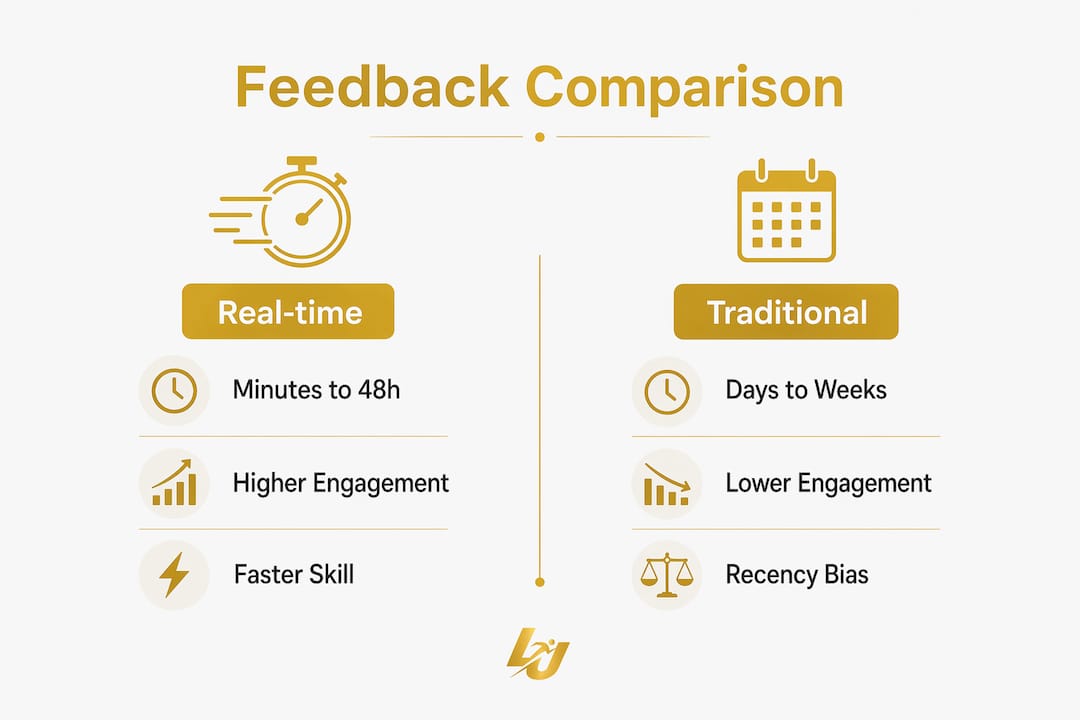
Traditional feedback in sport typically arrives in scheduled reviews, end-of-season assessments, or post-match debriefs held days after the event. Real-time performance evaluation operates on a completely different cycle. The table below shows the core differences across four dimensions.
| Dimension | Real-time feedback | Traditional feedback |
|---|---|---|
| Timing | Minutes to 48 hours | Days, weeks, or seasons |
| Frequency | Continuous, after each session or drill | Periodic, scheduled |
| Impact on learning | High: behaviour is fresh and adjustable | Lower: context is lost, recall is weaker |
| Athlete engagement | Active and ongoing | Passive, often anxiety-inducing |
The engagement gap is significant. Athletes receiving frequent, meaningful feedback are 3.6 times more likely to be actively engaged than those who receive infrequent input. That level of engagement translates directly into training effort, coachability, and long-term retention within a programme.
Traditional approaches also carry a structural problem: recency bias. Coaches and athletes tend to remember the most recent performances most vividly, which distorts longer-term evaluations. Real-time feedback reduces recency bias by capturing moments as they occur and logging them for formal review. This makes end-of-season assessments more accurate and less stressful for everyone involved.
Pro Tip: After every training session, log one specific observation per athlete before you leave the facility. Even a brief note in a performance app creates a documented record that removes guesswork from later reviews.
What are the proven benefits of real-time feedback for athletes and coaches?
The real-time feedback benefits extend across skill development, motivation, and the psychological environment of a training programme. Here are the most significant advantages backed by research.
- Faster skill acquisition. When correction arrives while the movement pattern is still active in muscle memory, athletes adjust more quickly. This is particularly visible in technical sports like cricket batting or netball shooting, where micro-adjustments compound over hundreds of repetitions.
- Higher engagement. Only 31% of employees are actively engaged in environments without regular feedback. In sport, low engagement shows up as reduced effort, poor attendance, and early dropout from academies.
- Reduced anxiety. Real-time feedback transforms coaches into coaching roles rather than evaluators, reducing the anxiety that high-stakes annual reviews create. Athletes who receive regular input feel less threatened by formal assessments because there are no surprises.
- Continuous improvement culture. When feedback is a daily norm rather than a quarterly event, athletes stop viewing it as criticism and start treating it as information. That cultural shift is one of the most powerful outcomes of consistent real-time performance evaluation.
- Better formal reviews. Capturing feedback moments and logging them removes guesswork from formal evaluations, making them evidence-based and far less stressful for both coach and athlete.
The motivational impact is particularly strong in younger athletes. Platforms like Levelup360hq use XP-driven challenges, badge systems, and live player cards to make feedback visible and rewarding. When an athlete can see their rating update after a strong session, the feedback loop becomes self-reinforcing.
How to give real-time feedback effectively in sports training
Knowing the importance of performance feedback is one thing. Delivering it well is another. These four methods represent the most effective approaches for coaches working across team and individual sports.
-
Deliver feedback immediately after the drill or rep. Do not wait for the end of the session. A rugby player correcting a tackle technique benefits most from input within seconds of the attempt, not 45 minutes later during a cool-down.
-
Keep it behaviour-specific, not character-based. Effective feedback must be behaviour-focused and delivered with intent to support growth. “Your left shoulder dropped on the approach” is useful. “You’re not trying hard enough” is not.
-
Use direct, clear language without the feedback sandwich. Avoid the feedback sandwich and instead use candid observations followed by clear, specific recommendations. Wrapping criticism between two compliments dilutes the message and slows improvement.
-
Use technology to support, not replace, human feedback. AI-powered tools analyse performance data to prompt optimally timed feedback, which is particularly useful in fast-paced training environments or when coaching multiple athletes simultaneously. Wearables, video analysis platforms, and apps like Levelup360hq allow coaches to document observations in the moment, attach video clips, and share feedback directly with athletes through a structured workflow.
-
Match the setting to the message. Immediate feedback that is specific, private for correction, and public for recognition achieves the best results. Correct a technical error privately. Celebrate a breakthrough publicly. The setting shapes how the message lands.
Feedback timing should also align with the training cycle. During a high-intensity block, brief and frequent input works best. During a recovery or reflection week, slightly longer conversations about patterns and progress are more appropriate.
Pro Tip: Use a sports coaching feedback guide to build a consistent feedback vocabulary across your coaching team. When all coaches use the same language and structure, athletes receive clearer, more consistent input regardless of who is on the pitch.
What challenges come with implementing real-time feedback?
Real-time performance evaluation is not without its complications. Coaches and clubs need to manage these risks deliberately.
- Feedback overload. Too much input, delivered too frequently, overwhelms athletes and reduces the impact of each individual piece. Quality matters more than volume. One precise, behaviour-specific observation is worth more than five vague comments.
- Tone and judgement. Feedback delivered under pressure, immediately after a poor performance, risks becoming emotional rather than constructive. Coaches must separate observation from judgement, particularly in competitive environments where frustration runs high.
- Technical constraints. Data accuracy matters. Wearable devices and performance apps can produce incorrect readings, and acting on faulty data creates confusion. Always cross-reference technology with direct observation.
- Individual preferences. Some athletes respond well to immediate, direct feedback. Others need a moment to process before they can absorb input. Feedback systems including weekly exchanges improve retention and clarity, but the format must suit the individual. A brief check-in after a session works for most, but a short written note via an app may work better for athletes who process information more privately.
- Balancing real-time with formal reviews. Continuous feedback does not replace structured evaluation. It feeds into it. Clubs should maintain a formal review cycle alongside daily feedback, using logged observations as the evidence base for those conversations.
Research from swim training shows that structured feedback in training can unlock measurable speed gains, but only when the feedback is consistent, specific, and well-timed. Sporadic or poorly delivered input produces no such gains.
Key takeaways
Real-time performance feedback is the single most effective tool for accelerating skill acquisition, raising athlete engagement, and building a training culture where improvement is continuous rather than seasonal.
| Point | Details |
|---|---|
| Timing is everything | Feedback delivered within 48 hours is far more effective than delayed input because behaviour recall fades quickly. |
| Engagement multiplies with frequency | Athletes receiving regular, meaningful feedback are 3.6 times more likely to be actively engaged in their development. |
| Behaviour-specific beats general | Feedback tied to a precise action or moment drives faster correction than broad character-based observations. |
| Technology extends reach | Tools like Levelup360hq and AI-powered platforms allow coaches to document, time, and deliver feedback at scale without losing precision. |
| Formal reviews need real-time data | Logging feedback as it happens removes recency bias and makes end-of-season evaluations evidence-based and accurate. |
What I have learned coaching with real-time feedback
The biggest mistake I see coaches make is confusing frequency with quality. They give feedback constantly, after every touch, every rep, every decision, and then wonder why athletes stop responding to it. Feedback loses its power when it becomes background noise.
What actually works is selectivity. Choose the one or two moments per session that matter most, and deliver those observations with precision and care. An athlete who receives three sharp, specific pieces of feedback per week will improve faster than one who receives twenty vague comments per day.
The second thing I have learned is that technology is a tool, not a substitute for human connection. Platforms like Levelup360hq are genuinely useful for logging observations, attaching video, and tracking progress over time. But the conversation still has to happen. An athlete seeing their rating drop on a player card needs a coach to explain why and what to do about it. The data creates the opening. The coach has to walk through it.
Finally, the coaches who get the most out of real-time feedback are the ones who have built a culture where athletes ask for it. When athletes trust that feedback is given to help them rather than judge them, they seek it out between sessions. That shift, from feedback as something done to athletes to something they actively want, is the real measure of a healthy development environment.
— Chris
How Levelup360hq supports real-time feedback in training

Levelup360hq is built around the principle that athletes develop faster when feedback is visible, timely, and tied to real performance data. The platform gives coaches video assessment tools, session management workflows, and approval systems that make it straightforward to deliver structured feedback after every training session. Athletes see their progress through live player cards, XP updates, and badge systems that make each piece of feedback feel meaningful rather than administrative. For clubs managing multiple squads across football, cricket, netball, or rugby, the centralised system means no observation gets lost and no athlete goes without input. Explore the platform to see how continuous feedback becomes part of your daily training rhythm, or try the demo to see the tools in action.
FAQ
What is real-time performance feedback in sport?
Real-time performance feedback is specific, behaviour-focused input delivered within minutes to 48 hours of an observed action. It gives athletes and coaches the context needed to make immediate adjustments to technique, decision-making, or effort.
How does continuous feedback differ from annual reviews?
Continuous feedback operates on a daily or session-by-session cycle, capturing observations as they happen. Annual reviews summarise patterns over time but lack the immediacy needed to change behaviour quickly.
What are the main real-time feedback benefits for coaches?
Coaches benefit from higher athlete engagement, faster skill development, and more accurate formal evaluations. Logging feedback in the moment removes recency bias and makes end-of-season assessments evidence-based rather than impressionistic.
How should a coach give feedback without causing anxiety?
Deliver corrections privately, keep observations behaviour-specific, and avoid the feedback sandwich. Direct, clear input tied to a precise action is less anxiety-inducing than vague or character-based criticism delivered in front of the group.
Can technology replace human feedback in athletic training?
Technology extends the reach and precision of feedback but does not replace the coaching conversation. AI tools and platforms like Levelup360hq provide data and structure, but the coach must still interpret that data and connect it to the athlete’s experience.
Recommended
Turn potential into a player card.
LevelUp360 tracks every match, builds your child's player card, and shows their development over time.
Get started free