What is coach-driven challenge creation?
Published 25 June 2026

Coach-driven challenge creation is the intentional design and delivery of structured, time-bound challenges by a coach to direct athlete behaviour, deepen engagement, and accelerate development. It goes well beyond setting drills or fitness targets. The method draws on frameworks such as the ACS (Assessment, Challenge, Support) model from the Centre for Creative Leadership, the Zone of Proximal Development from Vygotsky, and stepwise challenge design as outlined by HubFit. When coaches apply these principles deliberately, athletes stop going through the motions and start owning their growth.
What is coach-driven challenge creation and why does it matter?
Coach-driven challenge creation is defined as a coaching method where the coach designs specific, measurable challenges with defined behaviours, delivery modes, durations, and success thresholds. The goal is to shape the athlete’s environment so that the right behaviours become the natural response. This is distinct from simply assigning harder workouts or more repetitions.
The method matters because passive instruction produces passive athletes. When a coach designs a challenge with clear intent, athletes are placed in situations that require genuine decision-making and adaptation. Challenge-driven learning places real judgement calls on participants by leaving problems open-ended, which stimulates authentic development rather than rote compliance.

Coaches across football, cricket, netball, and rugby are adopting this approach because it produces measurable behaviour change. The challenge becomes the vehicle. The coach becomes the architect of the environment, not just the deliverer of content.
What are the key components of effective coach-led challenge design?
Effective coach-led challenge design follows a clear structure. HubFit’s five-step framework offers a practical model coaches can apply directly:
- Define the behaviour you want to reinforce or change.
- Choose the challenge mode: leaderboard or milestone.
- Set the duration: HubFit identifies a 3 to 62 day window as the effective range for maintaining engagement.
- Set badge thresholds that mark meaningful progress points.
- Name and brand the challenge to give it identity and motivational weight.
Leaderboard vs milestone: which mode fits your athletes?
The choice between leaderboard and milestone modes is not cosmetic. It shapes how athletes relate to the challenge and to each other.
| Feature | Leaderboard mode | Milestone mode |
|---|---|---|
| Primary driver | Competitive ranking | Personal progress |
| Best for | Athletes motivated by comparison | Athletes motivated by self-improvement |
| Risk | Can demotivate lower-ranked athletes | May lack urgency without peer pressure |
| Ideal use case | Squad fitness challenges, speed rankings | Skill acquisition, habit formation |
| Feedback type | Relative performance | Absolute achievement |
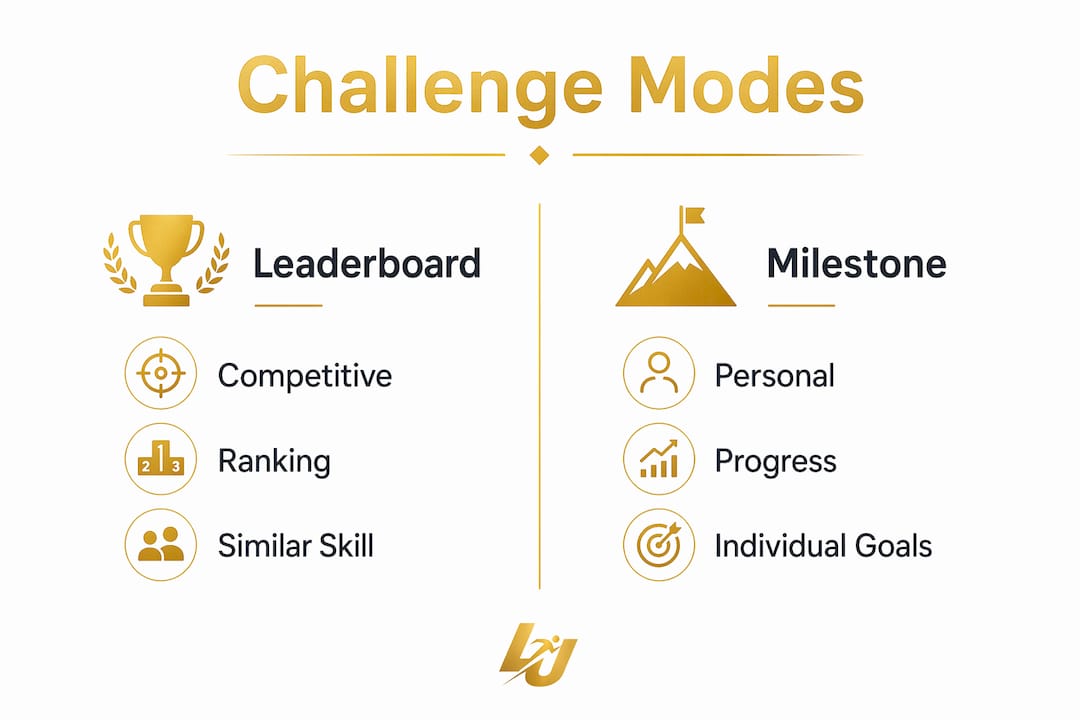
Leaderboard mode works well for physically competitive squads where athletes are at similar development stages. Milestone mode suits skill-building phases or athletes returning from injury, where personal benchmarks matter more than ranking.
Pro Tip: Run a short diagnostic before choosing a mode. Ask athletes whether they find peer comparison motivating or deflating. One wrong mode choice can undermine an otherwise well-designed challenge.
The ACS framework from the Centre for Creative Leadership adds a critical layer: challenge must be balanced with support to create psychological safety. Without that balance, athletes either disengage or shut down entirely.
How does psychology and task design shape challenge creation?
The psychological foundation of coach-driven challenge creation rests on one principle: athletes grow when they are stretched just beyond their current ability, with enough support to prevent failure from becoming demoralising. Vygotsky’s Zone of Proximal Development (ZPD) describes this as the space between what an athlete can do alone and what they can achieve with guidance. Scaffolded challenge calibration is not a one-time decision. It is an ongoing, dynamic process that responds to the athlete’s current state.
Task design is the practical tool coaches use to operate within the ZPD. Constraints such as rules, scoring systems, and time limits guide athlete behaviour without prescribing solutions. This is the key distinction. A constraint creates a problem the athlete must solve. A prescription tells the athlete what to do. The first builds adaptation. The second builds dependency.
Structured uncertainty is another powerful design principle. When a challenge is deliberately underspecified, athletes must identify the real problem themselves before solving it. MDA Training contrasts this with problem-based learning, where the problem is handed to the participant. In challenge-driven design, finding the problem is part of the development.
Common pitfalls in this area include:
- Confusing increased difficulty with better design. Adding more repetitions is not a constraint. It is volume.
- Removing all uncertainty to make athletes feel comfortable. Comfort and growth rarely coexist.
- Failing to create psychological safety. Athletes who fear judgement will not take the risks the challenge requires.
- Designing challenges in isolation from athlete feedback. The coach’s perception of difficulty rarely matches the athlete’s experience.
Pro Tip: Design your next challenge with one deliberate constraint removed, not added. Watch what athletes do when they have one fewer rule to follow. Their choices will tell you more about their development than any drill.
What practical steps help coaches implement and manage challenges effectively?
Implementing coach-driven challenges well requires structure before, during, and after the challenge runs. The following process covers the full cycle:
- Define the coach contract. Before launching, write down the success criteria, the behaviour proofs required (video, log, score), and the feedback schedule. Explicit success criteria prevent athlete disengagement caused by unclear expectations.
- Select your platform and tools. Technology platforms with auto-tracking and automated notifications reduce the manual workload significantly. Coaches who manage challenges manually lose time they should spend observing athletes.
- Launch with a briefing. Explain the purpose of the challenge, not just the rules. Athletes who understand the why behind a challenge engage more deeply than those who only know the what.
- Observe continuously. Dynamic athlete states such as stress, sleep quality, and learning speed shift the ZPD rapidly. A challenge that was well-calibrated on day one may be too easy or too hard by day seven.
- Recalibrate in real time. Adjust thresholds, add or remove constraints, or introduce new scaffolding based on what you observe. This is not failure. It is good coaching.
- Fade scaffolding deliberately. As athletes gain competence, reduce the support structures. The goal is athlete autonomy, not permanent dependence on coach guidance.
- Review and debrief. After the challenge ends, hold a structured reflection. What did athletes learn about themselves? What would they do differently? Coach roles extend beyond content delivery to facilitating reflection and supporting goal-setting.
Pro Tip: Build your feedback schedule into the challenge contract before you launch. Coaches who plan feedback intervals in advance deliver it consistently. Those who plan to “check in when needed” rarely do.
The practical benefit of this process is that it shifts the coach from reactive to proactive. Challenges become managed programmes, not ad hoc tasks.
What are common misconceptions about coach-driven challenge creation?
The most damaging misconception is that a harder challenge is always a better challenge. Increasing difficulty is not equivalent to better challenge design. Manipulating task constraints achieves meaningful behavioural pressure. Simply raising the bar without changing the environment produces frustration, not growth.
A second misconception is that challenges can be set once and left to run. Without dynamic adjustment, even a well-designed challenge becomes stale or misaligned with athlete development. Failure to adjust challenge and support quickly leads to boredom or athlete shutdown.
What most coaches miss when designing challenges:
- Athlete voice in design. Challenges built without athlete input often miss the motivational mark entirely.
- Psychological safety as a prerequisite. Athletes will not engage authentically with a challenge if they fear being judged for struggling.
- The difference between compliance and engagement. An athlete completing a challenge is not the same as an athlete developing through it.
- Feedback as part of the design. Feedback is not an add-on. It is a structural component of the challenge itself.
- Personalisation at the individual level. A one-size-fits-all challenge works for no one particularly well.
Pro Tip: After each challenge cycle, ask three athletes to rate how clear the goal was and how supported they felt. Those two scores will tell you exactly where your design needs work.
Key takeaways
Coach-driven challenge creation works when coaches design structured, time-bound challenges with defined behaviours, balanced support, and ongoing recalibration rather than simply increasing difficulty.
| Point | Details |
|---|---|
| Define behaviour first | Every challenge must target a specific behaviour, not a general outcome. |
| Balance challenge with support | The ACS framework requires psychological safety alongside stretch goals. |
| Use constraints, not just difficulty | Manipulating rules, scoring, and time creates better adaptation than adding volume. |
| Recalibrate continuously | ZPD shifts with athlete state; coaches must adjust challenge and support in real time. |
| Build in feedback from the start | Feedback schedules defined before launch produce consistent, meaningful athlete development. |
The shift I have seen coaches make, and why it changes everything
I have worked with coaches who were technically excellent but struggled to get consistent effort from their athletes. The problem was rarely ability. It was design. They were delivering content rather than creating environments.
The shift from instruction to environment design is the most significant change a coach can make. When you stop asking “what should I teach today?” and start asking “what situation will produce the behaviour I want to see?”, your athletes start solving problems rather than following instructions. That is a fundamentally different kind of development.
What surprises coaches most is how much emotional intelligence this requires. Designing a good challenge means knowing your athletes well enough to calibrate the difficulty, the support, and the mode correctly. It means being willing to change the challenge mid-cycle when the data tells you it is not working. That takes confidence and humility in equal measure.
Gamification tools and platforms are making this more accessible. The administrative burden of tracking, notifying, and reporting on challenges used to consume hours. Now it does not have to. That freed time belongs back in observation and recalibration, which is where the real coaching happens.
Challenge creation is a learnable skill. The coaches who commit to it consistently produce athletes who are more engaged, more adaptable, and more capable of driving their own development. That outcome is worth every hour spent getting the design right.
— Chris
How Levelup360hq supports coach-driven athlete development
Levelup360hq is built for coaches who want to run structured, trackable challenges without the administrative overhead. The platform includes XP-driven challenges, badge systems, leaderboards, and milestone tracking across football, cricket, netball, and rugby.

Coaches can launch challenges with defined thresholds, automate notifications, and monitor athlete progress through performance analytics in real time. The approval workflow and video assessment tools mean coaches spend less time chasing evidence and more time coaching. For clubs and academies, white-label branding and CRM tools sit alongside the challenge features, making Levelup360hq a complete athlete development platform rather than a standalone tool. Explore the platform demo to see how challenge creation works in practice.
FAQ
What is coach-driven challenge creation in sport?
Coach-driven challenge creation is the intentional design of structured, time-bound challenges by a coach to direct specific athlete behaviours and support development. It combines task design, psychological principles, and ongoing recalibration rather than simply assigning harder tasks.
How long should a coach-driven challenge last?
HubFit identifies a duration of 3 to 62 days as the effective range for maintaining athlete engagement in a structured challenge. Shorter challenges lack momentum; longer ones risk disengagement without strong feedback mechanisms.
What is the ACS framework in coaching?
The ACS (Assessment, Challenge, Support) framework from the Centre for Creative Leadership describes how coaches must balance stretching athletes with providing psychological safety and support. Without the support element, challenge alone leads to shutdown rather than growth.
How does the Zone of Proximal Development apply to challenge creation?
The Zone of Proximal Development identifies the space between what an athlete can do independently and what they can achieve with coach support. Effective challenge creation targets this zone and adjusts dynamically as the athlete’s state and capability change.
What is the difference between leaderboard and milestone challenge modes?
Leaderboard mode ranks athletes against each other and suits competitive squads. Milestone mode tracks individual progress against personal thresholds and suits skill acquisition or rehabilitation phases where self-improvement matters more than peer comparison.
Recommended
Turn potential into a player card.
LevelUp360 tracks every match, builds your child's player card, and shows their development over time.
Get started free