What is a player development badge: a complete guide
Published 23 June 2026

A player development badge is a digital, verifiable credential that recognises specific skills or achievements within an athlete’s defined progression pathway. Unlike a certificate printed on paper, a digital badge carries embedded metadata: the issuer’s identity, the criteria the athlete met, evidence links, and issue or expiry dates. This makes the badge portable, shareable, and independently verifiable. For athletes, coaches, and clubs, that combination of recognition and proof is what separates a meaningful badge from a hollow sticker. Platforms like Levelup360hq have built entire development frameworks around this principle, treating badges as live markers of athlete growth rather than static awards.
What is a player development badge and how does it work?
A player development badge is defined as a digital credential issued when an athlete meets a specific, pre-stated set of criteria within a development programme. The badge meaning goes beyond recognition. It carries structured data that tells anyone viewing it exactly what was achieved, who assessed it, and what evidence supports the claim.
The metadata embedded in each badge typically includes the issuing organisation, the criteria description, evidence links such as video assessments or test scores, the recipient’s details, and the issue date. Each of these fields exists to answer one question: can this achievement be trusted? Without that metadata, a badge is simply a logo.

Badges sit within broader athlete development frameworks. They are not standalone awards. A badge earned at the Foundation stage of a pathway carries a different weight and meaning than one earned at the Professional Development stage. Understanding the issuing body’s framework is the only way to interpret a badge correctly.
There is no universal player development badge standard across all sports. Each sport or programme defines its own criteria and meaning, which means badge context within a specific framework is the key to understanding its value.
How do player development badges fit into athlete development pathways?
Development pathways in elite sport are structured progressions. They move athletes through defined stages, each with its own physical, technical, and tactical demands. Badges mark the completion of each stage and the competencies demonstrated along the way.
The Premier League’s Elite Player Performance Plan, known as the EPPP, is one of the clearest examples. It maps player progress through three distinct phases: Foundation (U9–U11), Youth Development (U12–U16), and Professional Development (U17–U23). Badges aligned with these phases give coaches and clubs a visible record of where each athlete stands within that structured journey. The EPPP also integrates Bio-Banding, which organises players by biological age rather than calendar age, making development tracking fairer and more accurate.
The table below shows how badge types map to pathway stages in a structured system like the EPPP.
| Pathway stage | Age group | Badge focus |
|---|---|---|
| Foundation | U9–U11 | Fundamental movement and basic technical skills |
| Youth Development | U12–U16 | Tactical awareness, position-specific skills |
| Professional Development | U17–U23 | Performance analytics, elite competition readiness |
| Coaching Education | All ages | Module completion, assessed practical competency |
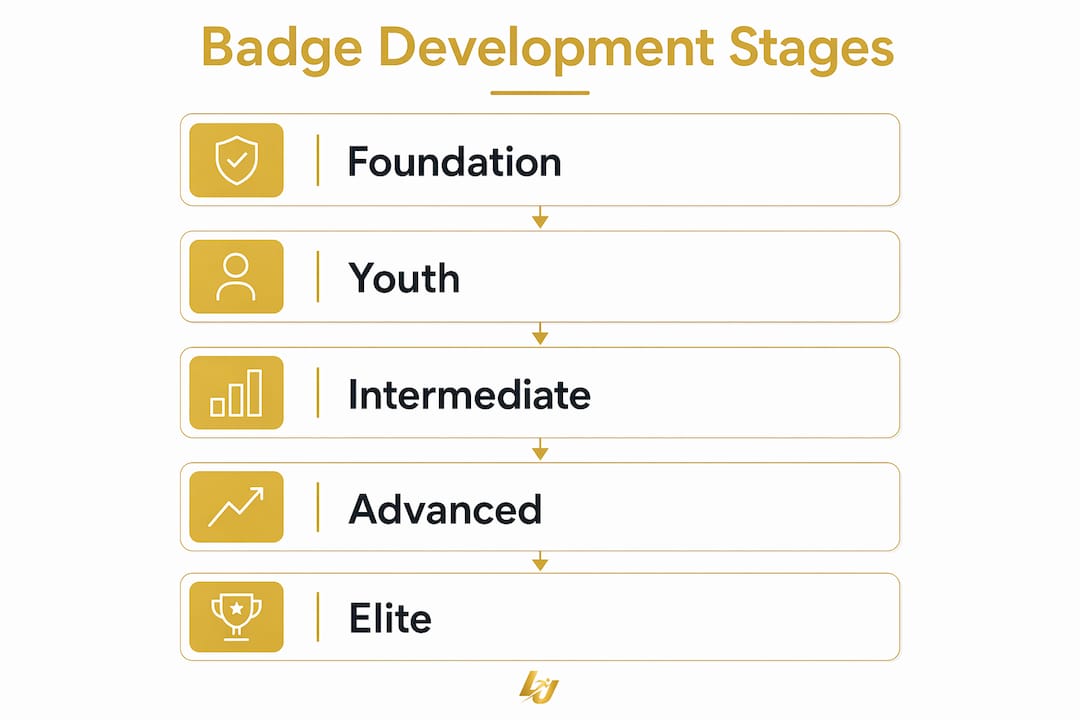
Generic badge schemes, where athletes receive a badge simply for attending a session, lack this structure entirely. A structured badge system ties each award to a specific stage and a specific set of assessed competencies. That structure is what gives the badge its meaning.
Pro Tip: When evaluating a badge programme, ask whether each badge maps to a named stage in a published development framework. If it does not, the badge is likely participation-based rather than competency-based.
What criteria and evidence make a player development badge credible?
A badge’s credibility rests entirely on the quality of its criteria and the strength of its evidence. Badges lose credibility when issued without clear achievement requirements or verifiable proof. This is the core problem known as badge inflation: too many badges issued too easily, until none of them mean anything.
Credible player development badges share a set of common features:
- Explicit criteria. The badge states exactly what the athlete must do or demonstrate. “Completed a session” is not a criterion. “Demonstrated accurate short passing under pressure in a structured assessment” is.
- Assessed performance. The athlete’s performance is observed and judged by a qualified assessor, not self-reported.
- Evidence links. The badge metadata includes a link to the evidence, such as a video clip, a test score, or a coach’s written assessment.
- Issuer transparency. The issuing body is named and its authority to issue the badge is clear.
- Expiry or review dates. Some badges include an expiry date, signalling that skills must be maintained and reassessed over time.
The USTA Coaching badge model illustrates this well. Each USTA badge is structured around up to seven microlearning modules, each approximately 20 minutes long, often supplemented by practical workshops. Coaches must complete and pass each module before the badge is issued. That combination of learning, assessment, and practical application is what makes the credential trustworthy.
Pro Tip: Before accepting a badge as proof of competency, check whether the issuing body publishes its assessment criteria publicly. Transparent criteria are the clearest sign of a credible badge system.
What are the benefits of player development badges for athletes and coaches?
Player development badges serve a practical function for both athletes and coaches. They are not simply motivational tools. They are portable proof of skills that can be shared across clubs, academies, and coaching networks.
- Portable skill recognition. A badge earned at one club travels with the athlete. When moving to a new academy or applying for a development programme, the athlete can share verified evidence of their competencies without relying on a coach’s word alone.
- Structured goal-setting. Badges give athletes a clear target. Knowing that a specific badge requires a specific skill assessment changes how athletes approach training. The badge becomes a checkpoint, not a prize.
- Feedback loops. The microlearning model used by organisations like USTA Coaching builds repeated assessment into the process. Each module creates a natural feedback point where coaches can identify gaps before the athlete progresses.
- Visibility in profiles and portfolios. Athletes can display badges on digital profiles, making their development history visible to scouts, coaches, and clubs. This is particularly valuable for younger athletes who lack a long competitive record.
- Coach certification pathways. Coaches use badge systems to demonstrate their own professional development. A coach who holds badges across multiple modules signals ongoing learning, not just an initial qualification.
Badges function as checkpoints within coaching development pathways. They do not replace the coaching relationship or the actual process of skill development. Their value is in making that development visible and verifiable.
Pro Tip: Athletes should treat each badge as a conversation starter with their coach, not a finish line. Ask what the next badge requires and use that criteria list as your next training focus.
What are the best examples of player development badge systems in elite sport?
The most effective badge systems in sport share one characteristic: they are built into a wider development framework rather than bolted on as an afterthought. Three examples stand out for their structure and clarity.
The Premier League’s EPPP uses stage-based badge progression tied to its three development phases. Clubs operating within the EPPP framework use badges to track player progress across Foundation, Youth Development, and Professional Development stages. The integration of Bio-Banding means that physical development is assessed alongside technical skill, giving a more complete picture of each athlete’s readiness.
USTA Coaching’s badge model takes a different approach, focusing on coach education rather than athlete progression. Each badge covers a specific coaching competency and requires completion of structured microlearning modules. The short module format, approximately 20 minutes per module, makes it practical for working coaches to complete assessments alongside their regular duties.
Community and youth football clubs operate at a smaller scale but use similar principles. Many county football associations in England issue badges for young players who complete structured skills programmes, with each badge tied to a specific age group and skill set.
| System | Sport | Badge focus | Key feature |
|---|---|---|---|
| Premier League EPPP | Football | Athlete stage progression | Three-phase pathway with Bio-Banding |
| USTA Coaching | Tennis | Coach competency | Microlearning modules, ~20 min each |
| County FA programmes | Football | Youth skill development | Age-group specific criteria |
| Levelup360hq | Multi-sport | Athlete and club development | Live badge tracking with XP and analytics |
Levelup360hq supports multiple sports including football, cricket, netball, and rugby. Its badge system sits within a gamified development framework that includes live player cards, XP-driven challenges, and performance analytics, giving athletes and coaches a real-time view of progression.
Key takeaways
Player development badges are only as valuable as the criteria and evidence behind them. A badge without explicit assessment standards is participation recognition, not competency proof.
| Point | Details |
|---|---|
| Badge definition | A digital credential with embedded metadata verifying an athlete’s specific achievement or competency. |
| Pathway alignment | Effective badges map to named stages in a development framework, such as the EPPP’s three phases. |
| Credibility factors | Explicit criteria, assessed performance, and evidence links separate credible badges from participation awards. |
| Practical benefits | Badges provide portable skill proof, structured goal-setting, and visibility for athletes and coaches. |
| Context matters | Badge meaning depends on the issuing body’s framework; no universal standard exists across all sports. |
Why badges need to be earned, not handed out
The most common mistake I see in youth sport is treating badges as a reward for showing up. Coaches hand them out after sessions to keep players engaged, and within a season, the badges mean nothing. Players stop caring, parents stop noticing, and the whole system collapses into background noise.
The badge systems that actually work, the EPPP, the USTA Coaching model, and the better community programmes, share one feature: the athlete has to do something specific and demonstrable to earn the badge. That specificity is what creates the motivation. When a 14-year-old knows exactly what they need to demonstrate to earn the next badge, they train with a purpose they would not otherwise have.
Coaches sometimes worry that a criteria-based system is too rigid. My experience is the opposite. Clear criteria give coaches a shared language with athletes and parents. Instead of vague feedback like “you need to improve your positioning,” a coach can point to a specific badge criterion and say “here is exactly what we are working towards.” That precision changes the coaching conversation entirely.
The future of badge systems in sport sits at the intersection of video assessment and real-time analytics. Platforms that can link a badge directly to a video clip of the assessed performance, alongside performance data, will make the credential far more meaningful than anything a paper certificate ever achieved. That is the direction the best development programmes are already moving in.
— Chris
How Levelup360hq supports badge-based athlete development
Athletes and coaches who want to put badge-based development into practice need a platform that connects badges to real performance data, not just a digital sticker collection.
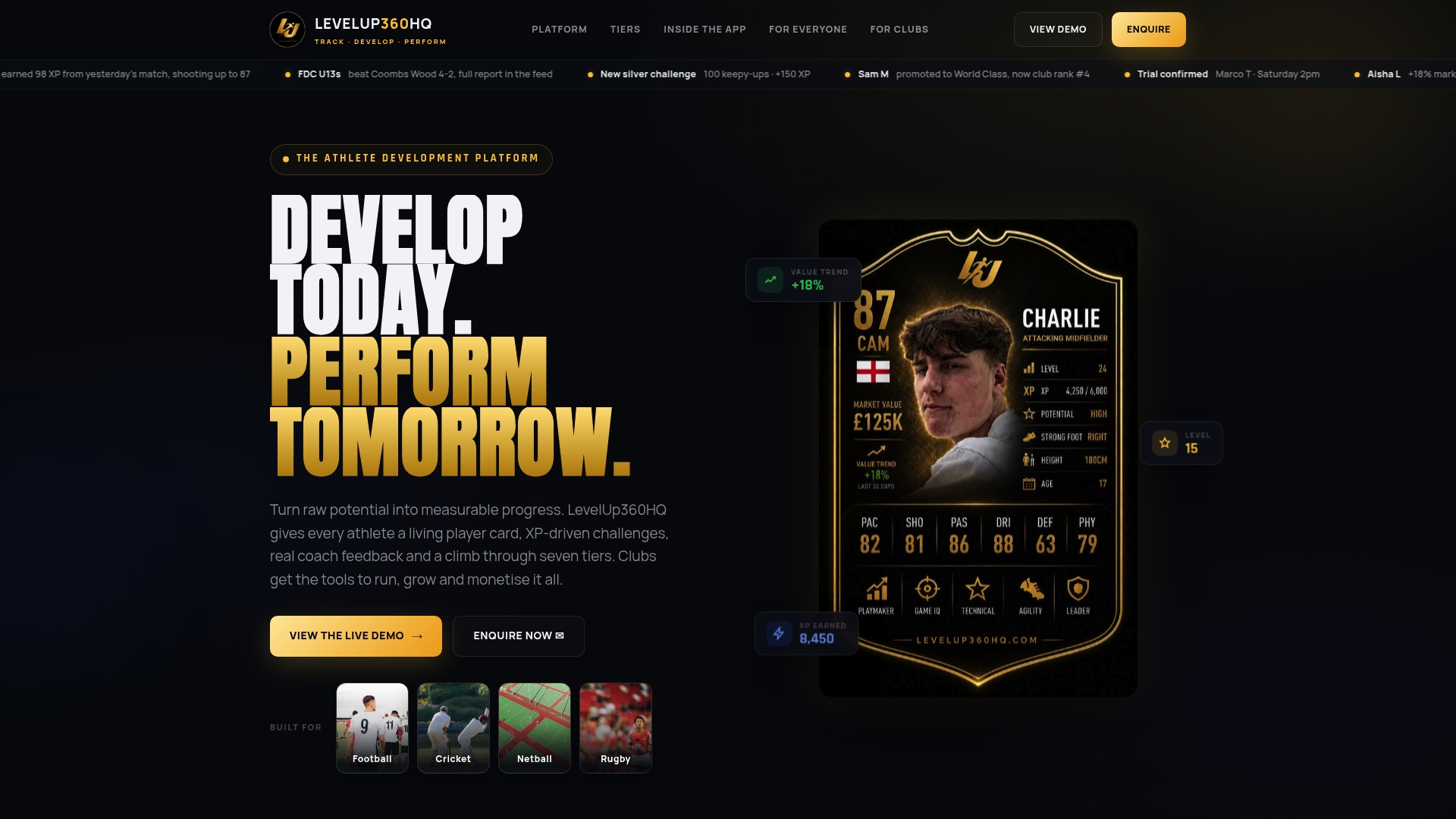
Levelup360hq brings badge tracking, XP-driven challenges, and live player cards together in one place. Coaches can run video assessments, manage approval workflows, and link badge awards directly to performance evidence. Athletes see their progression in real time through live development tracking that covers football, cricket, netball, and rugby. For clubs and academies, the platform includes white-label branding and CRM tools to manage the full athlete lifecycle. Explore the platform demo to see how badge-based progression works in practice.
FAQ
What is a player development badge?
A player development badge is a digital credential that verifies an athlete has met specific, assessed criteria within a development programme. It carries embedded metadata including the issuer, criteria, and evidence links to confirm its validity.
How do athletes earn player development badges?
Athletes earn badges by meeting explicit performance or learning criteria set by the issuing body, such as completing assessed training modules or demonstrating specific skills in a structured evaluation.
Are player development badges the same across all sports?
No. There is no universal standard. Each sport or programme defines its own badge criteria and framework, so a badge must always be understood in the context of the issuing body’s development system.
What makes a player development badge credible?
Credibility depends on explicit criteria, assessed performance, verifiable evidence links, and a named issuing body. Badges issued purely for participation, without assessment, carry no meaningful proof of competency.
Can coaches use player development badges too?
Yes. Coaching badge systems such as the USTA Coaching model use structured microlearning modules to award badges that verify specific coaching competencies, supporting ongoing professional development.
Recommended
Turn potential into a player card.
LevelUp360 tracks every match, builds your child's player card, and shows their development over time.
Get started free