Tier progression systems in sports explained
Published 9 June 2026

A tier progression system in sports is a structured method of grouping competitors into ranked layers, enabling performance-based movement between levels through measurable results and defined metrics. Whether you are an athlete climbing a rating ladder, a coach designing a development programme, or a club building a competitive league, understanding how these systems work is the foundation of building fair, motivating competition. The two dominant models are promotion and relegation leagues, as seen in the English football pyramid, and continuous rating ladders, as used in esports titles like Rocket League. Both share the same core purpose: matching competitors of similar ability and rewarding those who improve.
What are the primary types of tier progression system in sports?
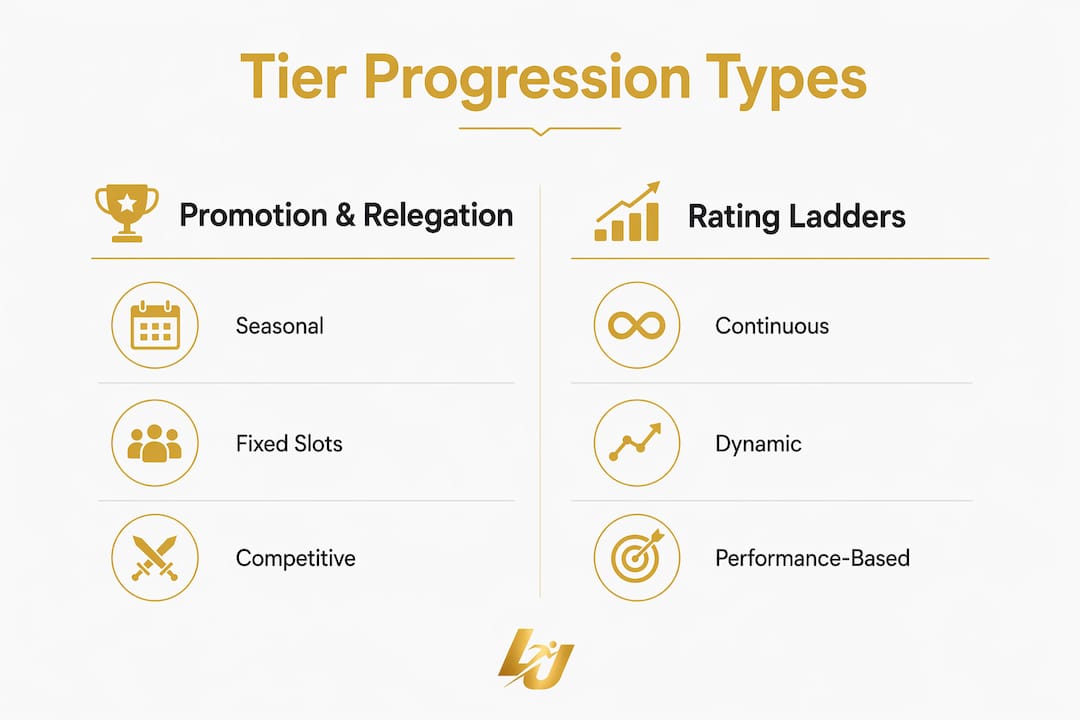
Tiered systems in sports fall into two broad categories, and choosing between them shapes every aspect of how competition feels for participants.
Promotion and relegation leagues operate on fixed play periods, typically a season or a weekly cycle. Tiered leagues feature linked leaderboards representing each tier, with competitors starting in the bottom tier and moving up or down after each play period based on their final position. A common structure promotes the top three performers and relegates the bottom three at the end of each cycle, with rewards scaling in value as tiers increase. The English football pyramid is the most widely recognised example of this model at scale.

The English football pyramid uses a fully connected tier system where the Premier League relegates its bottom three clubs, the Championship promotes its top two automatically plus one playoff winner, and League One relegates four teams. This cascading structure creates clear stakes at every level of the pyramid and is replicated, with local variations, across dozens of national football systems.
Rating ladder systems work differently. Rather than waiting for a season to end, rating systems assign a power rating to each competitor that updates iteratively after every match, using Elo-style zero-sum calculations. Tiers are then derived from where a competitor sits on the rating scale at any given moment. Rocket League uses this approach: its eight competitive ranks each contain internal divisions, and promotion requires clearing the top division of a tier before advancing. Demotion follows the same logic in reverse.
- Promotion and relegation leagues: best for structured, community-based sports with fixed seasons
- Rating ladder systems: best for high-frequency, match-based competition where form changes rapidly
- Hybrid models: combine fixed tiers with continuous rating updates within each tier
Pro Tip: If you are designing a system for a youth academy or club league, start with a promotion and relegation model. The clear seasonal rhythm gives young athletes a defined goal and a natural reset point, which sustains motivation across a full programme.
How do tier progression systems balance competitiveness and fairness?
Fairness in a tiered system is not automatic. It is the product of deliberate design decisions around how many competitors move between tiers, what metrics determine movement, and how the system protects participants from catastrophic drops caused by a single poor performance.
The number of promotion and relegation slots is the most consequential variable. Too few slots and the system stagnates, with strong performers trapped below their true level for extended periods. Too many and the system becomes chaotic, with competitors cycling between tiers without ever stabilising at the right level. Fairness depends on balancing the number of promotions and relegations alongside the metrics used for placement, whether that is points accumulated, win rate, or a composite rating score.
Reward structures are the second lever. Scaling rewards with tier level is standard practice because it creates a tangible incentive to progress. A system where rewards double or triple between the bottom and top tier gives competitors a concrete reason to push for promotion beyond the competitive satisfaction alone. This is particularly relevant for sports organisations running paid leagues or academies where athlete retention is a commercial priority.
Stability controls are the third and most overlooked element. Ladder systems include step floors and ceilings to prevent demotivation caused by a single poor session dropping a competitor far below their established level. Pickleheads, the pickleball platform, places the top four finishers at step one initially and uses step floors to prevent drops below a defined threshold. This prevents the demoralising experience of losing weeks of progress in a single afternoon.
- Define the number of promotion and relegation slots before launch, not after complaints arise
- Set reward values at each tier level that create genuine aspiration without making lower tiers feel worthless
- Implement a tier floor so that one bad performance period does not erase months of progress
- Use a placement match or initial seeding process to reduce early-stage churn
- Review tier movement data after each play period and adjust thresholds if too many or too few competitors are moving
One structural nuance worth noting: some sports pyramids require off-field conditions for promotion, such as stadium infrastructure or financial stability standards. Germany’s football pyramid is a clear example, where a club can finish first in their division and still be denied promotion if they fail to meet licensing requirements. For sports organisations building their own systems, this raises the question of whether performance alone should determine tier movement, or whether off-field criteria like attendance, coaching qualifications, or facility standards should also play a role.
League-style promotion vs. rating ladders: which model fits your sport?
The choice between a seasonal promotion and relegation model and a continuous rating ladder is not simply a technical preference. It reflects the nature of your sport, the frequency of competition, and the experience you want athletes to have.
| Feature | Promotion and relegation leagues | Rating ladder systems |
|---|---|---|
| Update frequency | End of fixed play period (weekly, monthly, seasonal) | After every match or session |
| Tier stability | High. Competitors stay in their tier until the period ends | Lower. Ratings shift continuously, tiers can change frequently |
| Player experience | Clear goals, defined seasons, strong community identity | Immediate feedback, constant progression signal |
| Administration complexity | Moderate. Requires scheduling and period management | Higher. Requires rating calculation infrastructure |
| Best suited for | Structured leagues, academies, club competitions | Esports, racket sports, individual match-based formats |
Seasonal leagues offer a clarity that rating ladders cannot replicate. When a competitor knows that their tier is locked until the end of the month, they can focus entirely on performance within that window rather than obsessing over every rating point. This psychological stability is particularly valuable in youth development settings, where confidence and long-term engagement matter as much as competitive accuracy.
Rating ladders, by contrast, provide a feedback loop that seasonal systems cannot match. Deciding between discrete seasonal changes and continuous rating updates is a fundamental design choice that affects player experience and system complexity in equal measure. For sports with daily or weekly competition, such as tennis, padel, or esports, a rating ladder keeps the system feeling alive and responsive. For a football academy running monthly fixtures, a seasonal model is almost always the better fit.
Pro Tip: You do not have to choose one model exclusively. A hybrid approach, where tiers are defined seasonally but internal rankings within each tier update continuously, gives you the stability of a league system with the engagement of a rating ladder. Several golf tournament formats already use this logic effectively.
How to implement a tier progression system for your sports organisation
Designing a tier progression system from scratch requires decisions in a specific order. Getting the sequence wrong, for instance setting rewards before defining tier boundaries, leads to systems that feel arbitrary and lose athlete buy-in quickly.
-
Define your tier structure first. Decide how many tiers you need based on the size of your participant pool. Three to five tiers work well for most club-level organisations. Too many tiers with too few participants per tier creates hollow competition.
-
Set promotion and relegation rules with precision. Promotion and relegation counts and timing must be precisely defined before launch. Mismatches between promotion schedules and play period timing cause engagement drops because competitors move tiers without immediately having the chance to compete at their new level.
-
Design your reward scheme around tiers, not just outcomes. Rewards should increase meaningfully at each tier level. Whether those rewards are points, badges, prize money, or visibility within your platform, the gap between tiers needs to feel worth the effort of promotion.
-
Build in initial placement logic. Dropping all participants into the bottom tier at launch creates an immediate bottleneck and frustrates your strongest athletes. Use a placement round, a seeding process, or historical performance data to distribute participants across tiers from day one.
-
Use technology to manage the operational load. Manually tracking ratings, scheduling matches across tiers, and calculating promotion slots at the end of each period is unsustainable at any meaningful scale. Platforms designed for tiered league management handle this infrastructure automatically, freeing coaches and administrators to focus on athlete development rather than spreadsheet maintenance.
-
Monitor and adjust. Using larger sample sizes or fixed play periods reduces churn in tier movement when tiers are based on continuous rating updates. Review your data after each cycle. If more than 40% of your participants are moving tiers every period, your thresholds are too sensitive. If fewer than 5% are moving, the system has stagnated.
The tennis fantasy sports contest formats community offers a useful parallel here: the most engaging competitive structures are those where participants feel that their effort directly influences their standing, but where a single bad day does not undo months of progress. That balance is the goal of every well-designed tier system.
Key takeaways
A well-designed tier progression system requires clear promotion rules, scaled rewards, and stability controls to sustain both competitive integrity and athlete motivation.
| Point | Details |
|---|---|
| Choose the right model | Seasonal leagues suit structured clubs; rating ladders suit high-frequency, match-based sports. |
| Define movement rules precisely | Set promotion and relegation slot counts before launch to prevent scheduling conflicts and engagement drops. |
| Scale rewards across tiers | Rewards that increase meaningfully at each tier level create genuine aspiration and improve retention. |
| Build in stability controls | Tier floors and placement seeding prevent demotivation from single-session performance swings. |
| Use technology to manage complexity | Automated platforms handle rating calculations, scheduling, and leaderboard management at scale. |
Why most tier systems fail before they find their rhythm
I have seen sports organisations spend months designing tier structures, only to watch athlete engagement collapse within the first two play periods. The reason is almost always the same: the system was built around the administrator’s convenience rather than the athlete’s experience.
The most common mistake is launching with too many tiers and too few participants. A five-tier system with twelve athletes per tier sounds structured on paper. In practice, it means the bottom tier feels like a punishment rather than a starting point, and the top tier feels unreachable. Three tiers with meaningful populations at each level will outperform a granular system every time.
The second mistake is treating rewards as an afterthought. I have worked with clubs that built technically sound promotion and relegation systems and then offered the same recognition at every tier level. Within a month, athletes in the top tier were asking why they should bother staying there. Reward scaling is not optional. It is the mechanism that makes tier progression feel worth pursuing.
The third, and most damaging, mistake is failing to communicate the rules clearly before competition begins. Athletes who do not understand exactly how promotion works, what metrics determine their standing, and when tier changes happen will assume the system is unfair the moment they experience an outcome they did not expect. Transparency is not a nice addition to a tier system. It is the foundation of its credibility.
The Elo-like rating systems that underpin the most trusted competitive structures work precisely because their logic is public and consistent. Every competitor knows that the system treats every match the same way. That consistency is what you are trying to replicate, regardless of whether you are running a Premier League academy or a local netball club.
— Chris
See tier progression in action with Levelup360hq

Levelup360hq is built specifically for sports organisations that want to run tier progression without the administrative burden. The platform supports configurable promotion and relegation logic, real-time leaderboards, and reward scaling across tiers for football, cricket, netball, rugby, and more. Athletes track their progress through FIFA-style player cards with live ratings, XP-driven challenges, and badge systems that make every tier feel worth reaching. Coaches manage sessions, approve performance data, and monitor athlete development from a single dashboard. If you want to see how a fully operational tier system works in practice, explore the Levelup360hq demo and experience the mechanics firsthand.
FAQ
What is a tier progression system in sports?
A tier progression system groups competitors into ranked tiers based on performance, allowing movement between levels through promotion and relegation or rating updates. The goal is to match athletes of similar ability and reward those who improve.
How does promotion and relegation work in a tiered league?
At the end of each play period, the top performers in a tier are promoted to the next level up, while the bottom performers are relegated to the tier below. The English football pyramid, where the Premier League relegates its bottom three clubs each season, is the most widely recognised example.
What is the difference between a rating ladder and a league tier system?
A rating ladder updates a competitor’s tier continuously after every match using calculations similar to the Elo system, while a league tier system locks tiers for a fixed play period and updates them only at the end of that period.
How do you prevent demotivation in a tier progression system?
Tier floors and placement seeding prevent competitors from dropping far below their established level after a single poor performance. Pickleheads uses step floors on its pickleball ladder to protect athletes from losing significant progress in one session.
Do all sports use performance alone to determine tier movement?
No. Some sports pyramids, including Germany’s football system, require clubs to meet off-field standards such as infrastructure and financial criteria before promotion is granted, even if their on-field results qualify them.
Recommended
Turn potential into a player card.
LevelUp360 tracks every match, builds your child's player card, and shows their development over time.
Get started free