Tier-based athlete ranking for scouts explained
Published 8 June 2026

Tier-based athlete ranking is a system that groups athletes into clusters of roughly equivalent projected value, rather than assigning each player a unique position on a linear scale. Scouts at organisations like NHL Central Scouting and recruiting platforms such as Inside Lacrosse use this approach because it reflects how talent evaluation actually works: the difference between the 12th and 15th ranked prospect is often negligible, while the gap between the 15th and 16th can be enormous. Understanding what tier-based athlete ranking means for scouts gives athletes and coaches a sharper lens for interpreting recruitment signals and making smarter development decisions.
How do scouts use tier-based rankings to evaluate athletic talent?
Tiers group athletes into clusters of roughly interchangeable value, which is fundamentally different from a numbered list where every position implies a meaningful step up or down. A scout using a tiered evaluation system is not asking “is this player 14th or 15th?” They are asking “is this player in the top tier, or have they crossed into the next one?” That distinction changes everything about how a prospect is pursued.
The concept of a “tier cliff” is central to understanding why this matters. When an athlete crosses from one tier into a higher one, the change in perceived value is dramatic. Moving from rank 20 to rank 15 within the same tier carries little practical weight. Moving from tier three to tier two, however, signals a step-change in projected outcome and triggers a different level of recruiting attention.

Linear rankings create false precision. Tier-based systems reduce this by treating closely ranked athletes as equivalent until evidence clearly separates them. This protects scouts from over-investing in marginal rank differences and helps coaches understand why their athlete’s ranking may shift without their tier changing.
Tiers also communicate probability. Rather than saying “this player will be a second-round pick,” a scout using tier grades is expressing a likelihood range. NHL Central Scouting grades players by letter tiers aligned with projected draft rounds, so an “A” grade signals a first-round projection and a “B” grade points toward rounds two or three. The grade is a probability statement, not a guarantee.
- Tiers simplify decision-making by creating value clusters where athletes are similarly rated
- The tier cliff matters more than rank movement within a tier
- Letter grades and star ratings communicate expected outcomes, not fixed positions
- Scouts use tiers to manage uncertainty and express trajectory expectations
Pro Tip: If your athlete’s ranking shifts but their tier stays the same, do not treat it as meaningful progress. Focus your development goals on what it takes to cross the next tier boundary.
What are the common tier classification methods scouts use?
Different sports use different labelling systems, but all tier classifications share the same underlying logic: group athletes by projected outcome, not by precise rank order. The three most common formats are star ratings, letter grades, and numeric scales.
| Classification method | Sport context | Tier meaning |
|---|---|---|
| Star ratings (1 to 5) | Lacrosse, football recruiting | Proportion-based buckets; 5-star is top 0.2 to 0.5% of class |
| Letter grades (A, B, C) | NHL draft scouting | Tied to projected draft round; A = first round |
| Numeric scale (1 to 5) | College recruiting | Linked to performance outcome; 5 projects All-American level |
| Combined score plus tier | Multi-sport platforms | Evaluation score informs but does not determine tier placement |
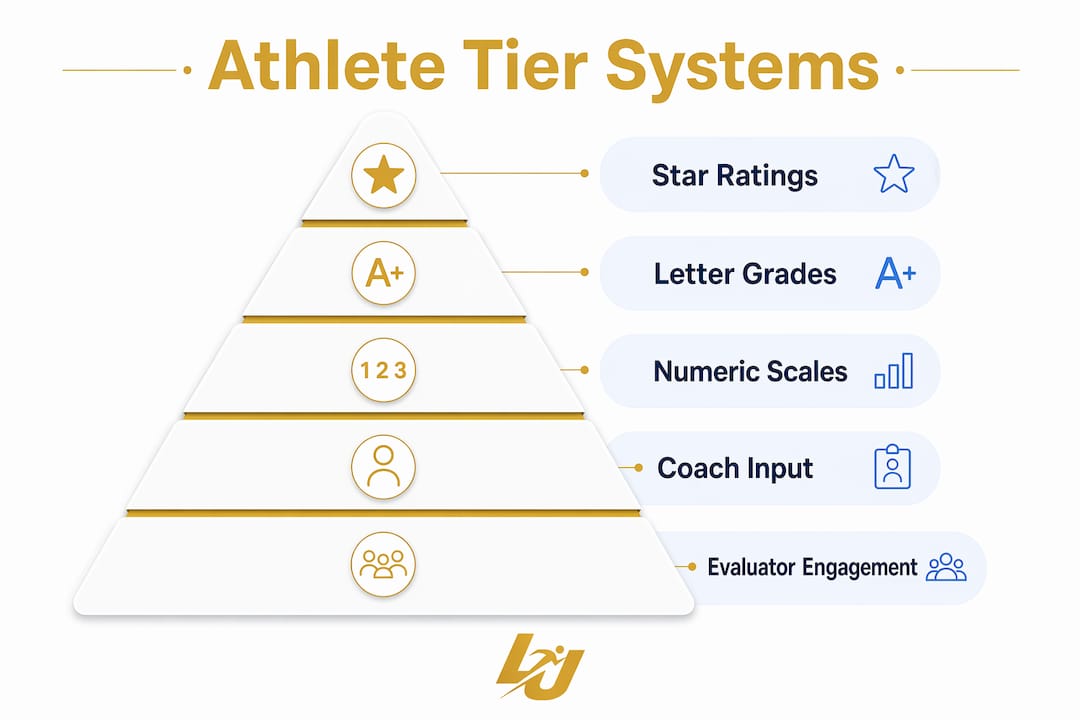
Inside Lacrosse’s star rating system is one of the most transparent examples of tier classification in recruiting. Five-star prospects represent just 0.2 to 0.5% of a class, four-star athletes make up roughly 12 to 15%, and three-star athletes account for approximately 40%. These proportions are deliberate. They reflect the actual distribution of elite talent and prevent tier inflation, which would make the system meaningless.
NHL Central Scouting’s letter-grade approach ties tiers directly to draft-round projections. This is useful for athletes and coaches because it translates abstract evaluation into a concrete outcome expectation. A “B” grade does not mean a player is mediocre. It means scouts project them as a second or third-round selection, which is a significant achievement.
Numeric scales used in college recruiting take a slightly different approach by linking tiers to performance outcomes. A rating of three means a prospect is expected to compete for playing time. A rating of five projects All-American recognition. This outcome-based framing helps coaches set realistic development targets and helps athletes understand what scouts are actually measuring.
One critical nuance: higher evaluation scores do not guarantee higher star ratings or rankings. Coach opinion, recruiting contact frequency, and evaluator engagement all influence tier placement. Raw performance data is necessary but not sufficient.
How can athletes and coaches improve scouting visibility through tiers?
Understanding the tier system is only useful if you act on it. The goal is not to obsess over your exact rank. The goal is to identify which tier you are in, understand what separates you from the tier above, and build a visibility strategy around crossing that boundary.
- Identify your current tier. Use available recruiting platforms, coach feedback, and any formal evaluation scores to establish where you sit. Knowing your tier gives you a realistic baseline.
- Understand the tier above yours. Research what attributes, performance metrics, or recruiting contact levels characterise athletes in the next tier. This is your development target, not a vague aspiration.
- Time your visibility windows. Tier rankings are updated periodically, often annually. Recruiting visibility peaks around these update cycles. Plan your best performances, highlight reels, and coach outreach to coincide with evaluation periods.
- Maintain consistent contact across all levels. Do not assume that being in a lower tier means scouts are not watching. Consistent engagement with scouts across all tiers is critical. Coaches and scouts who feel ignored at the lower tier stage rarely revisit a prospect later.
- Do not confuse rank movement with tier movement. Moving from 45th to 38th within the same tier is not a recruiting breakthrough. Crossing from tier three into tier two is. Keep your energy focused on the boundary, not the number.
Pro Tip: Visibility and evaluator engagement influence tier movement beyond measurable stats. Make sure scouts can find your performance data easily, and that your coach is actively communicating your development progress to evaluators.
Coaches play a specific role here. Star-tier ratings incorporate coach opinions and recruiting contacts, meaning a coach who actively advocates for an athlete and maintains relationships with scouts can directly influence tier placement. This is not about gaming the system. It is about understanding that evaluation is a human process, not a purely algorithmic one.
What are the limitations of tier-based athlete ranking systems?
Tier-based systems are more accurate than linear rankings, but they are not perfect. Athletes and coaches who treat tier grades as certainties rather than probability statements will misread their recruitment situation.
- Tier boundaries are probabilistic, not fixed. A player graded as a first-round prospect may slip to the second round due to injury, a poor performance window, or a shift in team needs. The tier expresses likelihood, not outcome.
- Over-segmentation is a real risk. When scouts create too many tiers, the system begins to replicate the false precision of linear rankings. Five tiers with clear boundaries are more useful than twelve tiers with blurry ones.
- Tier ratings do not automatically update with new performance data. An athlete who has significantly improved may still carry an outdated tier label until a formal evaluation cycle occurs.
- Ignoring lower-tier prospects is a common and costly mistake. Recruiting staffs that focus only on top-tier athletes and neglect consistent communication with lower tiers lose optionality and damage trust with prospects who later develop.
“Coaches should engage prospects in all tiers equally until final decisions to maintain options and trust.” — Dan Tudor, college recruiting strategist
Injury risk and physical development uncertainty also affect tier interpretations, particularly in youth and junior sport. A 16-year-old rated in tier two may be projecting based on current physical maturity rather than long-term athletic potential. Scouts who understand this nuance use tiers as a starting point for ongoing evaluation, not a final verdict.
Key takeaways
Tier-based athlete ranking groups athletes into value clusters where crossing a tier boundary matters far more than shifting rank within one, making it the most practical framework for both scouts and athletes to understand recruitment standing.
| Point | Details |
|---|---|
| Tiers beat linear rankings | Grouping athletes by value cluster removes false precision and reflects how scouts actually make decisions. |
| Tier cliffs drive strategy | Crossing into a higher tier triggers significantly more recruiting attention than any rank movement within a tier. |
| Classification methods vary | Star ratings, letter grades, and numeric scales all express the same idea: projected outcome probability, not exact position. |
| Visibility influences tiers | Coach advocacy, evaluator contact, and performance timing all affect tier placement beyond raw statistics. |
| Communication across all tiers | Scouts and coaches who ignore lower-tier athletes risk losing talent and damaging long-term recruiting relationships. |
Why tier thinking changes everything for athletes
I have spent years watching athletes and coaches misread the recruiting process because they fixate on the wrong number. They celebrate moving from 22nd to 18th on a list without realising they are still in the same tier, still receiving the same level of attention, still being evaluated the same way. The number feels like progress. The tier tells the truth.
The most useful shift I have seen in athlete development is when a player stops asking “how do I improve my ranking?” and starts asking “what does it take to get into the next tier?” Those are completely different questions. The first leads to chasing metrics. The second leads to targeted, purposeful development.
Timing matters more than most athletes realise. Scouts update their evaluations on cycles, and the athletes who benefit most are the ones who peak at the right moment and make sure their progress is visible. That means working with coaches who understand recruiting transparency and who actively communicate with evaluators throughout the season, not just at showcase events.
My honest advice: trust the tier signal, but do not be passive about it. If you are sitting at the top of your current tier, you are the most likely candidate to cross into the next one. That is your window. Use it.
— Chris
Track your tier progress with Levelup360hq

Levelup360hq is built for athletes and coaches who want to turn tier awareness into tier advancement. The platform provides FIFA-style player cards with real-time ratings, XP-driven challenges, and performance analytics that map directly to the attributes scouts evaluate. Coaches can use video assessments and session management tools to document development and communicate progress to evaluators at the right moment. Whether you play football, cricket, netball, or rugby, Levelup360hq gives you the data and visibility tools to make your next tier crossing a deliberate outcome rather than a lucky one. Explore the platform demo to see how it works in practice.
FAQ
What is tier-based athlete ranking for scouts?
Tier-based athlete ranking groups athletes into clusters of roughly equivalent projected value rather than assigning each a unique linear position. Scouts use tiers to communicate expected outcomes and identify where meaningful value differences between athletes actually occur.
How is a tier different from a ranking number?
A ranking number implies a precise order, while a tier groups athletes who are considered roughly interchangeable in value. Moving from 15th to 12th within the same tier carries little strategic weight, whereas crossing into a higher tier signals a significant change in projected outcome.
What tier systems do scouts actually use?
NHL Central Scouting uses letter grades (A, B, C) tied to projected draft rounds. Inside Lacrosse uses star ratings where five-star prospects represent just 0.2 to 0.5% of a class. College recruiting platforms often use numeric scales from one to five linked to expected performance outcomes.
Can an athlete move between tiers?
Yes. Tier movement is influenced by performance data, coach advocacy, evaluator engagement, and recruiting contact frequency. Raw statistics matter, but visibility and timing during evaluation cycles also directly affect tier placement.
Why should coaches care about tier-based rankings?
Coaches who understand tier systems can set more precise development targets, time recruiting outreach more effectively, and advocate for athletes at the moments that most influence tier placement. Consistent communication with scouts across all tier levels also protects recruiting options and builds long-term trust.
Recommended
Turn potential into a player card.
LevelUp360 tracks every match, builds your child's player card, and shows their development over time.
Get started free