The role of challenges in athlete growth
Published 11 July 2026

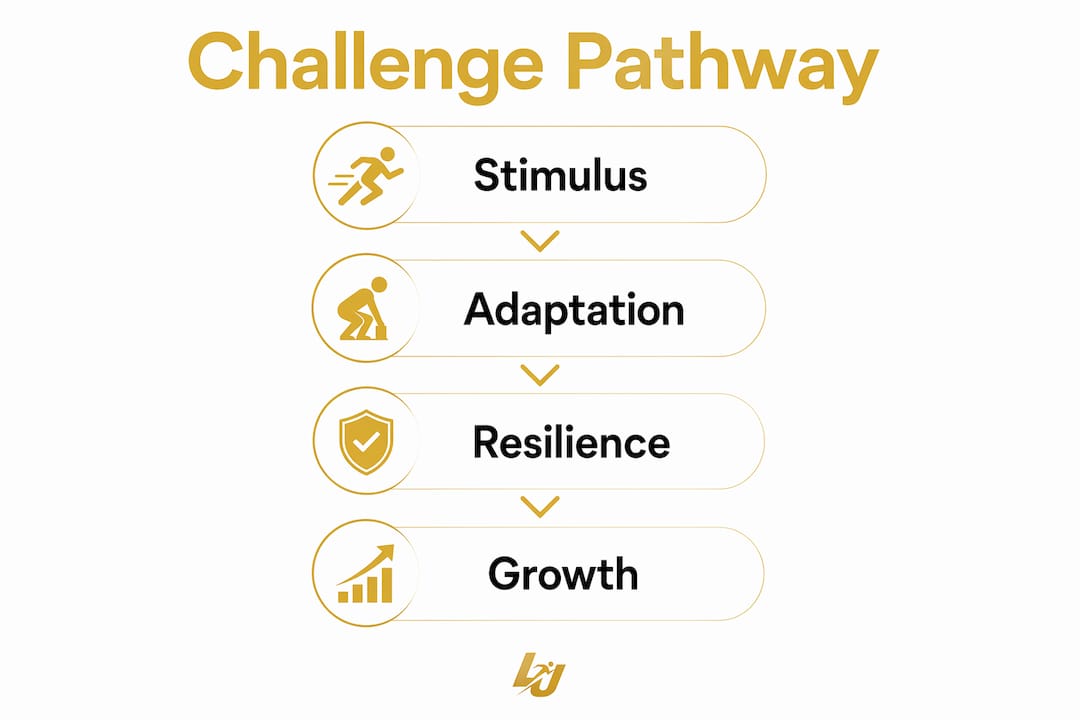
Challenges are the primary catalyst for athlete growth, not obstacles to manage around. The role of challenges in athlete growth is well established in sports psychology: adversity triggers adaptation, and adaptation builds the physical and mental qualities that separate good athletes from great ones. Dr Carol Dweck’s growth mindset research shows that athletes who view difficulty as opportunity develop faster than those who avoid it. The Minimal, Adequate, and Accurate (MAA) framework for training monitoring and stress appraisal theory both confirm that how athletes and coaches respond to challenge determines long-term outcomes. Levelup360hq is built on this principle, using XP-driven challenges and performance analytics to make adversity a structured part of development.
What is the role of challenges in athlete growth?
Challenges act as stimuli that force the body and mind to adapt. Without sufficient difficulty, athletes plateau. With the right level of challenge, they build resilience, sharpen problem-solving, and develop the confidence to perform under pressure.
The distinction between eustress (productive challenge) and distress (harmful overload) is central to this. Stress appraisal theory, developed within sports psychology, explains that the same stressor can either motivate or paralyse an athlete depending on how they interpret it. Athletes who appraise stressors as challenges use better problem-solving and show less anxiety, which directly boosts performance. That single cognitive shift, from threat to challenge, changes the physiological and psychological response entirely.
Dweck’s mindset research adds another layer. Athletes with a fixed mindset believe talent is static, so failure feels like proof of inadequacy. Athletes with a growth mindset treat failure as data. Early athletic success without embracing challenges can stagnate development when athletes hold fixed mindset beliefs, because they stop seeking difficulty once they feel competent. Coaches who understand this actively introduce challenge rather than waiting for it to arrive naturally.
How do challenges shape athletes psychologically?
The psychological benefits of adversity are specific and measurable. Athletes who regularly face and overcome difficulty develop higher self-efficacy, stronger emotional regulation, and greater tolerance for uncertainty. These are not soft skills. They are the mental qualities that determine performance when the pressure is highest.
Competitive anxiety is one of the most studied obstacles in athletic performance. The key finding is that anxiety itself is not the problem. The problem is interpreting anxiety as a sign of weakness rather than a sign of readiness. Athletes trained to reframe pre-competition nerves as activation, rather than dread, consistently perform better. This reframing is a learnable skill, not a personality trait.
Perfectionism presents a more complex picture. Adaptive perfectionism, where athletes set high standards and respond constructively to falling short, correlates with strong performance. Maladaptive perfectionism, where falling short triggers shame and avoidance, corrodes confidence over time. Coaches who distinguish between these two patterns can intervene early, redirecting the athlete’s response before it becomes entrenched.
The psychological benefits of well-managed challenges include:
- Increased self-efficacy through repeated experiences of overcoming difficulty
- Stronger emotional regulation built through practising discomfort
- Improved problem-solving from navigating novel obstacles
- Greater resilience, developed by recovering from setbacks rather than avoiding them
- Higher intrinsic motivation, as athletes connect effort to progress
Pro Tip: When an athlete describes a training session as “too hard,” ask them whether they felt threatened or challenged. The answer reveals their current appraisal style and tells you exactly where to focus the next coaching conversation.
How do physiological challenges drive adaptation?
Physical challenge is the engine of athletic development. The body adapts to stress placed upon it, a principle known as the general adaptation syndrome. The critical variable is not how hard you train. It is whether the training load is appropriate for the athlete’s current readiness.

The MAA framework, which stands for Minimal, Adequate, and Accurate, offers coaches a practical structure for training monitoring. Rather than collecting every available metric, the MAA approach focuses on the smallest set of data points that are sufficient and reliable enough to inform decisions. Excessive data and poor-quality metrics create inefficiencies and frustrate athletes, which undermines the very development the monitoring is meant to support. Less data, used well, outperforms more data, used poorly.
Travel is an underappreciated physiological challenge. Long-haul travel across three or more time zones requires approximately 1.5 days of recovery per hour of time zone difference to mitigate jet lag’s effects on performance. A team flying from London to Tokyo for a tournament faces a recovery debt that no amount of motivation can override. Coaches who ignore this are not being demanding. They are being careless.
| Physiological challenge | Impact on performance | Best management practice |
|---|---|---|
| Overtraining syndrome | Fatigue, reduced concentration, depression | Monitor load-to-recovery ratio weekly |
| Jet lag and travel fatigue | Disrupted sleep, impaired reaction time | Allow 1.5 days per time zone crossed |
| Sleep disturbance | Reduced stress tolerance, slower recovery | Prioritise sleep hygiene as a training variable |
| Poor data quality | Flawed decisions, athlete frustration | Apply the MAA framework to monitoring |
Sleep disturbances affect approximately 25% of athletes, impairing performance under stress. That figure means one in four athletes on any squad is operating with a compromised recovery system, often without either the athlete or coach realising it.
Pro Tip: Track subjective wellbeing scores alongside objective load data. A simple daily rating of sleep quality, mood, and energy takes under a minute and often catches problems that heart rate monitors miss entirely.
How can coaches use challenges to develop athletes effectively?
The most effective coaching approach treats challenge as a tool, not a by-product of training. Coaches who deliberately calibrate difficulty, rather than simply increasing volume or intensity, produce athletes who are more resilient and more adaptable over a full career.
Grit and resilience are best cultivated through phased autonomy. This means coaches should progressively shift ownership of challenges to the athlete rather than managing every variable themselves. An athlete who learns to self-regulate under difficulty becomes independent. An athlete who is always managed through difficulty becomes dependent on the coach to function.
Intentionally increasing adversity for early performers helps develop the psychological characteristics vital for long-term success, even when short-term results suffer. This is a difficult sell to parents and club administrators focused on winning now. Coaches who understand long-term athlete development hold this position anyway.
Coaches must also recognise when challenge has crossed into harm. Emotional blunting is a key warning sign. When an athlete stops caring about outcomes they previously valued, excessive training control has likely stripped them of motivation. This is not toughness. It is burnout in progress.
Practical coaching steps for challenge-based development:
- Assess each athlete’s current stress appraisal style before increasing training difficulty
- Introduce challenges progressively, starting at the edge of comfort rather than well beyond it
- Frame setbacks explicitly as learning data, not evidence of inadequacy
- Shift decision-making responsibility to athletes as their competence grows
- Monitor both physical load and psychological wellbeing weekly
- Adjust challenge intensity immediately when emotional blunting or withdrawal appears
- Use platforms like Levelup360hq to track challenge responses and development trends over time
What are the risks when challenges become harmful?
Challenge without adequate support becomes harm. The line between productive difficulty and damaging overload is real, and crossing it consistently produces outcomes that set athletes back rather than forward.
Overtraining syndrome causes fatigue, reduced appetite, depression, and decreased concentration. These are not signs of an athlete who needs to push harder. They are signs of a system under more stress than it can absorb. Coaches who misread these signals and increase load make the situation significantly worse.
Mental health risks in sport are not rare edge cases. The prevalence of anxiety, depression, and burnout among competitive athletes is higher than most sporting cultures acknowledge. Perfectionism, when it tips into the maladaptive pattern, amplifies every setback and makes recovery from failure much slower.
Parental and coaching instincts to rescue athletes from discomfort deprive them of the psychological regulation skills that only develop through facing setbacks. Removing the obstacle removes the growth opportunity. The athlete arrives at the next challenge less equipped than before.
Warning signs that challenge has become harmful:
- Persistent fatigue that does not resolve with rest
- Loss of enthusiasm for training or competition the athlete previously enjoyed
- Increased irritability or emotional withdrawal from teammates
- Declining performance despite maintained or increased training volume
- Sleep disturbances lasting more than two weeks
- Expressions of hopelessness or worthlessness connected to sport
When these signs appear, the correct response is to reduce challenge intensity, increase recovery time, and involve a sports psychologist if symptoms persist beyond two weeks.
Key takeaways
Challenges are essential to athlete development when they are calibrated correctly, monitored consistently, and framed as growth opportunities rather than threats.
| Point | Details |
|---|---|
| Challenge drives adaptation | Productive difficulty forces physical and psychological growth that comfort cannot produce. |
| Stress appraisal determines outcome | Athletes who view stressors as challenges perform better and show less anxiety than those who view them as threats. |
| The MAA framework improves monitoring | Focusing on minimal, adequate, and accurate metrics produces better coaching decisions than collecting excessive data. |
| Phased autonomy builds resilience | Progressively shifting challenge ownership to athletes develops independence and long-term grit. |
| Emotional blunting signals burnout | When athletes stop caring about outcomes they valued, challenge intensity must be reduced immediately. |
Why I think we’ve been getting challenge wrong
The instinct to protect athletes from failure is understandable. Watching someone you coach struggle is genuinely uncomfortable. But that discomfort, yours as a coach, is not a signal to intervene. It is a signal to hold steady.
The athletes I have seen develop most consistently are not the ones who were shielded from difficulty. They are the ones whose coaches trusted them to work through it. Supporting athletes means enabling them to face discomfort, not removing the obstacles that build their capacity to cope.
The research on growth mindset is not new. Dweck’s work has been in the public domain for decades. Yet sporting cultures still celebrate early talent and penalise early failure, which is precisely backwards. The athlete who fails at fifteen and learns from it is better prepared at twenty-five than the one who won everything young and never had to adapt.
My honest view is that the most important thing a coach can do is make challenge feel safe. Not easy. Safe. There is a significant difference. An athlete who trusts that failure will not end their relationship with their coach will take the risks that produce real growth. An athlete who fears judgement will play it safe every time, and playing it safe produces mediocre athletes.
— Chris
How Levelup360hq supports challenge-based athlete development
Tracking how athletes respond to challenge over time is where most programmes fall short. Good intentions and good coaching instincts are not enough without reliable data to confirm what is working.

Levelup360hq gives coaches and athletes a structured way to monitor development through XP-driven challenges, performance analytics, and tier progression. The platform’s athlete development tools make it straightforward to see whether challenge intensity is producing growth or tipping into overload. For clubs running multiple squads across football, cricket, netball, or rugby, the data sits in one place and informs decisions that would otherwise rely on guesswork. Visit Levelup360hq to see how challenge-responsive development works in practice.
FAQ
What is the role of challenges in athlete growth?
Challenges act as stimuli that force physical and psychological adaptation, building resilience, self-efficacy, and problem-solving capacity. Without sufficient difficulty, athletes plateau regardless of their natural ability.
How does a growth mindset affect how athletes respond to setbacks?
Athletes with a growth mindset treat setbacks as learning data rather than evidence of inadequacy, which means they recover faster and seek out further challenge rather than avoiding it.
What is the difference between eustress and overtraining syndrome?
Eustress is productive challenge that stimulates adaptation, while overtraining syndrome occurs when load consistently exceeds recovery capacity, producing fatigue, depression, and declining performance.
How can coaches tell when challenge has become harmful?
Emotional blunting, persistent fatigue, withdrawal from teammates, and declining performance despite maintained training volume are the clearest signs that challenge intensity needs to be reduced.
What is the MAA framework in athlete monitoring?
The MAA framework focuses on Minimal, Adequate, and Accurate metrics, giving coaches the smallest reliable data set needed to make sound training decisions without overwhelming athletes or staff.
Recommended
Turn potential into a player card.
LevelUp360 tracks every match, builds your child's player card, and shows their development over time.
Get started free