Clubs: Pilot a Sports Training Curriculum and See Results in 1 Month
Published 12 September 2026
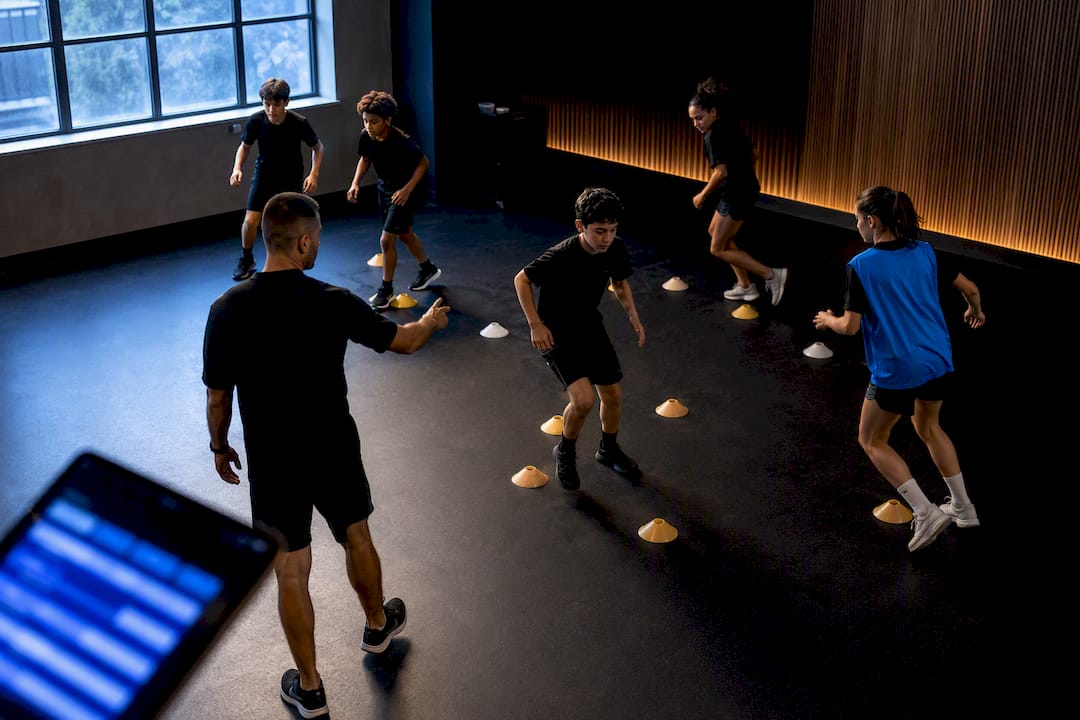
A sports training curriculum, in the sense that matters to club administrators, is the digital system that sequences a club’s syllabus, tracks every athlete’s progress, and turns coaching output into a manageable, revenue-generating programme. The practical move is not to build another set of PDFs and spreadsheets but to run that curriculum on a purpose-built platform that combines syllabus sequencing, XP and badge based progress tracking, and monetisation tools. LevelUp360HQ was built around exactly that job.
TL;DR:
- A true sports curriculum platform automates syllabus sequencing, athlete progress tracking, and monetization tools in one integrated system, eliminating reliance on spreadsheets or PDFs.
- Effective rollout should start with a single pilot squad, use gamification to build early momentum, and incorporate feedback to prevent overextension and ensure adoption.
- Participation, revenue, and admin hours saved are the key KPIs, with noticeable engagement usually appearing within one month and measurable results by six to twelve months.
- A platform that integrates membership data, payments, and store purchases into a single system reduces administrative workload and improves data accuracy across multiple sports.
- Building physical load, recovery, and mental wellbeing into tracking workflows supports athlete safety and holistic development beyond technical skills.
Table of Contents
- What is a sports training curriculum platform, really?
- How do you design a multi-sport curriculum and season plan?
- How should a club roll out a new curriculum platform?
- Which KPIs prove a curriculum platform is working?
- What integrations turn a curriculum platform into the club’s system of record?
- How do you build physical and mental health into the curriculum?
- What does safety and injury-prevention compliance actually require?
- How do you run remote or hybrid training sessions well?
- What examples show a curriculum working across different sports?
- How do you adapt one curriculum across ages and skill levels?
- Author perspective: pragmatic lessons and common trade-offs
- See a curriculum platform built for exactly this job
- Sources
- FAQ
What is a sports training curriculum platform, really?
Ask ten coaches what a “training curriculum” means and you will get ten different answers. Some picture a folder of drills. Others mean a termly syllabus with attendance sheets stapled to it. For a club or academy trying to run programmes at scale, none of that is a curriculum. It is paperwork.
A curriculum management platform treats the syllabus as a living product: sessions sequenced against outcomes, athlete progress recorded automatically, and coaches given tools instead of forms. That is the standard the rest of this guide works from, and it is worth naming clearly because so much of the search results on this topic actually cover something else entirely: exercise plans and periodised workouts for individual athletes. That is a genuinely useful subject, but it is not what a club administrator evaluating a curriculum system needs solved. What you need is syllabus management for academies, not another set of training splits.
The features that separate a real system from a glorified spreadsheet fall into a handful of categories, and most clubs discover the gaps only after they have already tried to run a season on Google Sheets.
- Syllabus and session sequencing — modules and templates that let a director build one term once and reuse it across squads, rather than rebuilding the same session plan for under-9s and under-15s from scratch.
- Progress tracking — XP-driven challenges, tier progression, badges, and live player cards that give athletes a visible, motivating record of development rather than a coach’s private notebook.
- Assessment workflows — video assessments with a defined approval chain, so a rating means something consistent across coaches rather than one adult’s private opinion.
- Coach tools — session management, approval flows, and reporting that cut the admin load rather than adding another login to check.
- Club-level tools — white-label branding, CRM, subscription management, and store integration so the curriculum sits inside the same system that runs the business.
- Analytics — reporting that connects athlete development data to attendance, retention, and revenue, not just a leaderboard nobody reads twice.
Platforms built for this exact job, including LevelUp360HQ, tend to bundle all six categories rather than making a club stitch together a scheduling app, a video tool, and a payments processor separately. Program builders that let clubs import existing spreadsheets or PDFs and start from expert templates cut migration time considerably, which matters more than it sounds when a director is staring at three years of paper records.
How do you design a multi-sport curriculum and season plan?
Most clubs get the order backwards. They pick session content first and try to justify it with outcomes later. The better approach starts at the top and works down.
- Define the season’s outcomes first. Decide what a player should be able to do by the end of the term, not just what drills you will run. This becomes the spine every module hangs off.
- Break outcomes into modules, then weekly sessions. A term might split into four modules of three to four weeks each, each with a specific technical or tactical focus.
- Map each objective to a progress marker. Attach XP thresholds, badges, or assessment checkpoints to specific sessions so progress is measured as it happens, not guessed at in December.
- Build reusable templates with role-based views. A director’s view, a coach’s view, and a parent’s view of the same season plan should show different depth, not three separate documents.
- Decide your delivery mix. Blend in-person sessions with short video modules for theory or tactical review; keeping video lessons in the 90 second to 5 minute range with a quick knowledge check afterwards keeps volunteer coaches actually finishing them.
A sample layout looks like this: Term → four Modules → three weekly Sessions each → one assessment checkpoint per module, each checkpoint tied to a badge or a live player card update. That structure turns a vague athletic training program into something a platform can actually host, schedule, and report on, rather than a binder nobody opens after week two.
How should a club roll out a new curriculum platform?
The single biggest rollout mistake is trying to launch every squad, every sport, and every feature on day one. Clubs that succeed do the opposite: they shrink the launch until it cannot fail, then grow it.
- Pick one pilot squad and one internal champion. A coach who already likes the idea will sell it to sceptical colleagues far better than a memo from the director.
- Automate onboarding. Link the platform to existing member records so athletes and parents are not asked to re-enter data they already gave the club once.
- Use gamified hooks to build early momentum. XP challenges and a visible leaderboard in the first fortnight give athletes a reason to check in without being told to.
- Train coaches specifically on the assessment workflow. This is where administrative friction actually lives, not in the session plans.
- Collect pilot feedback and adjust before scaling. One iteration on the pilot squad saves five headaches across the full club.
- Roll out in phases, sport by sport or age group by age group. Momentum compounds; a single flawless launch does not exist.
This mirrors what worked at Hammarby Fotboll, where introducing automation and short microlearning modules more than doubled coach participation, from 26% to 55%, within three months of launch.
Pro Tip: Give your pilot champion a small, visible win in week one, like a full squad leaderboard, before asking them to champion anything to the rest of the coaching staff. Enthusiasm sells better than instructions.
Which KPIs prove a curriculum platform is working?
Three numbers matter more than the rest: participation, revenue, and admin hours saved. Everything else is detail underneath those.
Track completion and attendance rates alongside coach engagement, since a curriculum that coaches ignore never reaches the athletes it was built for. On the revenue side, connect subscriptions, paid modules, store purchases, and event bookings to individual member profiles rather than tracking them as separate, disconnected income lines. On the admin side, measure hours saved on onboarding, scheduling, and season rollover, because that time reclaimed is often the number that gets a renewal signed off.
Hammarby’s coach participation rate rose from 26% to 55% in three months after a blended rollout with automation and short modules, a jump directly tied to how the programme was structured for adoption rather than to any change in content quality.
A realistic timeline: expect a pilot to show engagement signals within the first month, meaningful participation gains by three months, and measurable retention and revenue attach by six to twelve months once reporting habits and reminders are fully embedded. Clubs that architect their reporting properly around this timeline see predictable retention and attach revenue rather than a single good season followed by a slump.
What integrations turn a curriculum platform into the club’s system of record?
A curriculum tool that sits apart from your membership records and payment system just becomes one more login nobody checks. The goal is to make the platform the single place staff go for the truth about who is enrolled, who paid, and who showed up.
- Member database or CRM, so athlete records, attendance, and curriculum progress live in one place instead of three.
- Payment and subscription gateways, tied directly to member profiles so renewals and lapses are visible immediately.
- POS and store integration, so kit sales, event bookings, and private sessions attach to the same profile as training data.
- Reporting or API export, so multi-location clubs can compare programme performance across sites without manual spreadsheet consolidation.
All-in-one platforms that fold membership, payments, scheduling, and attendance into one connected system consistently cut the administrative load clubs otherwise absorb through separate tools that do not talk to each other.
How do you build physical and mental health into the curriculum?
A curriculum that only tracks technical skill is missing half the athlete. Physical readiness and mental wellbeing both belong in the same system that tracks a player’s tactical progress, not in a separate conversation that happens only after something goes wrong.
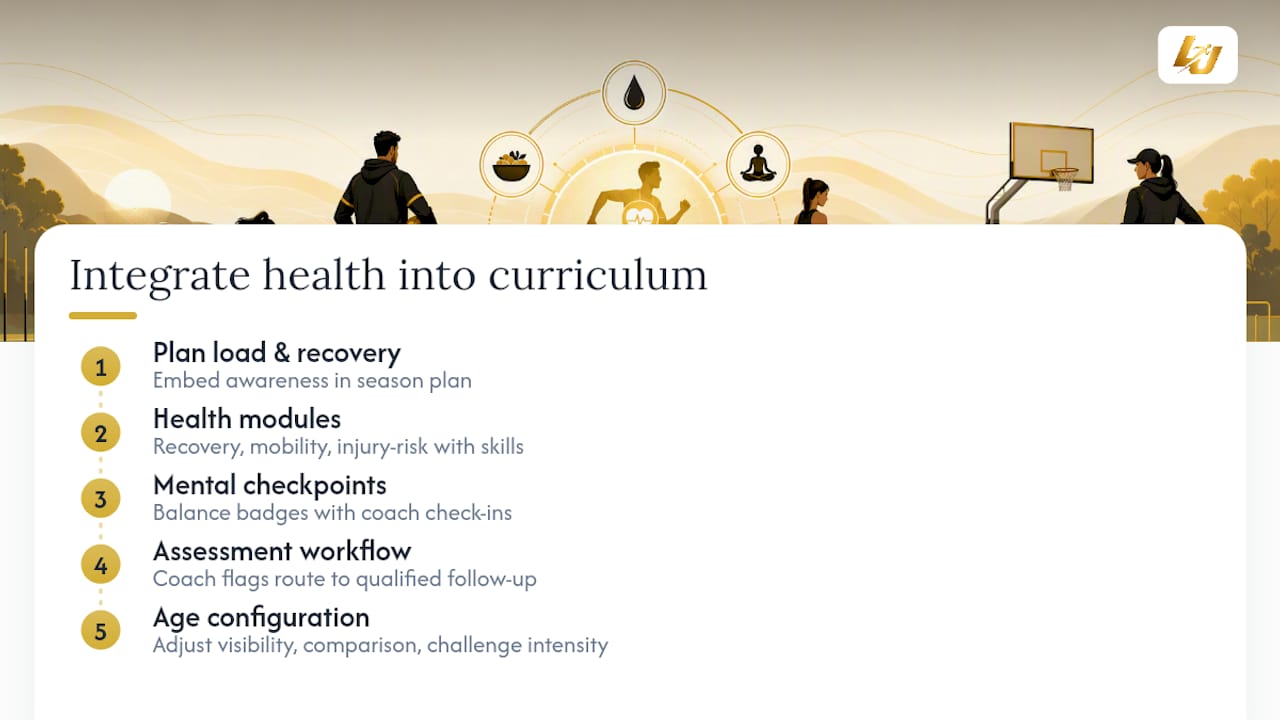
Build load and recovery awareness directly into the season plan rather than treating it as an afterthought. Modules that address recovery, mobility, and injury risk alongside skill development give coaches a fuller picture of why an athlete’s performance dips, and resources on recovery and safe training progression are a useful addition to a curriculum’s supporting content, not a replacement for medical advice.
On the mental side, build in checkpoints, not just challenges. Badge systems and leaderboards motivate, but they can also tip into unhealthy comparison for younger athletes if a club leans on them without balance. A well-run curriculum pairs the gamified layer with coach check-ins that ask how an athlete is coping, not just how many XP points they earned this week. Assessment workflows should leave room for a coach to flag a player who seems off, mentally or physically, and route that flag to someone qualified to follow up.
Age matters enormously here. A tier-progression system that motivates a sixteen-year-old competing for a first-team spot can feel like pressure to an eight-year-old who just wants to enjoy Saturday mornings. The platform itself does not decide this. How a club configures visibility, comparison, and challenge intensity by age group does, and that configuration deserves as much attention as the technical syllabus.
What does safety and injury-prevention compliance actually require?
Every curriculum decision has a safety dimension, whether or not it is written down. A platform helps most by making the safety layer visible and auditable rather than assuming a coach remembers it.
Session templates should carry load-management guidance appropriate to the sport and age group, and assessment workflows should flag when an athlete’s reported effort or attendance pattern suggests overtraining risk. This is not a substitute for qualified medical judgement. It is a way of surfacing a pattern a busy volunteer coach might otherwise miss until an injury has already happened.
Governance matters as much as the content itself. Decide, in writing, who approves a video assessment, who can override a rating, and who is notified when a red flag appears. Role-based access prevents a single untrained volunteer from signing off on something that should have gone to a head coach or a physiotherapist, and it gives the club a clear audit trail if a decision is ever questioned later.
Compliance requirements vary by sport, age category, and governing body, so a platform’s role is to support the club’s own policy rather than replace it. Keep the curriculum’s safety protocols aligned with whatever safeguarding and duty-of-care standards your sport’s national or regional governing body sets, and update session templates whenever those standards change. A curriculum platform that lets you push an updated protocol to every coach at once, rather than emailing a PDF and hoping it gets read, is doing real safety work, not just administrative tidying.
How do you run remote or hybrid training sessions well?
Not every session needs a pitch, a court, or a pool. Tactical theory, recovery education, and mental skills content translate well to remote delivery, and a hybrid model often gets more genuine engagement than forcing everything into a physical session slot that not every athlete can attend.
Short video modules work better than long lectures. Keeping remote content in the same 90 second to five minute range that worked for coach education applies just as well to athlete-facing material, paired with a quick knowledge check so the platform can confirm the content actually landed rather than assuming a video was watched.
Live player cards and XP challenges translate naturally to remote weeks. An athlete stuck at home with an injury or travel commitment can still complete a badge-linked challenge, log a self-assessment, or review a video breakdown, keeping their progression moving instead of stalling for a fortnight. Approval workflows matter more here, not less, since a coach reviewing remote submissions needs the same structured process they would use for an in-person assessment.
The practical test for any remote or hybrid tool is whether a coach can review it in the platform they already use, rather than switching between four apps to piece together one athlete’s week. A curriculum system that treats remote sessions as just another session type, rather than a separate category bolted on afterwards, keeps that experience coherent for coaches and athletes alike.
What examples show a curriculum working across different sports?
Football gives the clearest published example. Hammarby Fotboll’s academy saw coach participation jump from 26% to 55% within three months of moving to a structured, automated, microlearning based programme, proof that the structure and delivery format of a curriculum matter as much as its content.
Outside football, the same principles hold even where the sport looks completely different. A padel and pickleball club turned an on-court coaching amenity into a predictable, recurring revenue line by recruiting a champion instructor, building a club-specific content library, and offering subscription bundles rather than one-off lessons. Neither example is a training methodology in itself. Both are proof that a well-structured, well-championed rollout produces measurable results regardless of the sport on the label.
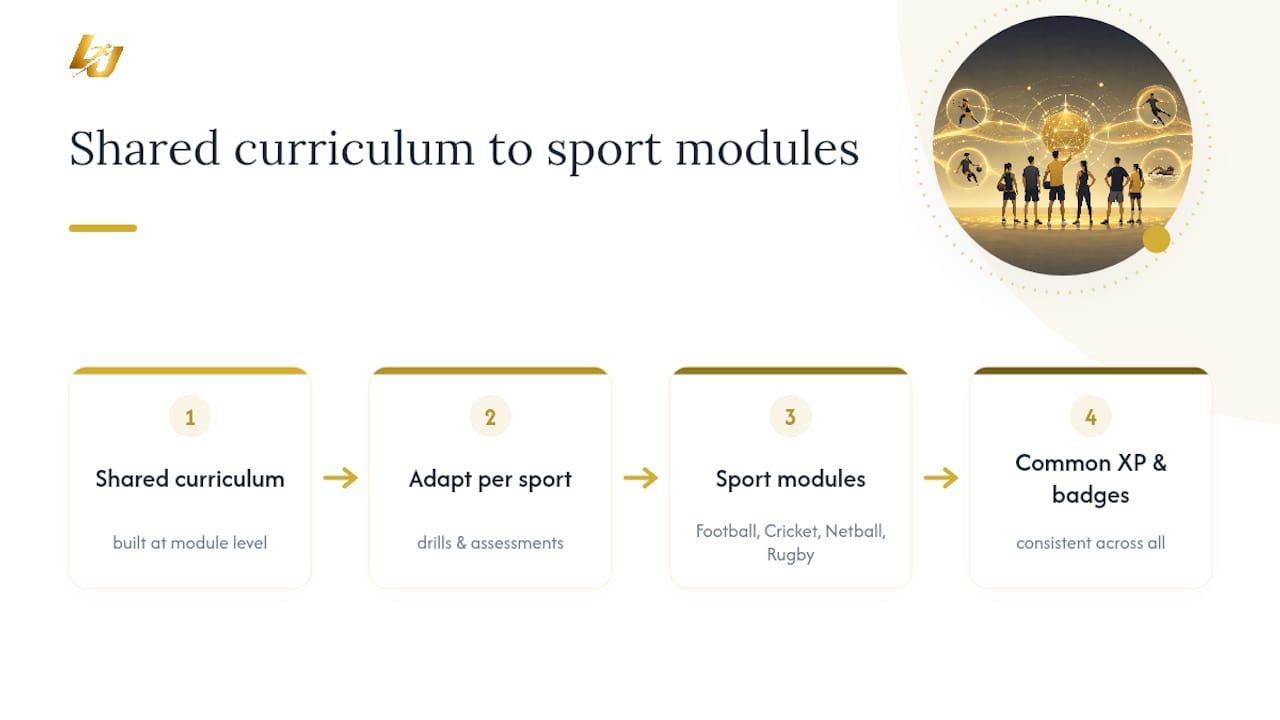
For multi-sport academies running football, cricket, netball, and rugby programmes side by side, the lesson generalises: build once at the module level, adapt the specific drills and assessment criteria per sport, and let the platform’s XP and badge logic stay consistent across all of them. Athletes moving between sports, or parents managing siblings in different programmes, get a familiar experience rather than four unrelated systems to learn.
How do you adapt one curriculum across ages and skill levels?
A curriculum built for elite under-16s and copy-pasted down to under-9s will fail both groups. The younger athletes get overwhelmed by comparison mechanics designed for competitive teenagers, and the older ones get bored by content pitched too simply.
Sports coaching strategies that work well tend to scale the gamification, not just the drills. Younger age groups benefit from participation-based badges, where showing up and trying earns recognition, rather than performance-ranked leaderboards that put an eight-year-old’s name below a more athletic teammate’s every single week. Older, competitive squads can handle tier progression and public rankings because that comparison mirrors what they will face in actual competition.
Skill level matters independently of age. A talented twelve year old training with older peers needs an assessment track calibrated to their actual ability, not their birth year, and a platform with role-based session templates makes that adjustment straightforward rather than requiring a parallel manual system. Coaches should be able to assign a different module pathway to an individual athlete without rebuilding the whole season plan around one player.
The practical rule: keep the underlying module and assessment structure consistent across the club so data stays comparable, but let visibility settings, challenge intensity, and comparison features flex by age band. A training plan for athletes at development level should look and feel different from one built for a representative squad, even when both sit on the same platform and the same season architecture underneath.
Author perspective: pragmatic lessons and common trade-offs
Most curriculum launches fail for one of two reasons: the club tries to digitise everything on day one, or coaches see the new system as extra admin rather than less. Neither failure is really about the software. It is about sequencing and buy-in.
Gamified markers earn their keep here. Badges and XP are not decoration. They give coaches an objective reference point instead of a subjective memory, which raises both completion rates and accountability across a coaching staff that is often part-time and stretched thin.
The trade-offs are real. Comparison mechanics that motivate a competitive sixteen year old can demotivate a nervous nine year old, and no platform solves that on its own. Configuration and coach judgement still decide whether gamification helps or harms a specific squad.
— Chris
See a curriculum platform built for exactly this job
A suitable curriculum platform is the alternative to running your programme across three disconnected tools: a scheduling app, a payments processor, and a folder of drills nobody updates. Such platforms give clubs and academies live player cards with real-time ratings, XP-driven challenges and tier progression, video assessments with approval workflows, and white-label branding with built-in CRM, subscription management, and store integration.
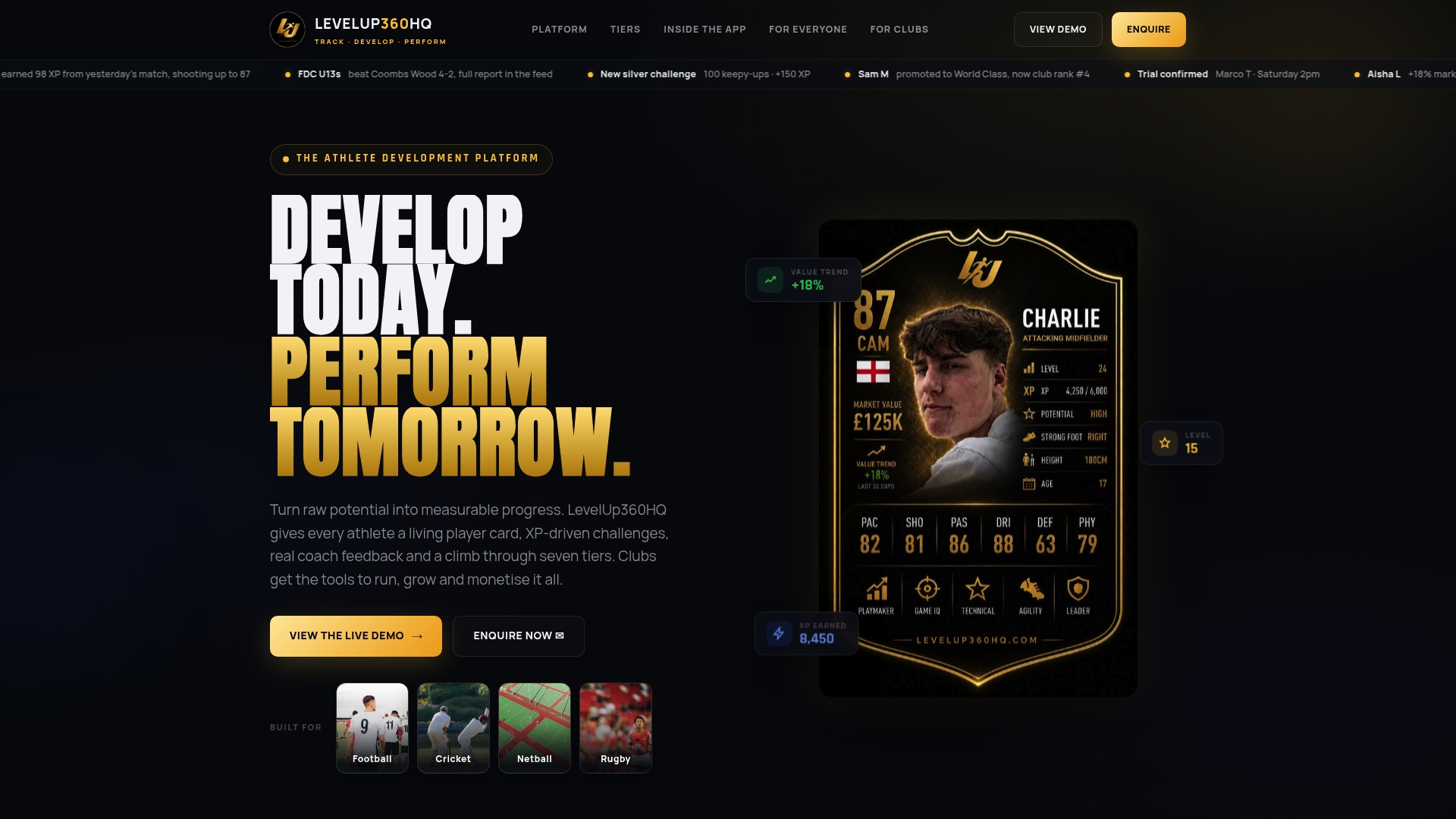
It fits multiple sports programmes side by side, which matters if your club runs more than one sport under the same roof and does not want separate systems tracking separate athlete records. A club piloting one squad, or an academy director trying to unify session management, assessments, and monetisation into one place, would benefit from a platform designed for that purpose. Take a closer look at the full platform feature set or book a walkthrough of the demo to see how a pilot rollout would actually look on your own syllabus.
Sources
- How Hammarby Fotboll reinvented their training program – and doubled participation | Learnifier
- How to architect revenue operations for a boutique… in 2027
FAQ
What is a sports training curriculum platform?
It is a digital system that sequences a club’s syllabus into modules and sessions, tracks athlete progress through XP, badges, and assessments, and connects that data to membership and revenue tools, rather than a fitness plan for an individual athlete.
How long does it take to see results from a new curriculum platform?
Engagement signals typically appear within the first month of a pilot, participation gains build by three months, and measurable retention or revenue effects tend to show between six and twelve months once reporting is fully embedded.
Do gamified features like XP and badges actually improve coach engagement?
Yes. A blended rollout with automation and short modules more than doubled coach participation at one football academy within three months, evidence that structured, gamified delivery changes adoption more than content alone.
Can one platform manage multiple sports at the same club?
Yes, platforms built for multi-sport clubs, including LevelUp360HQ, let academies run football, cricket, netball, and rugby programmes on shared module logic while adapting specific drills and assessment criteria per sport.
What should a club check before choosing a curriculum platform?
Confirm it covers syllabus sequencing, progress tracking, coach assessment workflows, and club-level tools like CRM and subscription management together, since stitching separate tools for each function usually recreates the admin burden the platform was meant to remove.
Turn potential into a player card.
LevelUp360 tracks every match, builds your child's player card, and shows their development over time.
Get started free