198 member break even: Cut churn with a sports club pricing strategy
Published 17 September 2026

Before touching a single price point, calculate your true cost per member this week.
TL;DR:
- Matching the pricing model to actual costs and capacity is essential, with tiered or value-based strategies often outperforming simple cost-plus models.
- Calculating the break-even point requires fixed costs, variable costs per member, and targeted margins, with ongoing review before every pricing adjustment.
- Annual billing significantly boosts retention rates, and structuring onboarding and renewal conversations early increases the likelihood of member renewal.
- Limiting to two or three well-defined tiers simplifies decision-making and avoids cannibalization, with prices spaced around double for the top tier.
- Testing price changes through controlled experiments on new members minimizes retention risk and reveals true revenue impact before full rollout.
Table of Contents
- Building a sports club pricing strategy: the main models compared
- How do you calculate break-even and cost per member?
- Why annual billing changes your retention numbers
- How many pricing tiers should a sports club offer?
- Demand management: off-peak and dynamic pricing tactics
- Promotions and introductory pricing that protect long-term value
- Which benchmarks actually matter for sports club pricing?
- How do you test a pricing change without wrecking retention?
- Consideration of value-added services and bundling options
- Segmentation strategies for different customer groups
- Author perspective: practical priorities while you revise pricing
- Run your pricing ladder on a platform built for it
- Sources
- FAQ
Building a sports club pricing strategy: the main models compared
Most clubs default to whatever price a competitor charges. That’s backwards. A proper sports club pricing strategy starts with matching a pricing model to your actual cost structure and capacity, then layering competitive awareness on top.
Cost-plus pricing takes your per-member cost and adds a fixed margin. It’s simple and protects your margin mathematically, but it ignores what members actually value, so it tends to underprice premium clubs and overprice budget ones.
Value-based pricing starts from what members will pay for the outcome, not the input cost. A boutique strength studio with a waiting list can charge well above its cost floor because scarcity and coaching quality drive perceived value.
Tiered “good-better-best” pricing is the industry default for good reason. Most gyms run three to four tiers and benchmark them regularly against local competitors to keep pricing aligned with perceived value. It works because members sort themselves rather than you having to guess their willingness to pay.
Drop-in and class-pack pricing suits clubs with variable attendance or seasonal demand, letting casual users pay per session without committing to a monthly plan. Credit systems (a bank of sessions redeemable across programmes) work particularly well for multi-sport academies where usage patterns vary week to week.
Dynamic or off-peak pricing flexes price by time slot rather than by member type, smoothing demand across quiet hours.
The strongest sports club pricing strategy usually blends these rather than picking one:
- A tiered core membership (entry, standard, premium) as the backbone revenue stream
- Class packs or credits layered on top for programme-specific access (swim clinics, strength blocks, youth academies)
- Drop-in pricing for walk-ins and visiting members, priced to make membership look like the obvious choice
- Off-peak discounts applied within the membership structure, not as a separate product
Match the model to your capacity constraints. A club with fixed coaching hours and limited court time benefits from tiered access control. A club with spare off-peak capacity benefits from dynamic pricing that fills dead hours rather than turning members away at busy ones.
How do you calculate break-even and cost per member?
Before setting a single price, you need three numbers: fixed costs, variable costs, and current or projected member count. Skip this step and every price you set afterwards is a guess dressed up as a strategy.
- List fixed costs — rent, salaried staff, software subscriptions, insurance, utilities. These don’t change with member count.
- List variable costs per member — coaching hours, consumables, payment processing fees, any per-athlete platform charges. These scale with headcount.
- Add them for total monthly cost. Say fixed costs run $18,000 and variable costs average $12 per member.
- Divide fixed costs by expected membership to get the fixed-cost share per member. At 300 members, that’s $60 per member.
- Add variable cost per member to the fixed-cost share: $60 plus $12 equals a $72 cost floor per member, per month.
- Set your target margin. A healthy club typically targets 25 to 35% margin above the cost floor. At 30%, your target price becomes $72 divided by 0.70, which is roughly $103 per month.
- Calculate break-even membership count by dividing total fixed costs by (price minus variable cost per member). At a $103 price and $12 variable cost, that’s $18,000 divided by $91, or about 198 members needed just to cover fixed costs.
This gives you a floor, not a ceiling. Once you know 198 members covers your overheads, everything above that is where margin, reinvestment, and owner profit actually live. Run this calculation before every price review, not just once a year.
Why annual billing changes your retention numbers
Members on annual contracts keep their membership at roughly 82% after twelve months. Monthly payers retain at just 35% over the same period. That single statistic from an analysis of over 44,000 memberships across 44 states should reshape how you structure your entire pricing ladder. Annual billing isn’t just a cashflow convenience. It fundamentally changes member behaviour because the sunk cost of an upfront payment keeps people showing up.
Price the annual option at a modest discount against twelve months of monthly payments. Some operator guides push further, treating annual as the primary product and pricing monthly at a higher premium instead of a discount, which reframes the entire conversation around flexibility rather than savings.
Uptake on annual plans rarely happens by accident. It needs to be the plan your front desk and sales staff present first, not an afterthought mentioned at checkout.
Protect the annual cohort with a structured onboarding sequence:
- A 30-day check-in confirming the member has attended and understands the programming available to them
- A 90-day usage review flagging anyone below expected visit frequency for a coach or staff nudge
- Milestone messages tied to programme progress, not just generic “we miss you” emails
- A renewal conversation that starts at month ten, not month twelve, giving lapsed engagement time to recover
Onboarding that secures usage in the first 90 days matters more for annual members than for anyone else, because a disengaged annual member who doesn’t renew has cost you a full year of goodwill, not just a month’s fee.
How many pricing tiers should a sports club offer?
Two to three tiers, not four or five. Every additional tier adds decision fatigue at the point of sale and dilutes the clarity that makes tiered pricing work in the first place.
The data on tier structure points toward what’s sometimes called a barbell pattern: a strong, genuinely useful entry tier and a clear, aspirational premium tier, with the middle tier often underperforming both. A simple barbell ladder frequently beats a crowded three-tier structure because members either want the basics or want everything, and the middle option ends up cannibalising sign-ups from both ends rather than adding incremental revenue.
Map features deliberately rather than by gut feel:
- Entry tier: facility access, standard class schedule, basic booking
- Mid tier (if you keep one): entry features plus priority booking, guest passes, a set number of coaching sessions
- Premium tier: unlimited coaching access, priority everything, added perks like recovery amenities or nutrition consultations
Price spacing matters as much as feature spacing. A common pattern puts the top tier at roughly double the entry tier, with clear, tangible reasons for the jump rather than a vague “premium” label.
Redirect those features into your top tier and simplify the choice down to two.
Demand management: off-peak and dynamic pricing tactics
Off-peak pricing shifts utilisation from congested hours into quiet ones by charging less for access during predictable low-demand windows, typically weekday mid-mornings or early afternoons. A differential of 15 to 20% off standard pricing for off-peak-only access is common and large enough to actually change behaviour, rather than being a token discount nobody notices.
Making this work operationally requires more than a price tag. You need:
- Access control systems that can actually enforce time-restricted membership tiers
- A booking system that flags off-peak slots clearly so members know when their access applies
- Reporting that tracks utilisation by hour, not just by day, so you can see whether the pricing is actually shifting demand
The biggest risk with dynamic or off-peak pricing isn’t the mechanics. It’s member confusion. If someone on an off-peak plan gets turned away or charged a penalty because they misjudged the cutoff time, you’ve turned a smart pricing tactic into a complaint. Set generous grace windows, communicate the exact hours in writing at sign-up, and avoid surge-style pricing that changes without warning. Off-peak works best as a fixed, predictable discount, not a fluctuating rate.
Promotions and introductory pricing that protect long-term value
The biggest promotional mistake clubs make is discounting without an end date. An open-ended discount doesn’t create urgency, and it trains new joiners to expect a permanently lower price, which quietly erodes your long-term value proposition.
Use trial windows of 7 to 30 days with a clear, dated conversion point. A 14-day trial that automatically prompts a membership conversation on day 12 outperforms an indefinite “try before you buy” offer because it forces a decision.
- Set a hard end date on every introductory price and state it explicitly in the offer copy
- Build a defined conversion path: what happens, and what the member pays, the day the trial ends
- Track cohort retention against your baseline cohort, not just sign-up volume, to see whether the promotion is bringing in members who stick around
- Treat a promotion with strong sign-ups but weak 90-day retention as a warning sign, not a win
Which benchmarks actually matter for sports club pricing?
National averages are close to useless for setting your own price. The median new-member price among analysed facilities climbed to $150 per month in the most recent data, but that figure hides enormous regional variation, and same-facility prices typically change by close to 0% year over year once a club finds its local level according to Baseline’s facility membership analysis.
Benchmark by metro area and by club type, not by national figures. Median dues vary meaningfully between multi-purpose clubs and fitness-only facilities, so a boutique studio comparing itself to a big-box multi-purpose club’s dues is comparing the wrong number entirely, a distinction IHRSA’s pricing guide makes explicit.
Track these KPIs against your local competitive set, not the national figure:
- Median price by plan style (entry, mid, premium) among comparable clubs in your metro
- Annual plan uptake rate as a share of total memberships
- Churn segmented by billing cadence, not blended into a single average
How do you test a pricing change without wrecking retention?
Never roll a price change out to your entire membership base at once. Run it as a controlled experiment first.
- Pick a test design. A phased roll-out (new joiners only, for 60 to 90 days) is lower-risk than an A/B split across existing members, though matched-cohort testing across similar locations works well for multi-site operators.
- Track primary metrics: new joins, cancellation rate, and payment failures during the test window.
- Track secondary metrics: average lifetime value of the test cohort against your existing baseline.
- Calculate your break-even churn threshold before you commit. If you’re raising price by 10%, you can afford roughly a 9% increase in churn and still come out ahead on revenue; anything beyond that erases the gain.
Conjoint surveys and pricing simulation models reduce the guesswork considerably here. One pricing simulation case study found that removing a joining fee altogether improved conversion enough to project a net revenue gain, a result the club would never have found without modelling the trade-off first.
Pro Tip: Run your test on new joiners only whenever possible. Existing members notice price changes; new joiners just see the price you’re currently offering.
Consideration of value-added services and bundling options
Bundling is where most clubs leave money on the table without realising it. A membership priced purely on facility access misses the revenue sitting in adjacent services members already want: personal training blocks, nutrition consultations, recovery services, retail, and event access.

The mechanics matter more than the concept. Bundle a fixed number of PT sessions into your premium tier rather than an unlimited allocation, because unlimited access to a labour-intensive service is one of the fastest ways to destroy your margin math from the earlier break-even calculation.
Store and retail integration adds a lower-effort revenue line. Kit, supplements, and branded merchandise sold through the same platform members already use for bookings convert better than a separate standalone shop, simply because the friction of a second login or a second payment method disappears.
Event and programme bundling works particularly well for multi-sport clubs and academies. A parent paying for a child’s core coaching programme is a much easier upsell for a holiday camp or a one-off skills clinic than a cold lead would be, because the trust and payment relationship already exist. Treat these as genuine bundle components in your pricing ladder, not as separate transactions bolted on afterwards.
Segmentation strategies for different customer groups
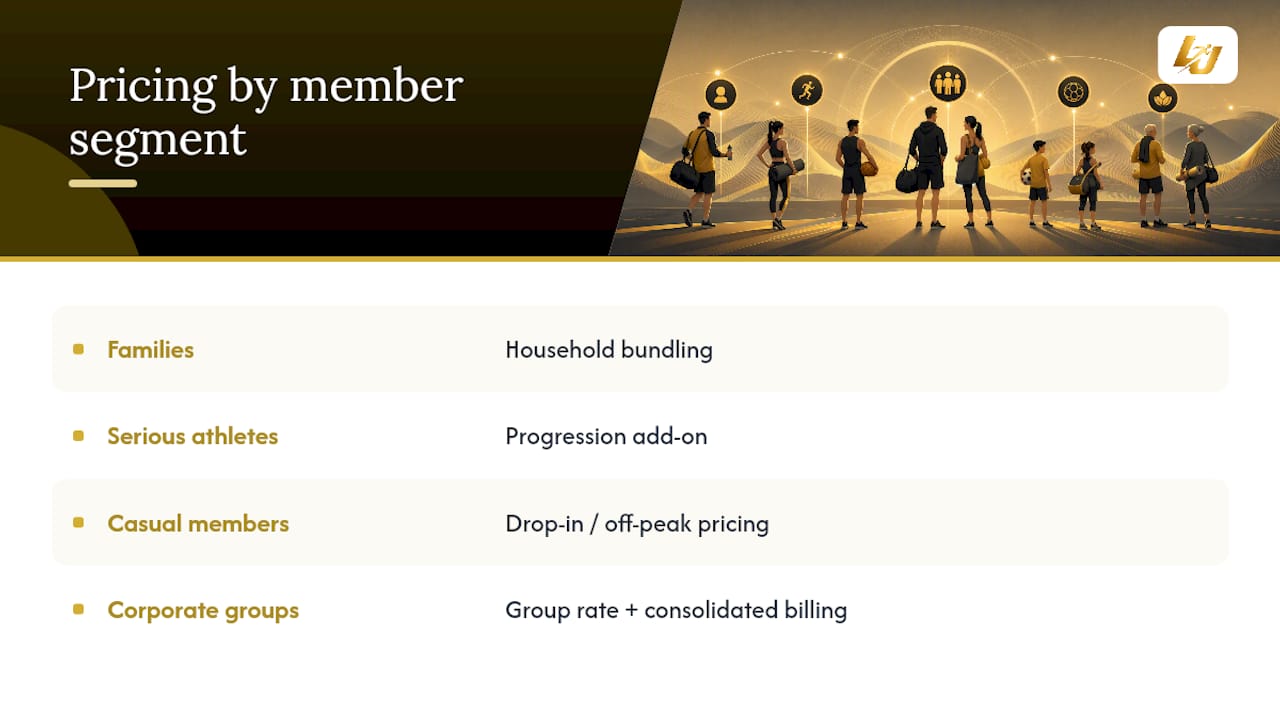
Not every member wants the same thing, and pricing that treats them identically leaves both revenue and retention on the table. Segmenting by need, not just by demographic, is what separates a pricing ladder that converts from one that just sits on a price list.
Families respond to household bundling: a discount for a second or third family member on the same plan, rather than three separate full-price memberships. This often lifts total household spend even at a discounted per-head rate, because it removes the friction of justifying multiple full-price sign-ups.
Serious athletes and competitive programme members will pay a premium for structured progression: access to advanced coaching tiers, performance tracking, and competition preparation. Price this as a distinct add-on or top tier rather than folding it into general premium access, because this group’s willingness to pay is tied specifically to development, not facility perks.
Casual and social members are price-sensitive and attendance-light. Drop-in and off-peak pricing suits this group far better than a full membership they’ll rarely use to capacity, and locking them into a standard tier they don’t fully use is a common cause of early cancellation.
Corporate and group members typically want simplicity and a single invoice more than a discount. A modest group rate with consolidated billing often converts better than a steep per-head discount, because the administrative simplicity is the actual value driver, not the price.
Author perspective: practical priorities while you revise pricing
Three things matter more than the price number itself: covering your real cost floor, onboarding new members properly, and testing before you commit. The mistake I see most often is open-ended discounting that fills a roster with low-lifetime-value joiners who were never going to renew at full price anyway. Every dollar you gain from a price increase should get reinvested into programming and onboarding that makes the higher price feel earned, not imposed.
— Chris
Run your pricing ladder on a platform built for it
Levelup360hq gives clubs the mechanics this article just walked through, without building a billing and tier system from scratch. Annual versus monthly cadences, tiered access, onboarding nudges, and store integration all live in one place instead of being stitched together across three separate tools.

The platform’s Pro plan runs at $49 per month, with an active athlete platform fee of $1.50 per month per athlete on top, so a club can price its own tiers and promotions on top of a predictable cost base rather than guessing at software overhead. White-label branding means members see your club’s identity, not a third-party tool, while the CRM and subscription management handle the annual-cohort onboarding and renewal timing covered above. For clubs running multiple sports or academies, the same system manages tier structures and monetisation across football, cricket, netball, and rugby programmes without separate platforms for each.
If you’re ready to see how the billing and tier tools map onto your own pricing ladder, book a demo and walk through your specific membership structure with the team.
Sources
- The State of Sports Facility Memberships (2026 Report) | Baseline
- Gym Membership Pricing Strategies for Profit - GymMaster
- Optimizing membership structure for a fitness club (Iris Pricing Solutions case study)
FAQ
What are the five main pricing strategies for a sports club?
The five most common approaches are cost-plus, value-based, tiered “good-better-best,” drop-in or package pricing, and dynamic or off-peak pricing, often blended together rather than used alone.
What are the 5 C’s of pricing?
Definitions vary across industries, but a common version covers cost, customers, competitors, channels, and context, all factors worth weighing before setting a final price on your ladder.
Is $70 a month a lot for a gym membership?
It depends entirely on your local market and club type. Median new-member pricing recently reached $150 per month among analysed facilities. Budget or fitness-only clubs in lower-cost metros can price well under that.
How much does Levelup360hq cost for a club?
The Pro plan is $49 per month, plus an active athlete platform fee of $1.50 per month per active athlete; revenue share terms are available on request.
How often should a club review its pricing?
Review pricing at least annually, but benchmark continuously, since same-facility prices tend to shift very little year over year once a club has found its correct local level.
Turn potential into a player card.
LevelUp360 tracks every match, builds your child's player card, and shows their development over time.
Get started free