Role of rating systems in coaching decisions
Published 14 July 2026

Rating systems are defined as structured frameworks that assign quantifiable scores to athlete performance, behaviour, and competency, giving coaches a measurable base for selection and development choices. The role of rating systems in coaching decisions has grown significantly as sports management professionals seek to reduce bias and improve consistency across evaluations. Subjective coach assessments remain the primary predictor in player selection, with predictive accuracy reaching Nagelkerke R² = 0.70 in research on 3×3 basketball. That figure confirms the coach’s eye is powerful, but it also shows why structured rating frameworks are needed to validate and support it. Platforms like Levelup360hq now embed performance analytics directly into coaching workflows, making this hybrid approach accessible across football, cricket, netball, and rugby.
How do rating systems complement the coach’s subjective evaluations?
Rating systems do not replace the coach’s judgement. They provide a quantifiable layer that validates, challenges, or refines it. The field of talent identification is shifting towards hybrid evaluation models where objective data sits alongside the coach’s eye rather than competing with it.
The core problem with relying solely on subjective assessment is variability. Interrater reliability among coaches sits at an ICC of 0.38 for female evaluators and 0.51 for male evaluators. That range means two coaches watching the same athlete can reach meaningfully different conclusions. Rating systems create a shared reference point that narrows that gap.

Hybrid approaches combine the best of both methods. Statistical models such as logistic regression and FFTrees show how quantitative ratings and subjective cues work together to improve selection accuracy. FFTrees, for instance, use fewer data cues than logistic regression but achieve comparable accuracy at 84% versus 84.8%. That near-identical performance with less information makes FFTrees particularly useful when coaches must decide quickly under pressure.
Practical benefits of combining ratings with subjective assessment include:
- Reduced individual bias by anchoring evaluations to shared criteria
- Faster consensus among coaching panels reviewing the same athlete
- Clearer audit trails for selection decisions, which supports athlete trust
- Quantifiable evidence that coaching programmes are producing measurable change
Pro Tip: When introducing a rating system to your coaching panel, run a calibration session first. Have each coach rate the same athlete independently, then compare scores. The gaps reveal where your criteria need tightening before ratings go live.
What challenges and limitations exist in using rating systems?
Rating systems carry real risks when poorly designed or left unaudited. The most serious is bias. Algorithms that promote high ratings can inadvertently reduce opportunities for marginalised groups, particularly when the historical data used to build those systems already reflects unequal treatment. Designing a system to look objective does not make it fair.
Low interrater reliability compounds this problem. When coaches apply the same rating criteria differently, the system produces inconsistent outputs regardless of how well the criteria were written. Uniform criteria and team-based decision-making among coaches are the most direct remedy. Without them, a rating system adds process without adding accuracy.
Over-reliance on data alone creates a different failure mode. Coaches who abandon subjective judgement entirely miss intangibles such as character, tactical intelligence, and resilience under pressure. The optimal approach uses objective data as a base layer to correct biases, while final judgements still hinge on the coach’s appraisal of those harder-to-quantify qualities.
“Ranking and rating systems must be audited regularly to prevent indirect perpetuation of discrimination, even when designed to be objective. A system that was fair at launch can drift as the athlete population or competitive context changes.”
Key challenges coaches and sports managers should address:
- Bias and fairness: Audit rating criteria at least annually against demographic outcomes
- Reliability gaps: Use multi-coach panels and calibration sessions to align scoring
- Data-only decisions: Treat ratings as a base layer, not a final verdict
- Transparency: Communicate rating criteria to athletes so the process feels fair and motivating
Which coaching performance metrics are most effective in rating systems?
Effective coaching measurement goes well beyond attendance logs and satisfaction scores. Tracking competency growth shows an average improvement of 23% in targeted skills when programmes measure it directly. That figure gives coaches and sports managers concrete evidence that their methods are working.
The most useful metrics fall into two categories: leading indicators and lagging indicators. Leading indicators measure activity and engagement in real time. Lagging indicators measure outcomes after the fact. Balanced scorecards combining both types improve sponsor confidence and support funding renewals. Coaches who rely only on one type risk either losing credibility with stakeholders or failing to catch performance problems early enough to act.
| Metric type | Examples | What it tells you |
|---|---|---|
| Leading indicators | Session attendance, drill completion, engagement scores | Whether athletes are participating and progressing week to week |
| Lagging indicators | Team retention, promotion readiness, ROI | Whether coaching investment is producing real-world outcomes |
| Competency growth | Skill assessment scores over time | Whether targeted development is working at the individual level |
| Behavioural application | 360 feedback, manager observations | Whether athletes are applying new skills outside structured sessions |
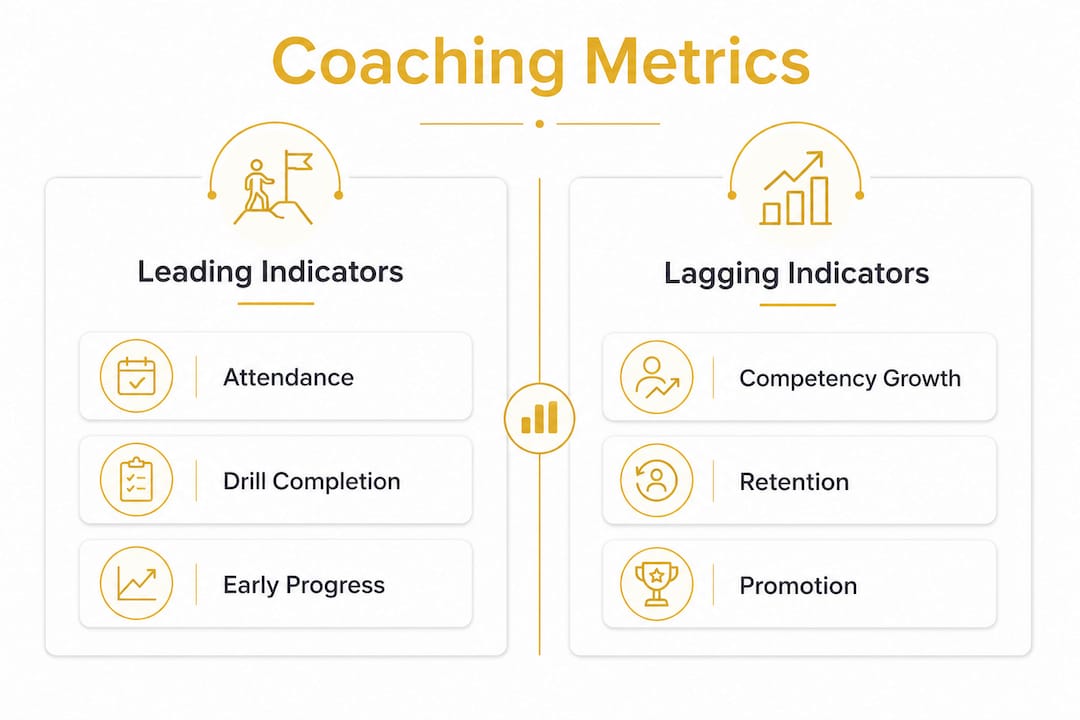
Assessment cadence matters as much as metric selection. A competency score measured once per season tells you very little. The same score measured monthly reveals whether a development plan is working or needs adjustment. Kirkpatrick and Phillips ROI frameworks provide a structured, layered approach to coaching evaluation that proves real-world impact at each stage of the programme.
Pro Tip: Set your assessment cadence before the season starts, not after. Monthly competency checks paired with end-of-season lagging indicators give you both the early warning signals and the proof of impact that stakeholders need.
How can coaches effectively integrate rating systems into decision-making?
Integration works best when rating systems are treated as infrastructure, not as a one-off tool. The goal is to build a consistent process that coaches follow regardless of who is in the room or how much time pressure exists. Neural networks and hybrid decision support systems outperform manual ranking under pressure and limited information, which is precisely the condition most coaches face during selection periods.
A practical integration process follows five steps:
- Establish shared criteria. Define what each rating dimension measures and how scores are assigned. Ambiguous criteria produce unreliable ratings regardless of the technology behind them.
- Use multiple evaluators. Sole reliance on a single coach’s subjective rating is risky given low interrater reliability. Two or three coaches rating independently, then reaching consensus, produces far more reliable outputs.
- Weight your metrics deliberately. Not all performance dimensions carry equal importance. A winger’s speed rating should carry different weight than a goalkeeper’s positioning score. Build that weighting into the system explicitly.
- Adopt decision support tools. FFTrees and logistic regression models are accessible starting points. Platforms like Levelup360hq embed these principles into FIFA-style player cards with real-time ratings, making the process visible and motivating for athletes as well as coaches.
- Audit regularly. Rating criteria drift. Competitive contexts change. An annual review of your criteria against actual outcomes keeps the system fair and relevant.
Pro Tip: Run a retrospective audit after each selection cycle. Compare your rating-based predictions against actual athlete performance over the following three months. The gaps between prediction and outcome are your most valuable data for improving the system.
Key takeaways
Rating systems improve coaching decisions most when they combine objective data with the coach’s subjective judgement, not when they replace it.
| Point | Details |
|---|---|
| Hybrid evaluation is the standard | Combine rating systems with coach intuition; neither alone produces reliable decisions. |
| Interrater reliability is a real problem | ICC scores of 0.38–0.51 show coaches vary widely; shared criteria and panels reduce this gap. |
| Track leading and lagging metrics | Attendance alone does not prove impact; competency growth and retention data complete the picture. |
| Audit for bias regularly | Rating systems can perpetuate discrimination if left unchecked; annual audits are non-negotiable. |
| Assessment cadence drives insight | Monthly competency checks reveal whether development plans are working before it is too late to adjust. |
Why I think most coaches are using rating systems the wrong way
The most common mistake I see is coaches treating a rating system as a verdict rather than a prompt. A score comes out of the platform, and the decision follows automatically. That is not how these tools were designed to work, and the research backs this up clearly.
The coach’s eye still carries the highest predictive weight in selection decisions. What rating systems do brilliantly is surface the blind spots that subjective assessment misses, particularly when multiple coaches are evaluating the same athlete and reaching different conclusions. That disagreement is not a problem to hide. It is the most useful signal in the room.
The coaches I respect most use ratings to start a conversation, not end one. They look at a low score on tactical awareness and ask why, rather than simply moving the athlete down the list. That question, prompted by the data, is where real development happens.
The other thing I would push back on is the idea that more data automatically means better decisions. A system tracking 40 metrics produces noise as much as signal. The coaches who get the most from rating systems are the ones who have chosen five or six metrics that genuinely reflect what they value, weighted them deliberately, and stuck to them long enough to see patterns emerge.
Levelup360hq’s approach of embedding ratings into live player cards is interesting precisely because it makes the data visible to athletes as well as coaches. That transparency changes the dynamic. Athletes who can see their own ratings are more likely to engage with the development process, which means the data improves over time as athletes take ownership of it.
— Chris
Levelup360hq gives coaches the tools to rate, track, and decide with confidence
Coaching decisions deserve better than gut feel alone, and they deserve better than raw numbers without context. Levelup360hq brings both together in one place.

The platform gives coaches FIFA-style player cards with real-time ratings, XP-driven challenges, and performance analytics that track competency growth across football, cricket, netball, and rugby. Video assessments, approval workflows, and session management tools sit alongside the rating engine, so coaches can move from observation to decision without switching between systems. For sports managers, the white-label CRM and subscription tools mean the whole club benefits from structured, transparent evaluation. Explore the platform to see how rating systems can work within your coaching process, or view the demo to see the tools in action.
FAQ
What is the role of rating systems in coaching decisions?
Rating systems provide a structured, quantifiable base layer that supports and validates the coach’s subjective judgement. They improve consistency, reduce individual bias, and create transparent audit trails for selection and development decisions.
How do rating systems affect interrater reliability among coaches?
Without shared rating criteria, interrater reliability among coaches sits at an ICC of 0.38–0.51, meaning significant variability exists. Structured rating systems with calibrated criteria and multi-coach panels reduce that variability considerably.
What coaching performance metrics should a rating system track?
Effective systems track competency growth, behavioural application, team retention, and promotion readiness alongside leading indicators like session attendance. Competency growth averages 23% improvement when programmes measure it directly.
Can rating systems introduce bias into coaching decisions?
Yes. Algorithms that promote high ratings can reduce opportunities for marginalised groups if the underlying criteria or historical data reflect existing inequalities. Regular auditing of rating criteria against demographic outcomes is the primary safeguard.
How often should coaches review their rating system criteria?
An annual review is the minimum standard. Coaches should also run a retrospective audit after each selection cycle, comparing rating-based predictions against actual athlete performance to identify where the criteria need updating.
Recommended
Turn potential into a player card.
LevelUp360 tracks every match, builds your child's player card, and shows their development over time.
Get started free