Digital tools in club administration: what you need to know
Published 1 August 2026

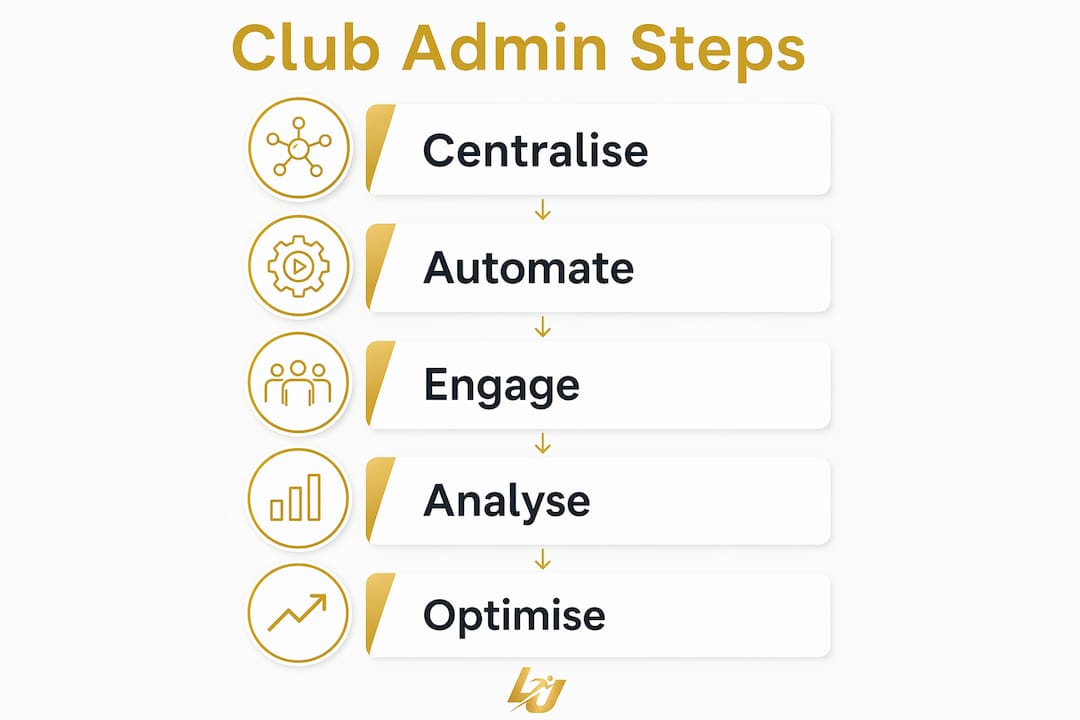
Digital tools centralise member and financial data, automate routine admin, and surface the KPIs your committee actually needs to make decisions. The single most practical first step is to get member records and online payments into one system before adding anything else.
That one move alone recovers volunteer hours, reduces overdue fees, and gives you a real-time view of who has renewed and who has not. The role of digital tools in club administration goes well beyond convenience. Done right, they are the difference between a committee that spends its evenings chasing spreadsheets and one that spends them running the club.
Start with membership centralisation and online payments. Add events, communications, and coaching modules once those two are stable. That phased approach is what separates clubs that sustain adoption from those that revert to Excel after six months.
Table of Contents
- Why digital tools matter for UK sports clubs
- Core modules to prioritise in your club management software
- Why an integrated system beats a patchwork of tools
- How to choose and implement a digital solution: a UK checklist
- Typical costs, timelines, and how to build a simple ROI case
- Overcoming resistance: volunteer buy-in and the digital steward approach
- How Levelup360hq maps to club administration needs
- Where club administration is heading: analytics and AI
- Key takeaways
- What implementing digital systems in clubs actually teaches you
- Start your Levelup360hq pilot: a practical 30/60/90-day outline
- Further reading and authoritative sources
Why digital tools matter for UK sports clubs
The efficiency case is straightforward. Volunteer administrators typically spend significant hours per month on administrative tasks. Online registration and automated payments can cut that significantly, freeing committee members to focus on the club itself rather than chasing renewals.
Member expectations have shifted too. People now expect to register online, pay by card, and receive clear communications. A club still relying on paper forms and bank transfers creates friction at the very first touchpoint.
Stat to know: Academic research on voluntary sports clubs found that 93.7% already use digital tools for internal and external communication, yet fragmented systems and inconsistent strategies remain the norm. The gap is not adoption — it is integration.
GDPR compliance is a practical concern that digital tools address directly. Storing member data in a compliant, audited system with clear consent records is far easier than managing a patchwork of spreadsheets and email threads. Under UK GDPR, clubs are data controllers and bear responsibility for how member data is held and processed. A purpose-built platform with audit trails and data-export capability makes demonstrating compliance straightforward.
The retention and revenue argument is equally concrete. Automated payment reminders reduce overdue fees. Integrated event booking increases uptake. Better communication keeps members engaged. These are not abstract benefits; they show up in your end-of-year accounts.
Core modules to prioritise in your club management software
Not all modules deliver equal value on day one. Here is what each does in practice and what it replaces.
| Module | What it replaces | Immediate time saving |
|---|---|---|
| Membership database | Multiple Excel files, paper forms | Eliminates duplicate entry; renewal flags surface automatically |
| Payments and accounting | Manual bank reconciliation, chasing emails | Automated receipts, real-time payment status, accounting journal entries |
| Event and bookings | Email threads, manual capacity tracking | Auto-confirmations, waitlists, capacity rules |
| Communication | WhatsApp groups, BCC email chains | Segmented sends, templates, full audit history |
| Coaching and performance | Paper registers, separate apps | Session plans, attendance, player records in one place |
| Retail and ticketing | Cash sales, separate payment links | Integrated store, transactional records tied to member profiles |

The benefits of digital administration become most visible when these modules share a single database. A member who updates their contact details does not need to be updated in three separate places. A payment recorded against a membership record flows automatically into the accounting view.
Pro Tip: Start with membership and payments only. Get those two working cleanly before touching events or communications. Clubs that try to roll out everything at once almost always stall.
Coaching and performance tracking is worth prioritising earlier than most clubs expect, particularly for academies and development programmes. Session attendance, player records, and simple progression notes are far easier to manage digitally, and the data becomes genuinely useful once you have a few months of it.
Why an integrated system beats a patchwork of tools
The hidden cost of fragmented tools is the manual labour of re-keying data across systems. A treasurer who exports a membership list from one tool, pastes it into a payment tracker, and then manually updates a communications platform is not just wasting time. They are introducing errors at every transfer point.
Moving data out of isolated spreadsheets into a single system is the most significant operational hurdle for most clubs. The target state is simple: enter once, use everywhere. A member joins, their payment is recorded, they are assigned to the correct communication subgroup, and their event eligibility is checked — all without a second manual step.
Stat to note: Research confirms that integrated platforms prioritise one login, one support contact, and a single data location. That reliability consistently outweighs having the “best” standalone feature for each individual function.
The KPIs that matter most in the first six months are:
- Member growth rate — are renewals tracking ahead of last year?
- Payment collection rate — what percentage of members are current?
- Attendance rate — which sessions or events are under-attended?
- Churn probability — which members have not engaged in 60+ days?
These figures are invisible in a spreadsheet-based setup. In an integrated system, they surface on a dashboard without anyone having to calculate them. That shift, from reactive to informed, is what real-time KPI visibility actually means in practice.

How to choose and implement a digital solution: a UK checklist
Before you shortlist any platform, work through these steps with your committee.
Must-have features (non-negotiable)
- UK GDPR compliance with clear data residency (UK or EU hosting, documented data processing agreements)
- Online member registration and self-service renewal
- Integrated online payments with automated receipts
- Data export in a standard format (CSV or Excel) — you must be able to leave
- Role-based access so coaches, treasurers, and administrators each see only what they need
Assessment steps
- Run a structured demo using your own club’s scenarios, not the vendor’s prepared examples
- Ask for two or three reference contacts at clubs of similar size and sport type
- Test data migration: import a sample of your existing member list and check what survives the transfer
- Confirm support hours and response times in writing — volunteer-run clubs often need help outside business hours
Red flags
- Opaque or usage-based pricing with no clear ceiling
- No data export or export locked behind a paid tier
- Servers hosted outside the UK or EU with no documented data safeguards
- A single point of contact who is also the only person who knows the system
Pilot approach
- Run a four-to-six week pilot with one team or one membership category before full rollout
- Define success metrics in advance: time saved on renewals, payment collection rate, volunteer hours on admin
A phased, modular adoption approach — membership first, then payments, then engagement — reduces risk and increases the likelihood of sustained adoption. Clubs that attempt a full replacement in one go typically face resistance and partial rollback.
Typical costs, timelines, and how to build a simple ROI case
Pricing models vary, but most platforms follow one of three shapes: a flat monthly club subscription, a per-member fee (typically pence per member per month), or a transaction fee on payments processed. Many combine two of these.
| Phase | Timeline | What happens |
|---|---|---|
| Quick start | Month 1 | Import existing member list, activate online registration and payments, set up basic communication groups |
| Pilot | Months 1–3 | One team or membership category live; measure time saved, payment collection rate, error rate |
| Full rollout | Months 3–9 | All modules active, all members migrated, coaching and events integrated |
A worked ROI example
Take a club with 150 members and two volunteer administrators each spending ten hours per month on admin. If digital tools recover five hours per administrator per month, that is ten volunteer hours returned monthly. At a conservative opportunity cost of £15 per hour, that is £150 per month in recovered capacity, or £1,800 per year.
Add improved payment collection. If 15% of members were previously late or non-paying and automated reminders recover even half of those, on a £60 annual subscription that is an additional £675 per year in collected fees. The combined figure of roughly £2,475 per year comfortably justifies a platform costing £30–£60 per month.
On VAT: most club management software is a standard-rated supply. If your club is VAT-registered, input tax recovery applies. If not, the subscription cost is the full cost. Some clubs access grant funding through Sport England or local authority sports development budgets to offset first-year costs — worth checking before you commit.
Overcoming resistance: volunteer buy-in and the digital steward approach
Culture, not technology, is the usual blocker. A platform can be well-designed and fairly priced, yet fail entirely if the people who need to use it do not trust it or understand why it matters. Digital transformation in voluntary sports organisations depends on leadership commitment and the availability of digitally skilled volunteers — not just on the software itself.
Pro Tip: Appoint a single “digital steward” — one person who owns the platform, acts as the first point of contact for questions, and liaises with the vendor. Research on nonprofit sports clubs confirms this single appointment dramatically improves adoption rates and reduces confusion during migration.
The steward does not need to be the most technically skilled person on the committee. They need to be patient, organised, and trusted by other volunteers. Their job is translation: turning vendor documentation into plain-language quick-start guides for coaches and treasurers.
Training works best in short, task-focused sessions rather than full-day workshops. A 20-minute session on “how to record a payment” is more useful than a two-hour overview of the whole platform. Build a library of these short guides and make them available in a shared folder.
Celebrate early wins visibly. When the treasurer reports that overdue fees dropped in the first month, say so at the next committee meeting. When a coach notes that session planning now takes half the time, share that. Concrete, named improvements build the social proof that sustains adoption.
How Levelup360hq maps to club administration needs
Levelup360hq is built for the full athlete ecosystem — clubs, coaches, and athletes — which means its modules address both the administrative and the development sides of club management in one platform.
On the administrative side, Levelup360hq provides white-label club platforms with CRM, subscription management, store integrations, and payment processing. Membership records, payment flows, and communication tools sit within a single system, which addresses the integration problem directly. Clubs can manage multiple sports — football, cricket, netball, rugby — within the same platform without needing separate tools for each.
The coaching and performance layer is where Levelup360hq goes further than a standard club management system. Video assessments with approval workflows, session and syllabus management, and AI-driven match reports and training plans give coaches a structured development environment. Athletes receive live player cards with real-time ratings, XP-based challenges, and tier progression — which drives engagement in a way that a basic attendance register cannot.
For clubs considering a pilot, Levelup360hq supports a phased approach. Start with the CRM and payment modules to address the immediate admin burden, then activate coaching and performance tracking once the administrative foundation is stable. The white-label capability means the platform carries your club’s branding throughout, which matters for member trust and adoption.
GDPR compliance and UK data handling are practical requirements, not optional extras. Levelup360hq’s platform is designed with these considerations built in, including audit trails and role-based access controls that support the club’s responsibilities as a data controller under UK GDPR.
You can see the platform in action before committing to anything.
Where club administration is heading: analytics and AI
The next practical step for most clubs is not more data collection — it is making better use of the data they already have. Predictive analytics and AI-enabled reporting are moving from enterprise-only features to practical tools for grassroots clubs.
The most useful near-term applications are:
- Churn prediction: identifying members who have not attended in 60+ days, whose payment is overdue, or whose engagement score has dropped — and triggering an automated outreach before they lapse
- AI-assisted reporting: generating plain-language summaries of attendance trends, payment collection rates, and event uptake without requiring a committee member to build the report manually
- Automated player progression insights: flagging athletes who have stalled in a development tier and prompting a coach review
Analysts predict that small-data AI — lightweight predictive models trained on a club’s own data — will be the most practical analytics step for grassroots clubs. These models require far less data than enterprise equivalents and deliver targeted prompts rather than complex dashboards. For a club with 100–300 members, that is a realistic near-term capability, not a distant aspiration.
When evaluating vendors on analytics capability, ask specifically: Can the platform flag members at risk of lapsing? Does it generate automated reports, or does someone need to build them? Can you export raw data to an external analytics tool if needed? What does the product roadmap look like for AI features in the next 12 months?
The clubs that will benefit most are those that start collecting clean, structured data now. Retention analytics only work when the underlying membership and attendance records are reliable. That is another reason to prioritise the administrative foundation before the analytical layer.
Key takeaways
Integrated digital tools, adopted in a phased order starting with membership and payments, deliver the fastest and most sustainable efficiency gains to UK sports club administrators.
| Point | Details |
|---|---|
| Start with membership and payments | Centralise member records and activate online payments in month one before adding any other module. |
| Use a phased rollout | Adopt membership first, then payments, then communications and events; avoid replacing everything at once. |
| Appoint a digital steward | One named owner for the platform improves adoption and reduces confusion during migration. |
| Track payment collection rate first | The percentage of members with current payments is the single most revealing early KPI. |
| Levelup360hq covers the full stack | Its CRM, payments, coaching, and gamified development modules address both admin and athlete engagement in one platform. |
What implementing digital systems in clubs actually teaches you
The conventional wisdom says the hard part is choosing the right software. It is not. The hard part is the week after go-live, when three volunteers are confused, the treasurer cannot find the payment report, and someone has imported the member list with duplicate entries.
Every club that has navigated this successfully did the same thing: they solved the biggest time sink first and ignored everything else until that one thing worked. For most clubs, that is the renewal and payment chase. Fix that, demonstrate the time saved, and the rest of the committee becomes far more willing to adopt the next module.
The other lesson: do not underestimate how much of the old process lives in people’s heads rather than in any document. Before you migrate, spend an afternoon with your treasurer and secretary mapping out every manual step they currently take. You will find tasks no one has written down, edge cases the software vendor has not anticipated, and at least one process that exists only because it was set up by someone who left three years ago.
A short pilot with a single team, clear success metrics, and a named steward is not just good practice. It is the only reliable way to surface these issues before they affect the whole club.
Start your Levelup360hq pilot: a practical 30/60/90-day outline
Most clubs do not need a lengthy procurement process. They need a low-risk way to test whether a platform actually solves their specific problems before committing.

Levelup360hq supports exactly that approach. A 30/60/90-day pilot gives your committee a structured way to evaluate the platform against your real admin workload, not a vendor’s demo scenario.
30 days: Import your existing member list, activate online registration and payments for one team or membership category. Track time spent on renewals and payment chasing against your pre-pilot baseline.
60 days: Activate the coaching and communication modules. Measure attendance recording time and email open rates. Collect feedback from two or three coaches and one committee member.
90 days: Review payment collection rate, volunteer hours on admin, and athlete engagement metrics. Decide on full rollout scope and timeline.
Bring your current member list (CSV or Excel), your existing payment volumes, and a list of the three admin tasks that consume the most volunteer time. That is enough to run a meaningful pilot.
The platform’s white-label capability means it carries your club’s branding from day one, and the monetisation tools — store integrations, event booking, subscription management — mean it can generate revenue as well as save costs.
Request a demo or explore the platform to see how the modules map to your club’s specific setup.
Further reading and authoritative sources
These sources are worth consulting for deeper reading on digital adoption in voluntary sports organisations.
-
Digital Transformation in Voluntary Sports Organizations: A Scoping Review — An academic review of what drives and blocks digital adoption in voluntary clubs. Useful for understanding why leadership and volunteer skills matter more than technology choice.
-
Digitalization in Organized Sport (Emerald Insight) — Empirical research across 787 voluntary sports clubs examining which digital tools are used and why. Gives useful benchmarks for where most clubs currently sit.
-
Digital Transformation in Nonprofit Sports Clubs: Opportunities and Challenges (Springer) — Covers the governance and communication challenges of digital adoption, including the fragmented-tools problem and the case for centralised platforms.
-
Digital Transformation for Clubs and Associations (TidyHQ) — A practical implementation guide covering migration from spreadsheets, module prioritisation, and the “enter once, use everywhere” principle. Directly applicable to UK club administrators.
-
The Role of Data in Athletic Decision-Making (DepthChartIQ) — Explains how real-time KPI tracking and analytics translate into better operational decisions for sports organisations.
Recommended
Turn potential into a player card.
LevelUp360 tracks every match, builds your child's player card, and shows their development over time.
Get started free