Club Treasurers: Use Open Banking Payments, Cut Fees With LevelUp360HQ
Published 13 September 2026

Yes: for most clubs collecting recurring dues or selling higher-value tickets, open banking payments (also called Pay by Bank) cut transaction fees and simplify reconciliation. The main trade-off is settlement speed, and member onboarding takes deliberate work. A Federal Reserve analysis puts typical savings around 1.5% per transaction, and some platforms already build these flows into club billing.
TL;DR:
- Open banking payments can save clubs around 1.5% per transaction by routing funds directly from member bank accounts, avoiding card network fees.
- These payments process faster than ACH transfers but are generally slower than card payments, with settlement times varying by bank.
- Implementation should prioritize high-value transactions first, with pilot testing on smaller flows to avoid member resistance and support issues.
- Reconciliation and dispute workflows improve significantly when payment data integrate into existing club management platforms, reducing manual work.
- Clubs processing over 200 transactions monthly or with average tickets above $100 should move to open banking now, while smaller clubs can pilot first.
Table of Contents
- Why open banking payments matter for clubs
- How open banking payments actually work
- Which payment option actually fits your club?
- What does switching actually save a club?
- Rolling out open banking payments without a member revolt
- How LevelUp360HQ fits into a club’s payment stack
- When to move now and when to pilot first
- Ready to centralise your club’s payments?
- Sources
- FAQ
Why open banking payments matter for clubs
Every card swipe costs a club money it never sees again. Open banking payments route funds directly from a member’s bank account to the club’s account through an API, skipping the card networks that take a cut on the way through. That’s the whole mechanical difference, and it’s why the savings are real rather than marketing gloss.
On a $950 season ticket, a 1.5% saving works out to $14.25 per transaction. Multiply that across a club with several hundred season-ticket holders and you’re looking at a significant annual saving on one revenue line alone, before touching merchandise, hospitality, or monthly dues.
The use cases stack up quickly once you start listing them:
- Monthly and annual membership subscriptions
- Season-ticket renewals and instalment plans
- Merchandise, kit, and hospitality package sales
- Away-day travel and event entry fees
- Referee, coach, and casual staff payments
There’s a quieter benefit too. Bank-to-bank payments arrive with cleaner reference data than card transactions, which makes reconciliation faster for whoever does the club’s books. Fewer chargebacks land on the club’s desk because pay-by-bank transfers, once authorised, are harder to dispute frivolously than a card payment. Some open banking providers now support variable recurring payments, letting a club adjust a direct debit-style charge within pre-agreed limits, useful for clubs with tiered subscription pricing.
How open banking payments actually work
Pay by Bank isn’t a rebrand of ACH or a new card scheme. It’s a different rail entirely, built on the same open banking APIs that let budgeting apps see your transaction history. Here’s the flow in plain terms:
- Initiate: the member chooses “Pay by Bank” at checkout, on your club’s payment page or membership portal.
- Authenticate: they’re redirected to their own bank’s login screen and confirm their identity there, not on your site.
- Authorise: the member approves the specific payment amount and recipient inside their banking app.
- Settle: funds move directly between bank accounts, typically faster than a card authorisation-to-settlement cycle, though timing varies by bank and processor.
Compare that with a card payment, which routes through the card network and issuing bank as intermediaries, each taking a fee, with settlement usually landing a day or two later. ACH transfers, meanwhile, run through the automated clearing house and commonly take two to four business days to settle, with no card network fee but a real cash-flow lag.
Security works differently too. There’s no card number to steal because none exists in the transaction. Authentication happens inside the member’s own banking app using whatever multi-factor login their bank already requires, and the payment data passed between systems is tokenised rather than stored raw. For a club treasurer worried about data breaches, that’s a meaningfully smaller attack surface than holding card details on file.
Which payment option actually fits your club?
Not every club needs every rail. Here’s how the realistic options stack up against each other.
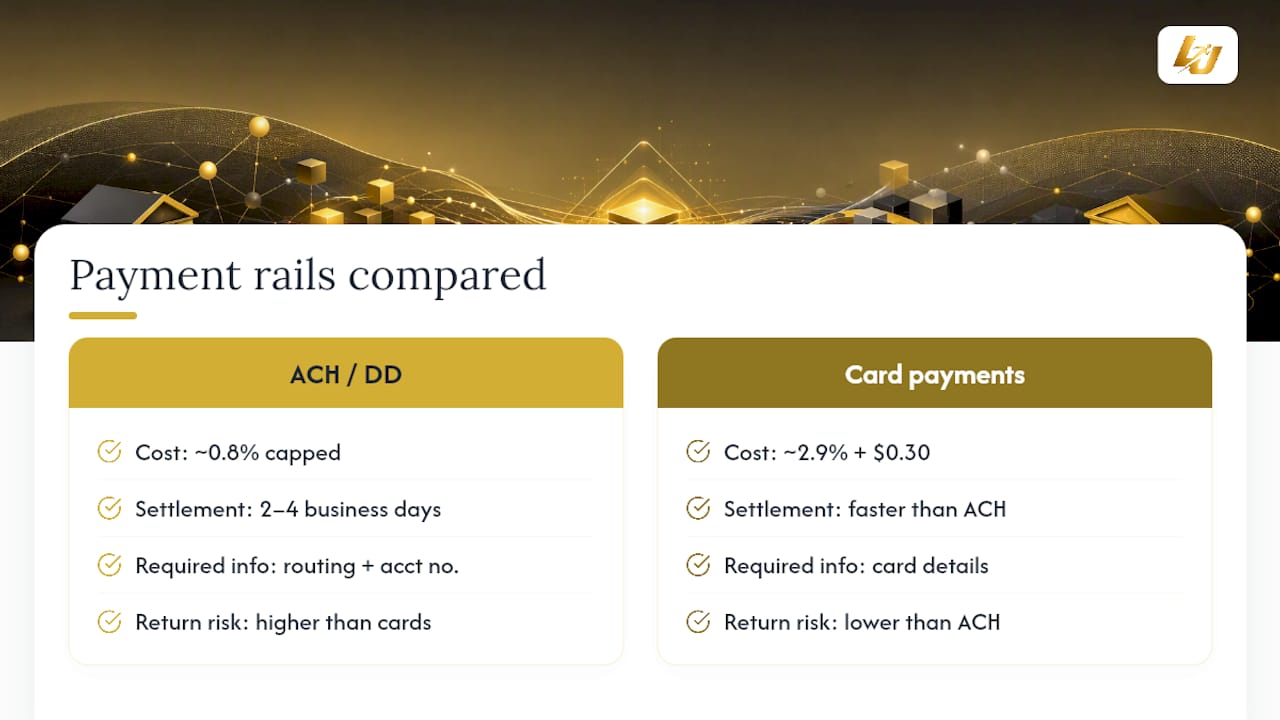
ACH / direct debit costs less per transaction than cards, often close to 0.8% capped versus roughly 2.9% plus $0.30 for cards, but settlement takes two to four business days and you need a member’s routing and account number on file, collected through a signed authorisation form. Return rates on ACH also run higher than card declines, so budget for chasing failed payments.
Variable recurring payments and bulk payment batches suit seasonal charges, tournament entry fees, and payroll-style payouts to coaches and referees, where you’re moving many similar payments on a schedule rather than one-off charges.
A small community club running one field and a few hundred members rarely needs more than Pay by Bank for dues and ACH as a fallback. A larger club with a pro shop, hospitality suite, and matchday retail needs a setup that also handles card-present transactions, which is where an all-in-one processor with hardware support earns its place.
Pro Tip: Don’t force every member onto one rail at once. Offer Pay by Bank alongside cards for the first season and let uptake happen naturally. Forced migration is what generates the most support tickets.
What does switching actually save a club?
Run the numbers on your own club’s transaction mix before assuming savings are automatic. Start with the season-ticket example: a $950 renewal at a 1.5% saving nets $14.25 back per transaction, money that otherwise disappears into card network fees.
Smaller transactions tell a different story.
That table assumes roughly half of members switch in year one, a realistic uptake rate rather than a best case.
Rolling out open banking payments without a member revolt
Adoption fails when clubs treat it as a system swap instead of a member communication project. Sequence it properly and the friction drops sharply.
- Audit first. Pull twelve months of transaction data and identify which payment types (dues, tickets, merchandise) carry the highest fees relative to volume. Convert the highest-cost flow first.
- Test in sandbox. Most open banking providers and payment processors offer a sandbox environment. Run test transactions before touching a single live member payment.
- Set up reconciliation rules. Map new bank-based transactions to your existing accounting codes so your bookkeeper isn’t reclassifying entries by hand every week.
- Prepare authorisation materials. For ACH specifically, routing and account numbers need collecting through a signed form, so have that ready before launch, not during it.
- Communicate the switch. Send a short, plain-language message explaining what’s changing and why, ideally with a small incentive (a discount or waived processing fee) for members who switch early.
- Build a dispute workflow. Decide in advance how the club handles a failed or returned payment, who chases it, and what the grace period looks like before a membership lapses.
- Track pilot metrics. Watch acceptance rate, payment failure rate, settlement lag, and the volume of member help tickets during the first two billing cycles.
Pro Tip: Pre-fill as much of the authorisation form as you can before sending it to members. A form that takes ninety seconds to complete gets signed; one that takes ten minutes gets ignored.
How LevelUp360HQ fits into a club’s payment stack
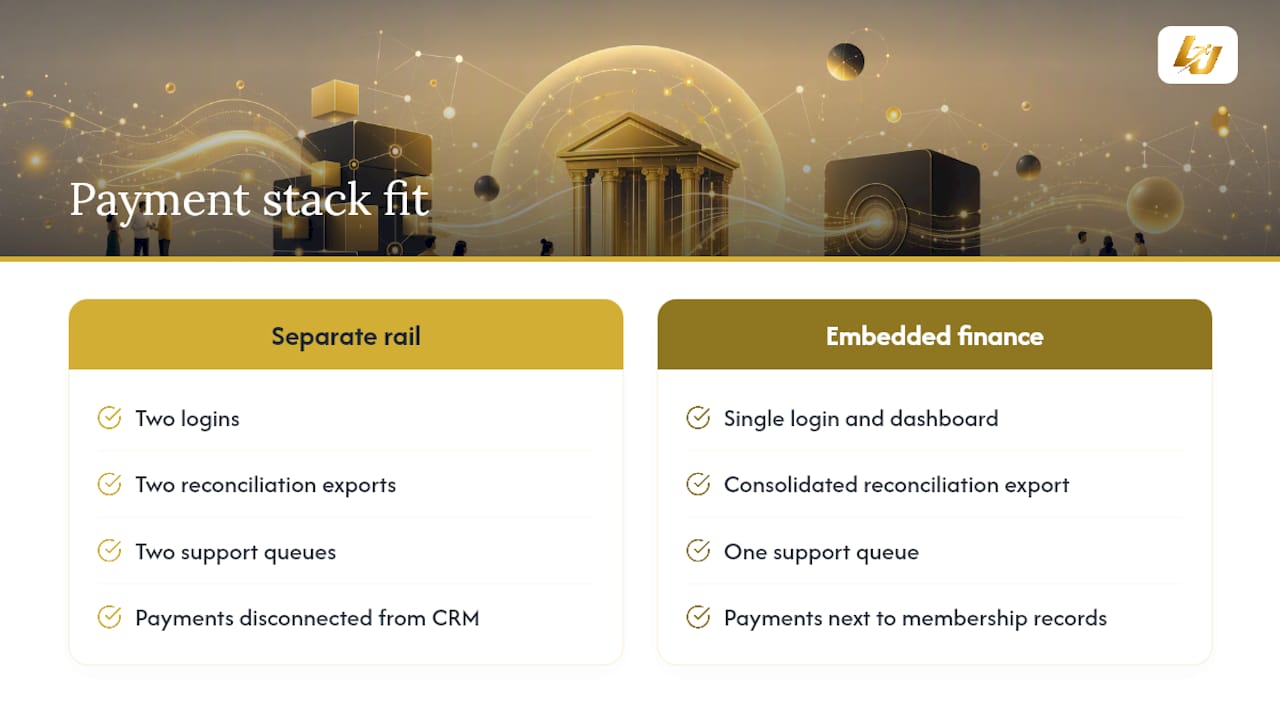
Bolting a new payment rail onto an existing club management tool usually means juggling two logins, two reconciliation exports, and two support queues. Certain platforms build subscription billing, store integrations, and monetisation tools into the same system clubs use for athlete development, CRM, and white-label branding, which means payment collection sits next to membership records rather than in a separate system.
That matters for the reconciliation problem raised earlier: embedded finance platforms that centralise collection and spending cut the manual work of matching payments across disconnected tools. For a club administrator running dues, event fees, and store sales through one dashboard, that consolidation removes a genuine daily headache.
When to move now and when to pilot first
If your club processes more than roughly 200 transactions a month or carries an average ticket above $100, the fee savings alone justify moving now. Smaller clubs with lower volume should pilot on one flow, season tickets or annual dues work well, before rolling wider. The real risk isn’t the technology; it’s forcing every member onto a new payment method in one go. Start with the highest-value transaction type, measure two billing cycles, then expand.
— Chris
Ready to centralise your club’s payments?
Running dues, ticketing, and merchandise through separate tools means separate reconciliation, separate support queues, and separate logins for whoever does your books. Some platforms fold subscription billing and store payments into the same system a club may already use for CRM, athlete tracking, and white-label branding, so one dashboard covers membership and money.

That consolidation is the practical payoff of everything covered above: fewer systems to reconcile, one place to see who’s paid and who hasn’t. If your club also runs a front desk or matchday retail operation, the workflow guidance on Fitness Flow’s blog is worth a read for hybrid collection setups. For clubs ready to see how billing and membership management work together in practice, book a walkthrough of the LevelUp360HQ platform or visit the LevelUp360HQ homepage to explore the full feature set.
Sources
- Stripe — ACH vs card transactions: how each payment method works
- Adyen — Embedded finance knowledge hub
- Somiti — Payment processing fees explained
FAQ
What kind of bank account should a club have?
Most clubs need a dedicated business chequing account separate from any personal accounts, and one set up to receive both ACH and open banking transfers without a personal-account transaction cap getting in the way.
What is an open banking payment method?
It’s a direct bank-to-bank transfer initiated through an API, where the payer authenticates and authorises the payment inside their own banking app rather than entering card details, typically saving merchants around 1.5% per transaction compared with card processing.
What is the $3,000 rule for banks?
This refers to a US anti-money-laundering recordkeeping threshold requiring banks to verify and retain identifying information on certain funds transfers; it isn’t a club-specific rule, but treasurers moving large payouts should be aware it can affect processing.
What are the downsides of open banking?
Bank coverage varies, so not every member’s bank supports it yet; settlement timing can differ from card payments; and returns and disputes on bank-based payments need a clear workflow since they don’t behave like card chargebacks. Platforms like LevelUp360HQ help by keeping payment records alongside membership data, which makes tracking a failed payment far faster than hunting across separate systems.
Turn potential into a player card.
LevelUp360 tracks every match, builds your child's player card, and shows their development over time.
Get started free