How to manage an athlete CRM system for UK clubs
Published 10 August 2026

For UK sports clubs and academies, the fastest path to organised membership and consistent athlete development is a purpose-built athlete CRM that combines roster management, session scheduling, automated payments, and performance tracking in one platform. Generic sales CRMs were not built for this, and the gap shows within weeks of adoption.
Three reasons to prioritise a sports-specific platform:
- Centralised roster: every athlete record, contact detail, attendance history, and development note lives in one place, accessible to coaches and administrators simultaneously.
- Automated renewals and payments: subscription reminders, invoice generation, and payment reconciliation run without manual chasing, which directly improves retention.
- Performance tracking linked to athlete records: session data, video assessments, and progress metrics attach to the individual athlete rather than sitting in a separate spreadsheet.
Immediate next step: book a 30-minute demo with a vendor, bring three to five sample athlete records, and test registration, a renewal reminder, and one automated communication before the session ends. A structured pilot of four to eight weeks, with two or three measurable KPIs agreed upfront, is enough to confirm fit without a long procurement cycle.
Key takeaways
A purpose-built athlete CRM that combines membership management, session scheduling, automated payments, and performance tracking is the most direct route to reducing admin and improving retention for UK sports clubs.
| Point | Details |
|---|---|
| Choose purpose-built over generic | A sports-specific CRM covers the full member lifecycle; a generic sales CRM does not. |
| Run a structured pilot | A four to eight week pilot with agreed KPIs confirms fit before full commitment. |
| Watch the pricing model carefully | Per-athlete fees and transaction charges can exceed the headline platform cost at scale. |
| Confirm UK data residency | UK GDPR and ICO compliance must be verified before signing any data processing agreement. |
| Levelup360hq covers the full stack | CRM, session management, gamified development, payments, and white-label portals in one platform. |
Table of Contents
- What is an athlete CRM and how does it differ from an AMS?
- Core features your athlete CRM should cover in a demo
- Which workflows can you automate with a sports CRM?
- How to choose the right athlete CRM for your club
- Why Levelup360hq is a strong fit for UK clubs and academies
- The conventional wisdom on sports CRMs gets one thing badly wrong
- Levelup360hq: what to expect when you book a demo
- Sources
What is an athlete CRM and how does it differ from an AMS?
Sport customer relationship management is defined academically as a strategic approach to managing interactions and activities needed for long-term customer relationships. In a club context, that translates to every touchpoint from a parent’s first enquiry through to a renewing senior member five years later.
A sports CRM handles the member lifecycle: enquiries, registrations, scheduling, communications, and renewals. It is the operational backbone of how a club manages contacts, collects money, and keeps members engaged.
An Athlete Management System (AMS) is a different tool. The Australian Sports Commission defines an AMS as a web-based platform used by sporting organisations to support athlete education and performance decision making. Where a CRM manages relationships and revenue, an AMS manages training loads, wearable data, physiology records, and performance decision making at an elite or semi-elite level.
Most UK clubs and academies need both capabilities, but not necessarily two separate products. The practical outcomes differ:
- CRM outcomes: membership revenue, renewal rates, communication consistency, reduced admin overhead.
- AMS outcomes: coaching insight, injury prevention signals, long-term athlete development data.
The strongest platforms for clubs combine both. Under UK law, any system storing member or athlete data must comply with the UK GDPR and the Information Commissioner’s Office (ICO) requirements, so data residency and consent management are non-negotiable features to confirm before signing a contract.
Core features your athlete CRM should cover in a demo
Centralising memberships, scheduling, payments, and communications in a single platform is what drives measurable improvements in member retention and operational efficiency. When you sit down with a vendor, these are the feature categories to test, not just tick off a brochure:
- Membership database: athlete profiles with contact details, emergency contacts, medical notes, and membership tier.
- Session and squad management: create sessions, assign coaches, cap attendance, and log registers.
- Scheduling and bookings: self-service booking for athletes and parents, with calendar sync.
- Payments and subscriptions: recurring billing, direct debit or card processing, and automated invoicing.
- Automated communications: email and SMS triggered by events (trial booked, payment due, session cancelled).
- Reporting and analytics: renewal rates, attendance trends, revenue by programme, and coach utilisation.
- Performance tracking: session ratings, progress milestones, and links to video assessments.
- White-label club portal: your branding, your domain, your athlete-facing experience.
On integrations, ask specifically about payment gateways (Stripe, GoCardless), accounting exports (Xero, QuickBooks), calendar APIs (Google, Outlook), and any wearable or LMS connections relevant to your sport.
Support matters as much as features. Confirm UK business-hours support, a named onboarding contact, data migration assistance, and training for volunteer staff who will not have time for a lengthy learning curve.
Pro Tip: Test roster-wide alert functionality during your demo. The ability to send a targeted message to every athlete in a specific age group or squad in under two minutes is one of the highest-frequency tasks a club administrator performs. If it takes more than three clicks, the daily friction will be significant.
Which workflows can you automate with a sports CRM?
The admin hours saved through automation are where clubs feel the difference most quickly. A well-configured athlete CRM removes the manual steps that consume coaching staff time and create gaps in member communication.
Automations to expect from a capable platform:
- Lead capture from your website or social channels, routed directly into the CRM with a follow-up sequence triggered automatically.
- Trial session scheduling with confirmation emails, coach assignment, and a pre-trial information pack sent without manual intervention.
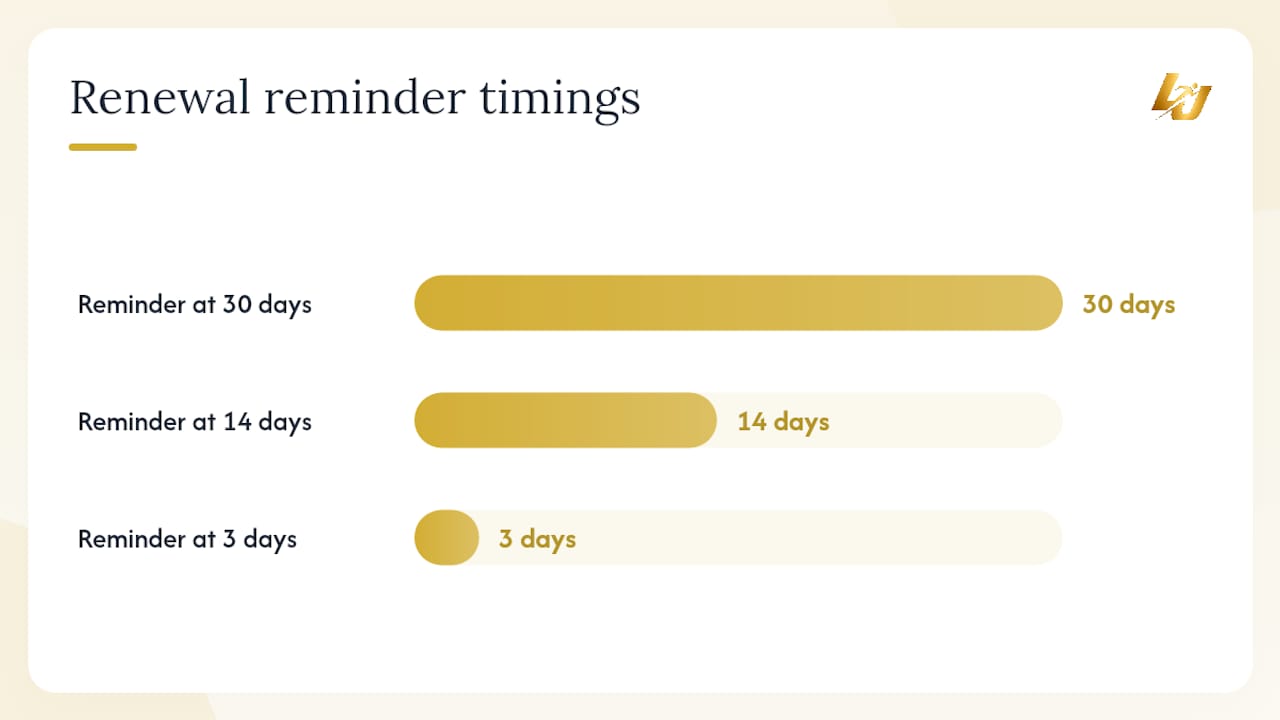
- Membership renewal reminders sent at 30, 14, and 3 days before expiry, with a payment link embedded.
- Session attendance registers auto-populated from bookings, with absence flags raised for coaches.
- Automated invoices generated on a billing cycle and reconciled against payment records.
- Event bookings and notifications for tournaments, grading days, or open sessions.
- Personalised athlete check-ins triggered by milestones or inactivity, keeping development conversations alive between sessions.
A practical workflow example: a parent submits an enquiry through your website at 9pm on a Tuesday. The CRM captures the contact, sends a welcome email with a trial booking link, and notifies the relevant coach. The parent books a trial slot. The coach receives an assignment notification. After the trial, a follow-up sequence triggers automatically, offering membership options and a payment link. If the parent converts, the athlete record is created, the first invoice is generated, and the onboarding communication sequence begins. No one in the club touched that process manually.
The metrics worth tracking during a pilot: time to register a new athlete, renewal capture rate in the first billing cycle, and total admin hours logged per week. These three figures give you a clear before-and-after picture within four to six weeks.
For clubs that also want to connect recovery and conditioning work to athlete records, integrating with services like sports massage and recovery tracking is a practical extension of the CRM’s performance data layer.
How to choose the right athlete CRM for your club
A structured evaluation process prevents the common mistake of buying on features alone and discovering the pricing model does not fit your club’s size six months later.
Evaluation checklist for vendor demos
- Import a sample roster of 20 athletes and confirm field mapping works correctly.
- Create a session, assign a coach, and book three athletes into it.
- Trigger a renewal reminder and confirm the payment link functions end-to-end.
- Generate an attendance report for the last 30 days.
- Test an automated email sequence from a new enquiry through to trial confirmation.
- Confirm data residency: where is member data hosted, and is it UK or EU-based?
- Ask for a live demonstration of the migration process from your current system.
Questions to ask vendors
- What is your UK data hosting arrangement, and do you have an ICO-compliant data processing agreement?
- What are the transaction fees on payments, and are they included in the platform fee or charged separately?
- How long does onboarding take for a club of our size, and is there a dedicated account manager?
- What training is available for volunteer administrators with limited technical experience?
- Can we white-label the athlete-facing portal with our club branding?
Pricing models explained
Enterprise CRM pricing commonly uses per-user, per-app, and tiered subscription structures. Sports-specific platforms typically use one of three models:
- Per-athlete: a monthly fee per active athlete on the platform. Works well for smaller clubs but can become expensive at scale. A club with a large number of athletes paying a small fee per athlete per month can see the total monthly costs add up significantly.
- Flat platform fee: a fixed monthly or annual subscription regardless of athlete count. Predictable for larger clubs, but the headline price can look high for a club of 50 athletes.
- Tiered subscription: bands based on athlete count or feature access. The most common model for growing academies.
Watch for transaction fees on payments. A platform charging 1.5% on every direct debit can cost more than the subscription fee itself for a club processing significant monthly volume. The lowest headline price can become the most expensive option at scale.
Pilot timeline and success criteria
A four to eight week pilot is enough to validate fit. Agree these KPIs before the pilot starts:
- The time to register a new athlete should be kept as short as possible to improve administrative efficiency.
- Renewal capture rate in the first billing cycle should ideally be high to indicate good retention.
- Admin hours saved per week versus your current process.
Red flags during demos: no UK data hosting option, no migration support, reporting locked behind expensive add-ons, or any workflow that requires a manual workaround to complete a basic task.
Why Levelup360hq is a strong fit for UK clubs and academies
Levelup360hq maps directly to the evaluation checklist above. The platform combines CRM, session management, gamified athlete development, payments, and white-label club portals in a single subscription, which removes the integration overhead that comes with stitching together separate tools.
Feature alignment with the checklist:
- CRM and membership management: athlete profiles, contact records, membership tiers, and renewal automation.
- Session and squad management: session creation, coach assignment, attendance registers, and syllabus management.
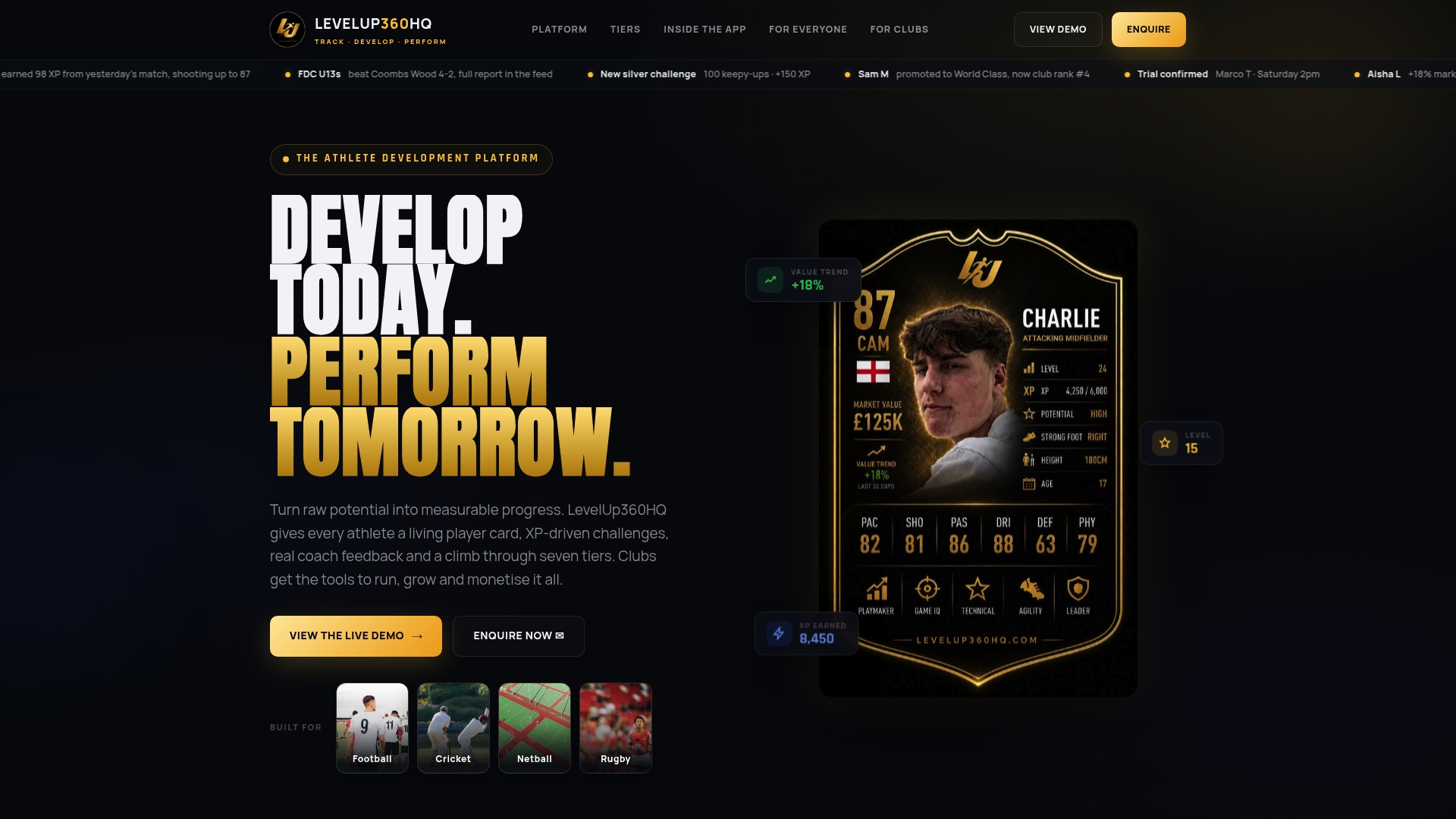
- Gamified athlete development: live player cards with real-time ratings, XP-driven challenges, tier progression, badge systems, and leaderboards that keep athletes engaged between sessions.
- Performance tracking and video assessments: coach-led video reviews with approval workflows, AI-driven match reports, and training plans linked directly to the athlete record.
- Payments and monetisation: subscription management, store integrations, and event booking tools that create additional revenue streams for the club.
- White-label portal: clubs and academies can run the platform under their own branding, which strengthens the athlete-facing experience and supports retention.
The platform supports football, cricket, netball, rugby, and other sports, so multi-sport clubs do not need separate systems for each programme.
On data protection, Levelup360hq operates within UK and EU data residency requirements and supports ICO/GDPR-compliant data processing. Clubs should request the data processing agreement during the demo to confirm the specific hosting arrangement for their records. This is general guidance, not legal advice; confirm current compliance details directly with the vendor.
Pricing follows a per-athlete and platform fee model with demo availability and pilot options. For clubs tracking athlete body composition and training load alongside CRM data, resources on athlete body recomposition and progress metrics illustrate the kind of performance data that integrates naturally with a platform like Levelup360hq.
Practical next steps: request a demo, bring your current roster size and a list of your existing tools, and ask the team to walk through the five-step evaluation checklist from the previous section.
The conventional wisdom on sports CRMs gets one thing badly wrong
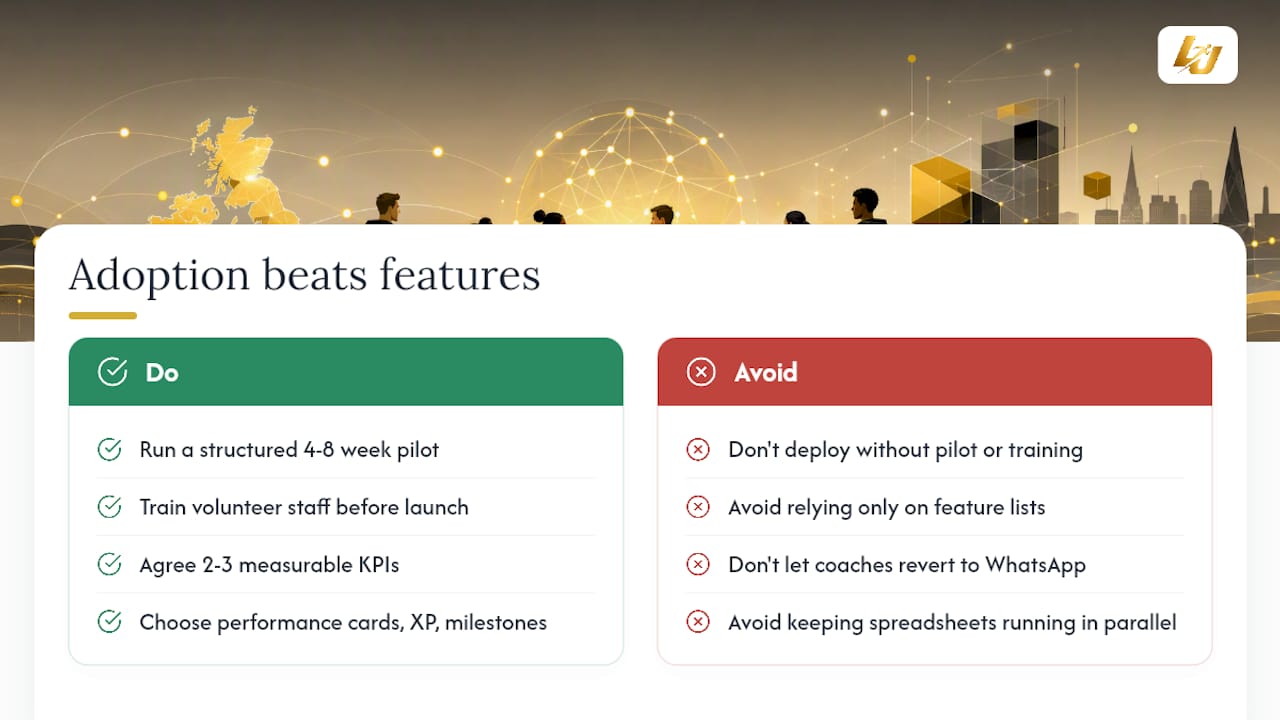
Most buying guides for sports club software focus almost entirely on the feature list. They produce comparison tables, tick boxes, and pricing breakdowns. What they rarely address is the adoption problem, which is where most CRM implementations actually fail.
A club that buys a well-featured platform and then deploys it without a structured pilot, without training for volunteer staff, and without two or three agreed KPIs to measure will find the system underused within three months. Coaches revert to WhatsApp groups. Administrators keep the spreadsheet running in parallel. The platform becomes an expensive contact database.
The pilot-first approach matters precisely because it forces the club to define what success looks like before the contract is signed. Four to eight weeks with measurable targets is not a trial period. It is the first phase of adoption, and it sets the habits that determine whether the system sticks.
The other thing guides underplay is the difference between a CRM that manages athletes and one that engages them. A platform that gives athletes live performance cards, XP progression, and visible development milestones does something a standard CRM cannot: it makes athletes want to log in. This engagement loop reduces churn more reliably than any automated renewal reminder, because the athlete has a reason to stay connected to the club’s digital environment between sessions.
Prioritise platforms that close both gaps. The feature list is the starting point, not the finish line.
Levelup360hq: what to expect when you book a demo
Levelup360hq offers a structured demo and pilot process designed for clubs that want to move quickly without a lengthy procurement cycle. The demo covers the full platform: CRM, session management, gamified athlete development, payments, and white-label setup.
Arrive at your demo with these items prepared:
- A sample roster (20–30 athlete records) to test data import and field mapping.
- A list of your current tools (payment processor, calendar, accounting software) to confirm integration compatibility.
- Two or three KPIs you want to measure during a pilot (registration time, renewal rate, admin hours).
- Any GDPR or data residency questions specific to your club’s obligations under the ICO.
In the first 30 days after a pilot starts, expect onboarding support, data migration assistance, and access to training materials for your administrative staff. The platform is built for clubs running multiple sports and multiple age groups simultaneously, so the setup process accounts for that complexity from day one.
Book a demo at Levelup360hq and arrive with your checklist. The pilot will tell you everything the feature list cannot.
Sources
The sources below back the claims in this article and are worth reviewing directly if you are in procurement or want to validate specific points.
- CRM for sports clubs: how to improve member retention in …
- Athlete Management System | ASC - Australian Sports Commission
Recommended
Turn potential into a player card.
LevelUp360 tracks every match, builds your child's player card, and shows their development over time.
Get started free