Live player card concept explained for athletes
Published 26 June 2026

A live player card is a digital profile that updates in real time based on an athlete’s ongoing performance data, combining gaming mechanics with objective analytics. The live player card concept explained simply is this: every time a relevant event occurs during play, the card reflects it. Platforms like MLB The Show Mobile use 900+ licensed player cards integrating skill-based gameplay with live data upgrades. That scale shows how far the concept has moved beyond static trading cards. For athletes, coaches, and sports enthusiasts, understanding player card features means understanding a tool that serves scouting, performance feedback, and community engagement all at once.
How do live player cards function and update with real-time athlete data?
Live player cards work by pulling data from automated feeds tied directly to live events. The card does not wait for a human to enter a result. Instead, data from video streams, sensors, or match tracking systems feeds directly into the card’s metrics the moment an event occurs.

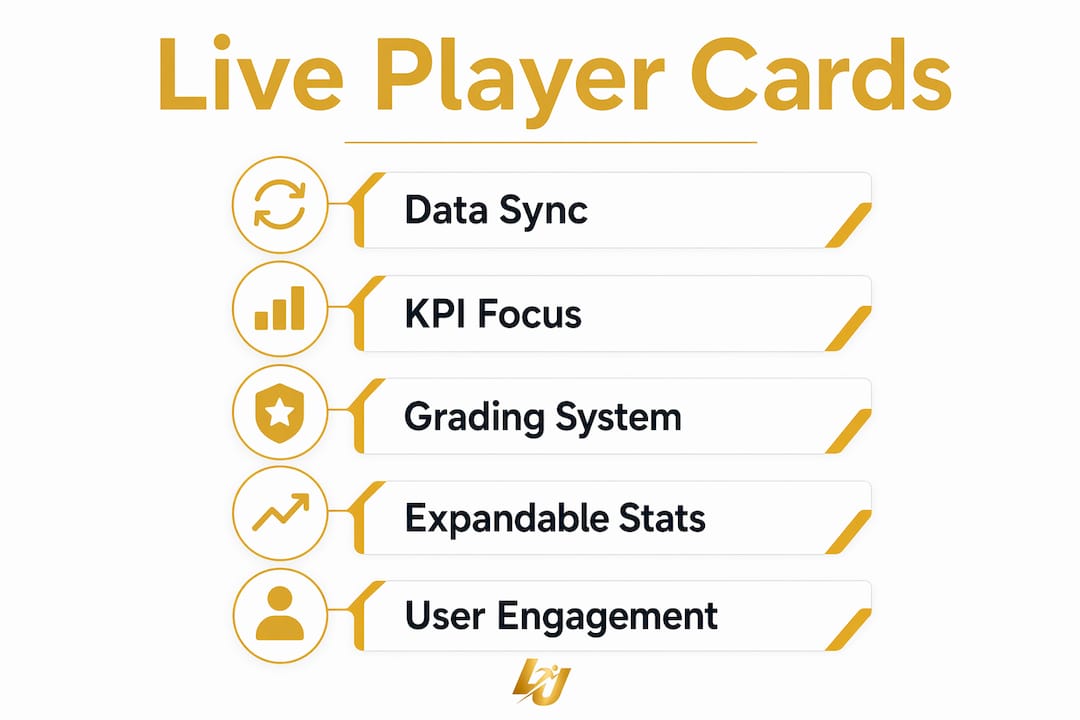
The technical challenge is timing. Synchronisation theatre is the practice of aligning UI overlays with live video playback to second-accurate precision, without causing a visible mismatch between what the viewer sees and what the card displays. The solution is to treat the UI data layer and the video stream as two separate systems that run in parallel. This prevents the latency traps that break immersion and trust.
Data accuracy is equally critical. Multi-redundant automated feeds verify each data point across multiple sources before updating the card. Manual updating, by contrast, creates bottlenecks that delay results and frustrate athletes waiting for feedback. Automation is not a convenience here. It is the foundation of a credible live card system.
The structure of the card itself matters too. A well-built live player card displays headline KPIs at the top level, with detailed secondary statistics available in expandable sections. This layered approach means a coach can glance at a card and get the essential picture in under three seconds, then drill down when a deeper assessment is needed.
Pro Tip: Treat the live data feed and the visual card as two independent systems. Build each to function correctly on its own, then connect them. This approach prevents a failure in one layer from breaking the entire experience.
What does effective player card design actually look like?
Design is where most live player card systems either earn trust or lose it. The visual hierarchy of a card communicates credibility before a single number is read.
Design experts recommend preserving the 2.5 x 3.5 inch legacy trading card dimension in digital interfaces. That proportion is already embedded in how people recognise and process sports cards. Anchoring the athlete’s name, team logo, and headline metric in the same positions as a physical card reduces cognitive load on small screens.
The number of metrics displayed on the primary view is decisive. Limiting the primary display to 3–5 role-specific KPIs supports fast comprehension for scouting and fan recognition. A goalkeeper’s card should show save percentage, clean sheets, and distribution accuracy. A striker’s card should lead with goals, shots on target, and expected goals. Showing every available stat at once produces noise, not insight.
Grading systems add another layer of clarity. An A+ grade caps at 3.5% of the population to maintain rarity and perceived value. This tier distribution, running from A+ down to F, gives athletes and coaches an immediate sense of relative performance without needing to interpret raw numbers.
Pro Tip: Use expandable sections for secondary data. Keep the primary card face clean and fast to read. Detailed stats should be one tap away, not cluttering the main view.
Static cards vs. live player cards: a comparison
| Feature | Static card | Live player card |
|---|---|---|
| Data update frequency | Manual or seasonal | Real time, per event |
| Metric relevance | Fixed at creation | Role-specific and adjustable |
| Engagement driver | Collectible value | Performance progression |
| Coaching utility | Historical reference | Active feedback tool |
| Personalisation | Limited | Avatars, nicknames, tiers |
How do live player cards impact athlete development and engagement?
Live player cards change the feedback loop for athletes. Instead of waiting for a post-match debrief, an athlete can see objective performance data reflected on their card within minutes of an event. That immediacy shifts how athletes relate to their own development.
Scoring transforms complex data into meaningful grades and role-tailored KPIs, which makes feedback actionable rather than abstract. A midfielder who sees their pressing intensity drop two grades after a match has a concrete, specific signal to work on. A coach reviewing the same card gets the same signal without needing to watch full match footage first.
The engagement mechanics built around live cards extend well beyond performance tracking. Platforms that use live player card functionality effectively tend to include:
- Tiered progression systems that move athletes through levels as their card ratings improve, creating visible milestones.
- Leaderboards that rank athletes within a squad, academy, or region, adding social competition without requiring monetary stakes.
- Flair badges tied to card levels, giving athletes a form of social identity within the platform community.
- Point economies where athletes earn rewards through participation and performance rather than spending money.
Platforms replace monetary gambling with point economies, offering rewards through participation and tier progressions. Athletes on platforms like Levelup360hq earn points through challenges and session completions, building social status via leaderboards connected to their card tier. This approach sustains engagement over months rather than days.
Social features like custom avatars, nicknames, and tiered progression deepen the athlete’s sense of ownership over their profile. When an athlete can personalise their card and see it reflect their real performance, the card becomes an identity asset, not just a data display.
What are the practical steps to create and maintain live player cards?
Building a live player card system requires decisions at three levels: data infrastructure, card design, and ongoing maintenance. Getting any one of these wrong undermines the other two.
-
Automate the data feed from day one. Manual data entry is the single biggest risk to a live card system. Delays and errors erode athlete trust quickly. Connect your data source directly to the card’s backend using automated feeds with multi-source verification.
-
Define role-specific metric sets before building the card template. A football defender needs different KPIs from a cricket batsman. Build metric profiles for each role before designing the card layout, so the template can flex without requiring a rebuild.
-
Separate the UI layer from the data layer. The card’s visual presentation and the data feeding it should operate independently. This means a data delay does not cause the card to break visually, and a design update does not require touching the data pipeline.
-
Apply a strict information hierarchy. Show 3–5 headline KPIs on the primary card face. Place all secondary metrics behind an expandable view. Tiered information hierarchy helps athletes focus on critical insights quickly, supporting mobile-first interfaces and deeper drill-down when needed.
-
Build in booster and progression mechanics from the start. Booster cards with varying rarity temporarily increase player card stats and enhance user strategy. For example, a rare booster might earn an athlete additional points per qualifying action during a session. These mechanics reward engagement and keep the card feeling dynamic between major performance updates.
-
Test synchronisation under real conditions. Run the card system against a live event before launch. Check that UI updates align with video playback and that no metric displays a stale value during active play.
The platforms that get this right share one characteristic: they treat the live card as a product in its own right, not as a feature bolted onto an existing system. Levelup360hq, for instance, builds FIFA-style player cards with real-time ratings, XP-driven challenges, and tier progression as core platform features rather than add-ons.
Key takeaways
Live player cards work because they combine real-time data automation, role-specific metric design, and social progression mechanics into a single athlete profile that updates with every performance.
| Point | Details |
|---|---|
| Real-time data is non-negotiable | Automated, multi-source feeds prevent the delays that destroy athlete trust in live card systems. |
| Design hierarchy drives usability | Limit primary card views to 3–5 KPIs; place detailed stats in expandable sections for mobile clarity. |
| Grading creates meaning | A+ to F tier distributions give athletes and coaches instant relative context without raw number interpretation. |
| Engagement needs social mechanics | Leaderboards, flair badges, and point economies sustain athlete motivation beyond the initial novelty. |
| Separation of layers prevents failure | Building the UI and data feed as independent systems protects the card experience when either layer has issues. |
Why live player cards are more than a digital gimmick
The first time I saw a live player card update mid-session during a training drill, my reaction was not “that’s clever technology.” It was “why did it take this long?” The concept is not new. Physical trading cards have carried athlete data for decades. What is new is the feedback loop closing in real time.
What strikes me most is how the live card shifts the power dynamic in athlete development. Historically, performance data lived with the coach or the analyst. The athlete received a summary, usually after the fact, usually filtered through someone else’s interpretation. A live card gives the athlete direct, unmediated access to their own performance signal. That changes the conversation between athlete and coach from “here is what I observed” to “here is what we both see.”
The design constraint I find most underappreciated is the 3–5 KPI rule. Coaches and developers consistently want to add more metrics. More data feels like more value. But athletes reading their own cards during or after a session do not need twenty numbers. They need three that matter to their role, updated in real time. The discipline of choosing those three is where the real design work happens.
The social layer is what separates a useful tool from an engaging platform. Leaderboards and tier progressions connected to athlete development tools create a community context that raw analytics cannot. An athlete who can see where they rank within their academy, and who can see their card tier rise as their performance improves, has a reason to keep coming back that goes beyond obligation.
The next evolution I expect to see is predictive card ratings, where the card projects a likely grade range based on current training load and historical patterns. That moves the card from a record of what happened to a signal of what is coming. Platforms that build that capability will define the next standard.
— Chris
Levelup360hq: live player cards built for real athlete development
Levelup360hq puts the live player card concept at the centre of its athlete development platform. Every athlete on the platform gets a FIFA-style player card with real-time ratings, XP-driven challenges, and tier progression tied directly to their performance data.

Coaches get video assessment tools and session management built around the same card system, so feedback is grounded in the same data the athlete sees. Clubs and academies get white-label branding and CRM tools on top of that. The live platform supports football, cricket, netball, and rugby, and the interactive demo lets you see the card system in action before committing to anything.
FAQ
What is a live player card?
A live player card is a digital athlete profile that updates in real time based on performance data from live events. It combines gaming mechanics with objective analytics to serve both development tracking and fan engagement.
How does a live player card differ from a static trading card?
A static card displays fixed data set at the time of creation. A live player card updates automatically with each new performance event, reflecting current form rather than historical snapshots.
How many metrics should a live player card display?
The primary card face should display 3–5 role-specific KPIs for fast comprehension. Detailed secondary statistics belong in expandable sections to keep the main view clean and mobile-friendly.
What grading system do live player cards use?
Most systems use a 0–100 score or an A+ to F grade scale. An A+ grade typically caps at 3.5% of the athlete population to preserve rarity and give the grade genuine meaning.
Can live player cards work across different sports?
Yes. The metric sets change by sport and role, but the underlying architecture of automated data feeds, tiered grading, and social progression applies equally to football, cricket, netball, rugby, and esports.
Recommended
Turn potential into a player card.
LevelUp360 tracks every match, builds your child's player card, and shows their development over time.
Get started free