Prevent Demotivation: Sports Leaderboard Design for Clubs, Academies
Published 20 September 2026

Segmented, relative leaderboards that reward effort and improvement, such as XP tiers and “most improved” boards, beat open-ended public rankings for keeping athletes motivated. Pair them with role-based views and opt-ins so no player gets stuck feeling permanently behind. The detail is in how you build that, not whether you build it.
TL;DR:
- Segmented leaderboards that rank athletes within their age or skill group, combined with effort-based metrics, prevent demotivation and promote sustained engagement.
- Using private views and opt-in public leaderboards helps protect athletes from feelings of permanent behindness and enhances their sense of autonomy.
- Short-term, event-focused leaderboards with scheduled updates effectively motivate short bursts of activity, while weekly or monthly updates suit season-long development.
- Implementing coach-verified scores with video proof and clear data sources reduces disputes and increases trust in leaderboard accuracy.
- Most successful club leaderboards focus on effort, attendance, and improvement rather than raw talent, ensuring motivation across all athlete levels.
Table of Contents
- What is leaderboard design for sports, and why does the format matter?
- Which leaderboard formats actually work for clubs and academies?
- How do you implement a leaderboard step by step?
- What metrics prove your leaderboard is actually working?
- How LevelUp360HQ puts these leaderboard patterns into practice
- What clubs get wrong about leaderboard motivation
- Start a leaderboard pilot with LevelUp360HQ
- Sources
- FAQ
What is leaderboard design for sports, and why does the format matter?
Leaderboard design for sports means deciding how athlete performance data gets ranked, displayed and shared inside a training or club platform, and to whom. Get the format wrong and a tool meant to motivate ends up demoralising half your roster. Get it right and it becomes the engagement engine your programme has been missing.
Research into classroom and training games backs this up directly. One study on game design found that infinite leaderboards, the kind that rank every single participant in one unbroken list, produced negative experiences for a sizeable minority of players. If your under-14s squad has a leaderboard that puts the same three kids on top every week and the same five at the bottom, you haven’t built a motivation tool. You’ve built a discouragement machine for most of the team.
That said, infinite boards aren’t always wrong. A senior performance squad chasing a genuine competitive edge might want the unvarnished full ranking, because that’s the culture they’ve opted into. The mistake is applying that same structure to a mixed-ability youth academy without asking who it’s actually for.
Segmented and relative views solve most of this. Instead of one global list, you show athletes their position within their age group, skill tier, or a rolling window of peers close to their own level. Combine that with effort-based metrics (attendance, session completion, most-improved scores) rather than pure talent ranking, and you reward the things every athlete can control.
Autonomy and relatedness matter here too. Gamification research in physical education shows that points, badges and leaderboards only lift motivation when they’re aligned with athletes’ sense of choice and belonging, not imposed as a single rigid scoreboard everyone must accept.
- Offer opt-in public leaderboards alongside a default private view.
- Show team or squad-level boards, not just individual rankings.
- Rank effort and improvement metrics above raw skill scores.
- Decide update cadence deliberately: real-time for live events, scheduled (daily or weekly) for season-long development boards.
Pro Tip: Real-time updates feel exciting for a live tournament, but for season-long development boards, a daily or weekly refresh actually reduces anxiety and obsessive checking, while still feeling current enough to matter.
Which leaderboard formats actually work for clubs and academies?
Four formats cover most club and academy needs. Each solves a different motivational problem, so the smart move is running two or three at once rather than betting everything on one design.
- XP and tier progression boards. These track cumulative experience points earned across a season through training attendance, drills completed and coach-verified milestones. They reward consistency over a single good performance, which suits long-term athlete development far better than a weekly snapshot.
- Most-improved boards. Rank the delta between an athlete’s baseline and current performance, not their absolute score. This is the single best format for keeping your less naturally gifted players engaged, because it gives every athlete on the roster a realistic route to the top.
- Event and session leaderboards. Short-lived, live rankings for a single tournament, trial day or training block. Because they reset, low finishers in one event aren’t locked into a demoralising position for months. Fast, short-format competitive structures, similar in spirit to how platforms like Flicksy’s Blitz PvP run quick 1v1 matches, show how contained, time-boxed competition keeps energy high without the fatigue of an endless leaderboard.
- Private player cards and role-based views. Not every metric belongs on a public board. Individual skill breakdowns, video assessment notes and coach feedback should sit in a private card visible only to the athlete, their parent or guardian, and their coach.
A practical guide to gamification in sports training makes a similar point: rank effort-based stats rather than raw talent if the goal is motivating the whole squad rather than just celebrating your three best players. Most academies get the best results running an XP/tier board as the season-long backbone, a most-improved board refreshed monthly, and event leaderboards for anything competitive and time-limited.
How do you implement a leaderboard step by step?
Start with the point currency, not the interface. Decide what actually earns points before you touch a single design setting; bolt-on gamification, added after the fact, is where most leaderboard projects go wrong.
- Define goals and point currency first. Attendance, drills, match performance, coach ratings, whatever you choose, write it down and get coaching staff to agree before configuration begins.
- Map your data feeds. Session stats, coach assessments, attendance logs and any wearable data need a clear, verified path into the platform. Inconsistent inputs produce leaderboards nobody trusts.
- Set views and permissions. Decide who sees the full squad board, who sees only their tier, and who can opt out entirely.
- Handle safeguarding and consent properly. For any athlete under 18, parental or guardian opt-in should govern whether performance data appears anywhere visible beyond the coaching team.
- Build a moderation and dispute workflow. Coaches need a way to approve or query a score before it goes live, ideally with a timestamped note or video clip attached as evidence.
- Pilot small. One team, one competition format, a baseline period of two to four weeks before you roll anything out club-wide.
Pro Tip: Attach a timestamped video clip or coach note to any manually entered score. It’s the single easiest way to kill disputes before they start, and it gives athletes proof of the moment they earned recognition.
Points should function as a currency tied to your programme’s actual values, not just a route to a prize. Case work from MLSE LaunchPad found that participants often preferred accumulating points for status and progression over redeeming them for physical rewards, which should shape how you design tiers and milestones.
What metrics prove your leaderboard is actually working?
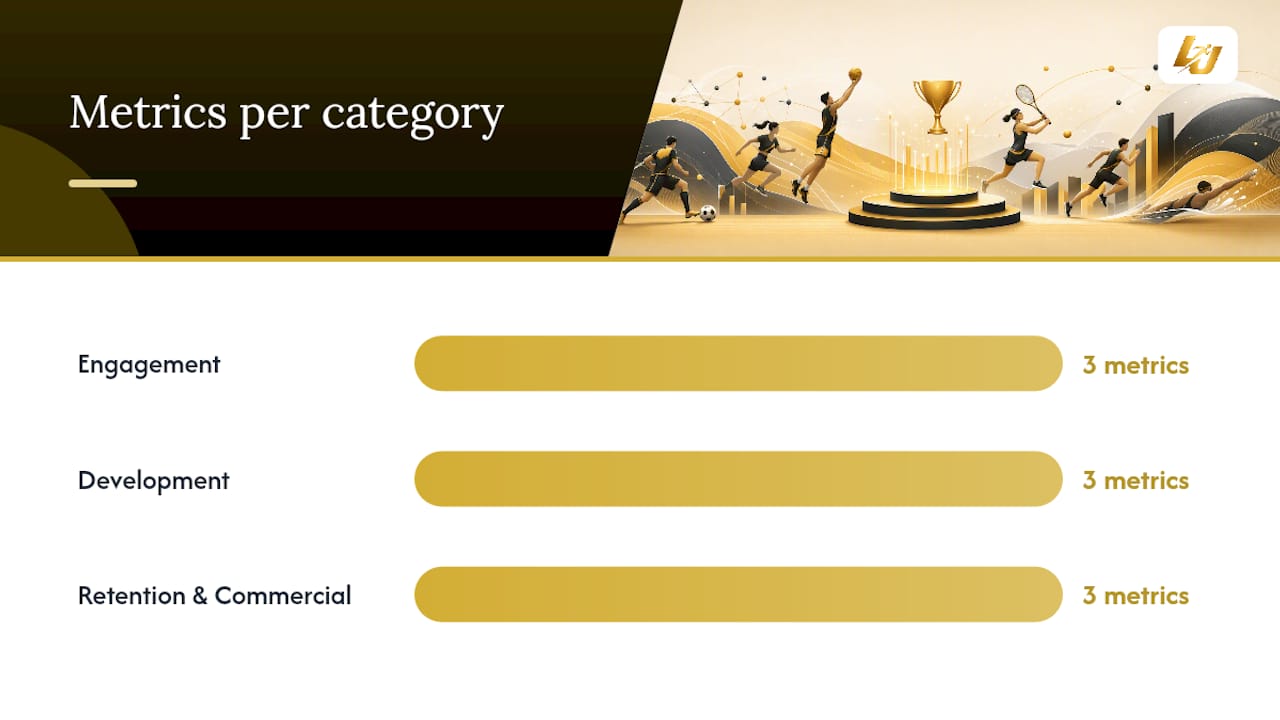
Three categories of metric tell you whether the leaderboard is earning its place in your programme, and you need at least one from each before you can call a pilot a success.
Engagement metrics come first: leaderboard views per week, challenge or event entries, and the proportion of your roster actively checking in versus those who’ve gone quiet. Development metrics follow: the rate of athletes moving up a “most improved” band, the size of assessment score deltas over a season, and skill progression tracked against your coaching syllabus. Retention and commercial metrics close the loop: programme retention rate, subscription upgrades, and any store or event-booking activity tied to leaderboard milestones.
Run simple A/B tests rather than guessing. Split your squad into a public board group and a segmented/private view group, and compare attendance and challenge completion after four weeks. Try real-time updates against daily batch updates and see which produces steadier engagement without spiking anxiety before sessions.
One pattern worth watching for directly: research on smartphone activity leaderboards found a curvilinear, U-shaped effect on motivation. Athletes at the very top and the very bottom of a ranking often show stronger activity increases than those stuck in the middle. That’s a strong argument for segmented views: a mid-table athlete on a full squad board gets none of that motivational pull, but the same athlete near the top of their own tier does.
- Leaderboard views and challenge entries per week
- Most-improved conversion rate
- Assessment score deltas over a season
- Programme retention and subscription upgrade rate
Present these to your board or committee as a short before-and-after comparison rather than raw numbers. A club director cares far more about “attendance rose after we segmented the boards” than about a spreadsheet of weekly view counts. Worth flagging too: one longitudinal study found that removing league tables from a school football context didn’t reliably shift participation either way, a reminder that leaderboards are a lever, not a guaranteed fix, and your own baseline data matters more than the general finding.
How LevelUp360HQ puts these leaderboard patterns into practice
The platform builds these principles directly into its athlete-development system rather than leaving clubs to configure them from scratch. Live player cards provide athletes a real-time rating and market value that updates as performance data comes in, giving every athlete a visible sense of progress without needing to top a global chart.
XP-driven challenges and tier progression handle the season-long motivation layer, rewarding consistency and effort rather than a single standout match. Video assessments with coach approval workflows verify the inputs feeding any leaderboard, so a score on the board has a coach-reviewed clip or note behind it, cutting down disputes before they happen. White-label branding and monetisation tools support funding prizes, store rewards or event entries directly from the platform, tying the leaderboard back into programme revenue.
For a first pilot, keep it narrow:
- One team or age group
- One competition type (an XP board or a single event leaderboard)
- A two to four-week baseline before wider rollout
What clubs get wrong about leaderboard motivation
Most clubs assume competition is the whole story. It isn’t. The research is fairly consistent that a single, unsegmented ranking motivates the athletes near the top and does very little, sometimes real damage, to everyone else. The fix isn’t removing competition. It’s narrowing the comparison group until every athlete has a realistic peer to measure against.

The advice that gets this backwards is the “gamify everything, add a leaderboard” line that circulates in a lot of coaching content. A leaderboard bolted onto data nobody trusts, with no opt-out and no segmentation, will damage engagement faster than having no leaderboard at all. What actually works is boring by comparison: agree the point currency first, verify your data sources, give athletes a private view as the default, and measure before you scale.
If there’s one thing club administrators should prioritise above the interface, it’s this: decide what you’re actually rewarding, effort, attendance, improvement, before you decide how it looks on screen. The design questions, real-time or scheduled, public or segmented, only matter once that foundation is right. Skip that step and no amount of clever UI will save the rollout.
— Chris
Start a leaderboard pilot with LevelUp360HQ
LevelUp360HQ is built specifically for the segmented, effort-first leaderboard patterns this guide recommends, combining live player cards, XP-driven challenges, tier progression and coach-approved video assessments in one platform rather than a bolt-on scoreboard plugin. Clubs get white-label branding, CRM tools and monetisation features to fund and manage the whole programme, not just the ranking screen.

A typical pilot starts small: one team, one competition format, a short baseline period, exactly the structure covered above. The club or academy pays the subscription, with the Pro plan priced at £49 per month plus an active athlete platform fee of £1.50 per month per athlete; athletes, parents and coaches use the platform without a direct charge. If you’re ready to see how segmented leaderboards, XP tiers and coach-verified assessments work together in practice, book a demo and walk through a pilot configuration for your own squad.
Sources
- Based Learning Game Design (IJSG)
- The curvilinear effects of relative positions in smartphone app leaderboards on physical activity
- Gamification and its effects in physical education contexts
FAQ
What is the best leaderboard design for youth sports?
Segmented or relative leaderboards that rank effort and improvement, such as most-improved boards and XP tiers, work best for youth sports because they give every athlete a realistic path to the top. Full open rankings tend to demotivate mid- and lower-ranked players, according to gamification research on leaderboard types.
Should leaderboards update in real time or on a schedule?
Real-time updates suit live events and single-day tournaments, where the excitement of an instant ranking change is part of the format. Season-long development boards generally work better on a daily or weekly refresh, which reduces anxiety without losing relevance.
How do you stop leaderboards demotivating lower-ranked athletes?
Use segmented views so athletes compare against a realistic peer group rather than the whole squad, and prioritise effort-based metrics like attendance and most-improved scores over raw talent ranking. Offering an opt-out or private view by default also protects athletes who don’t want public comparison at all.
Does LevelUp360HQ support these leaderboard patterns?
Yes. LevelUp360HQ combines live player cards, XP-driven challenges, tier progression and coach-approved video assessments so that leaderboard data is both motivation-safe and verified before it goes live, with white-label and monetisation tools for running club-wide competitions.
What does LevelUp360HQ cost for a club or academy?
The Pro plan is priced at £49 per month, plus an active athlete platform fee of £1.50 per month per athlete. Revenue share pricing is available on request through the platform’s demo page.
Turn potential into a player card.
LevelUp360 tracks every match, builds your child's player card, and shows their development over time.
Get started free