How white-label branding works for clubs
Published 1 June 2026

White-label branding for clubs is defined as a vendor re-skinning their platform so every member touchpoint, from checkout to mobile app, displays the club’s logo, colours, and name while the vendor operates the product invisibly in the background. Memberful describes this as a fully branded membership experience at checkout and member portals. The result is that your members never see a third-party name. They see yours. Platforms like Memberful, SuiteDash, and GoHighLevel have made this model accessible to clubs of all sizes, and in 2026 it has become the standard expectation for any serious club management operation. Understanding how white-label branding works for clubs is the first step to deciding whether it fits your growth strategy.
How does white-label branding technically work for clubs?
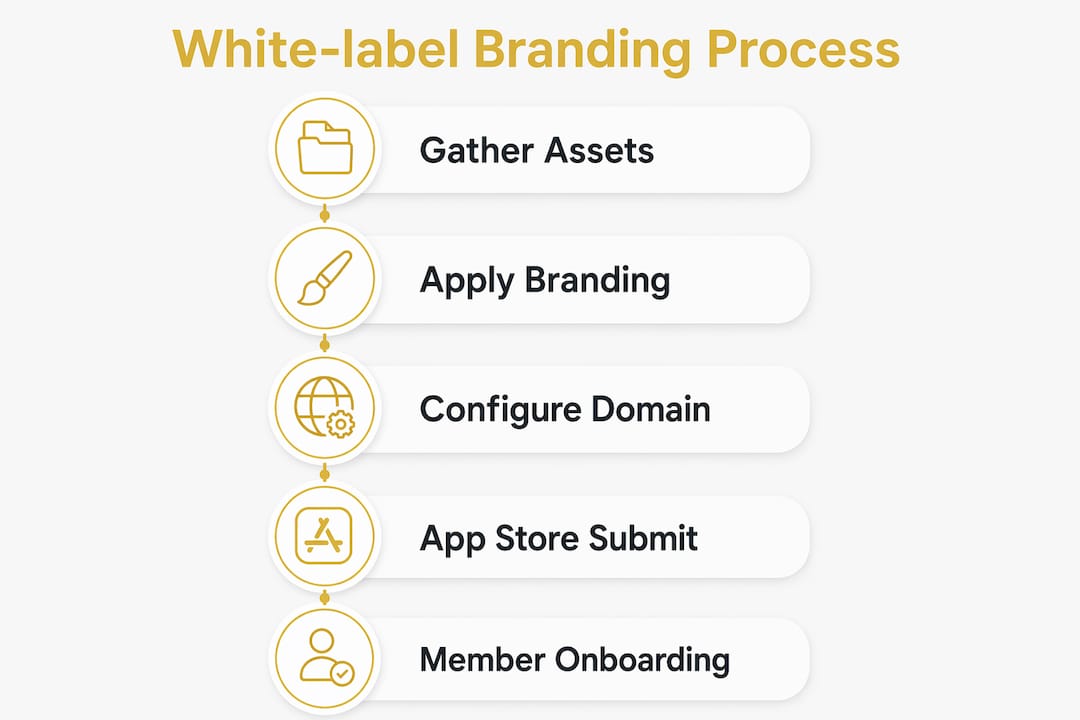
The process begins before a single line of code is touched. Your vendor needs a specific set of brand assets before they can apply your identity to the platform. Vendors require high-resolution logos in 1024×1024 PNG format with a transparent background, your primary brand hex colour codes, and a privacy policy URL that belongs to your club. Without these, the submission process stalls.
Once you hand over those assets, the vendor applies your branding across the app interface, member portal, email templates, and any store listings. This is not a simple logo swap. Every screen a member touches gets reviewed and updated. SuiteDash, for example, rebrand across all client surfaces including login pages, dashboards, outbound emails, and the mobile app, with zero vendor branding visible at any point.

The domain configuration is where many clubs fall short. A member logging in at a generic vendor URL immediately breaks the illusion of a club-owned platform. Custom subdomains require DNS configuration using CNAME records pointing to vendor servers, followed by domain verification and SSL provisioning. The practical outcome is that your members visit something like app.yourclub.com rather than a vendor-branded address. Removing vendor traces from URLs is one of the most impactful steps you can take for member perception.
App store submission adds another layer of timing to manage. Once the vendor prepares the branded build, it goes to Apple and Google for review. App store review typically takes one to three business days after submission, though rejections for policy reasons can extend this. Plan for at least two weeks from asset handoff to a live app in stores.
Pro Tip: Prepare your brand asset pack, including logos at multiple sizes, hex codes, and your privacy policy URL, before you even contact a vendor. Clubs that arrive with assets ready cut their launch timelines significantly.
The numbered steps below summarise the technical sequence:
- Compile brand assets: logo (1024×1024 PNG transparent), hex colour codes, privacy policy URL.
- Provide assets to vendor and agree on a branding preview timeline.
- Review vendor’s branding application across all UI surfaces and email templates.
- Configure your custom subdomain via DNS CNAME records and confirm SSL is active.
- Approve the branded app build and submit to Apple App Store and Google Play.
- Conduct a full audit of all member-facing touchpoints before launch.
What features do white-label club platforms include?
White-label branding is the visible layer, but the platform underneath it carries the real operational weight. Cohesive member journey integration is standard practice in quality white-label club platforms, meaning booking, payments, messaging, and access control all sit within the same branded environment.
The member portal is the centrepiece. Members log in to a branded dashboard where they can view their profile, manage bookings, check performance data, and update payment details without ever leaving what feels like your club’s own system. Mobile apps downloadable under your club’s name extend this experience to a device members carry everywhere. When a member sees your club’s icon on their home screen, the psychological association with your brand deepens every time they open it.
Here is how white-label platforms compare to non-branded alternatives:
| Feature | White-label platform | Non-branded alternative |
|---|---|---|
| Member portal branding | Fully branded with club logo and colours | Vendor branding visible throughout |
| Mobile app | Listed under club name in app stores | Listed under vendor name |
| Custom domain | app.yourclub.com | vendor.com/yourclub |
| Email communications | Sent from club domain with club branding | Sent from vendor domain |
| Member trust perception | High: members see only the club | Lower: vendor name creates confusion |
| Setup complexity | Moderate: requires asset prep and DNS config | Low: out-of-the-box vendor setup |
The distinction matters most at the moments of friction. When a member receives a payment receipt, a booking confirmation, or a password reset email, a non-branded platform sends that communication from a vendor address. A white-label platform sends it from yours. That consistency is what builds the kind of trust that reduces churn.
Key components typically included in white-label club platforms:
- Branded booking and scheduling interfaces
- Payment processing under the club’s domain
- Member self-service portals with branded dashboards
- Automated email communications from the club’s domain
- Mobile apps published under the club’s name
- Access control and attendance tracking within the branded environment
What are the benefits and limitations of white-label branding for clubs?
The benefits are concrete and measurable in member behaviour. White-label portals strengthen trust and loyalty by placing the club’s brand at every interaction point. Members who associate their development journey with your club’s identity are less likely to disengage when a competitor appears. Brand consistency across digital touchpoints is one of the clearest signals of a professional, well-run operation.
The control argument is equally strong. You decide what members see, when they see it, and how it is framed. Promotions, announcements, and performance updates all carry your brand’s voice rather than a generic vendor template.
The limitations, however, deserve equal attention. White-label platforms allow visual customisation but limit core functional changes without custom development. If the vendor’s booking workflow does not match how your club operates, rebranding the interface does not fix that. Clubs sometimes confuse brand identity with product differentiation. You can make the platform look entirely like yours, but the underlying features remain the vendor’s. Two clubs on the same platform may offer an identical member experience beneath different logos.
Pro Tip: After launch, audit every URL, email footer, and portal page for “Powered by” tags or vendor references. Thorough acceptance testing is the only reliable way to confirm the white-label experience is genuinely seamless.
Benefits at a glance:
- Full brand control across all member touchpoints
- Increased member trust through consistent club identity
- Professional perception without building proprietary software
- Faster time to market compared to custom development
Limitations to acknowledge:
- Feature customisation is constrained by the vendor’s product roadmap
- Multiple clubs on the same platform may have structurally similar experiences
- DNS and app store setup requires technical preparation
- Vendor dependency means platform changes are outside your control
How can clubs implement white-label branding effectively?
Effective implementation follows a two-phase workflow. Early branding handoff is critical to avoid delays in app store submissions and portal configuration. Clubs that treat branding preparation as an afterthought routinely push their launch dates back by weeks.
Phase one is entirely on your side. You gather and prepare every brand asset, confirm your privacy policy is live at a permanent URL, and decide on your subdomain structure. This phase should also include an internal review of how you want members to be addressed in automated communications. Tone of voice matters as much as visual identity.
Phase two transfers to the vendor. They apply your branding across the platform, configure your subdomain, and prepare the app build for store submission. Your role shifts to reviewing and approving. Build in at least one round of revisions. Vendors rarely get every detail right on the first pass.
The numbered implementation sequence:
- Finalise your brand asset pack: logos, hex codes, font preferences, and privacy policy URL.
- Choose and register your custom subdomain (e.g., app.yourclub.com).
- Submit assets to your vendor and agree on a preview deadline.
- Review the branded platform across desktop, mobile web, and app interfaces.
- Configure DNS CNAME records and confirm SSL certificate activation.
- Approve the app build and submit to Apple App Store and Google Play, allowing up to two weeks for review.
- Prepare member onboarding communications that introduce the new branded platform.
- Conduct a full audit of all touchpoints before sending member invitations.
Member onboarding communications deserve specific attention. Members who receive a clear, branded email explaining what the new platform is and why it benefits them adopt it far faster than those who receive a generic link. Frame the launch as a club upgrade, not a software migration.
Key takeaways
White-label branding works for clubs because it places the club’s identity at every member touchpoint while the vendor manages the underlying infrastructure, creating trust without the cost of building proprietary software.
| Point | Details |
|---|---|
| Brand assets come first | Prepare logos, hex codes, and privacy policy URL before contacting any vendor. |
| Domain configuration is non-negotiable | Custom subdomains via DNS CNAME records remove vendor traces and reinforce club identity. |
| Features stay vendor-controlled | White-label branding changes the visual layer only; core functionality remains the vendor’s product. |
| App store timelines need planning | Allow up to two weeks from asset handoff to a live branded app in stores. |
| Audit before launch | Check every URL, email, and portal page for vendor references before members see the platform. |
Why most clubs underestimate the branding handoff
The clubs I have seen struggle most with white-label implementation are not the ones with small budgets. They are the ones that treat branding as the last item on the project list rather than the first. They arrive at the vendor conversation without a finalised logo, without hex codes, and with a privacy policy that lives on a page nobody has updated in three years. The vendor cannot move until those assets are ready, and every day of delay pushes the app store submission back.
The second mistake I see consistently is conflating visual identity with product capability. A club will invest time making a platform look exactly right, then feel disappointed when the booking flow does not match their internal process. White-label branding is a powerful tool for member perception. It is not a substitute for choosing the right platform in the first place. Evaluate the product features first, then apply your brand to the one that fits your operation.
The clubs that get this right see a genuine shift in member engagement. When every email, every app notification, and every portal login carries the club’s identity, members stop thinking of their digital experience as separate from the club itself. That psychological integration is where loyalty is built. It is not glamorous work, but the preparation behind a clean white-label launch is what separates clubs that members stay with from clubs they drift away from.
— Chris
Take your club’s brand further with Levelup360hq
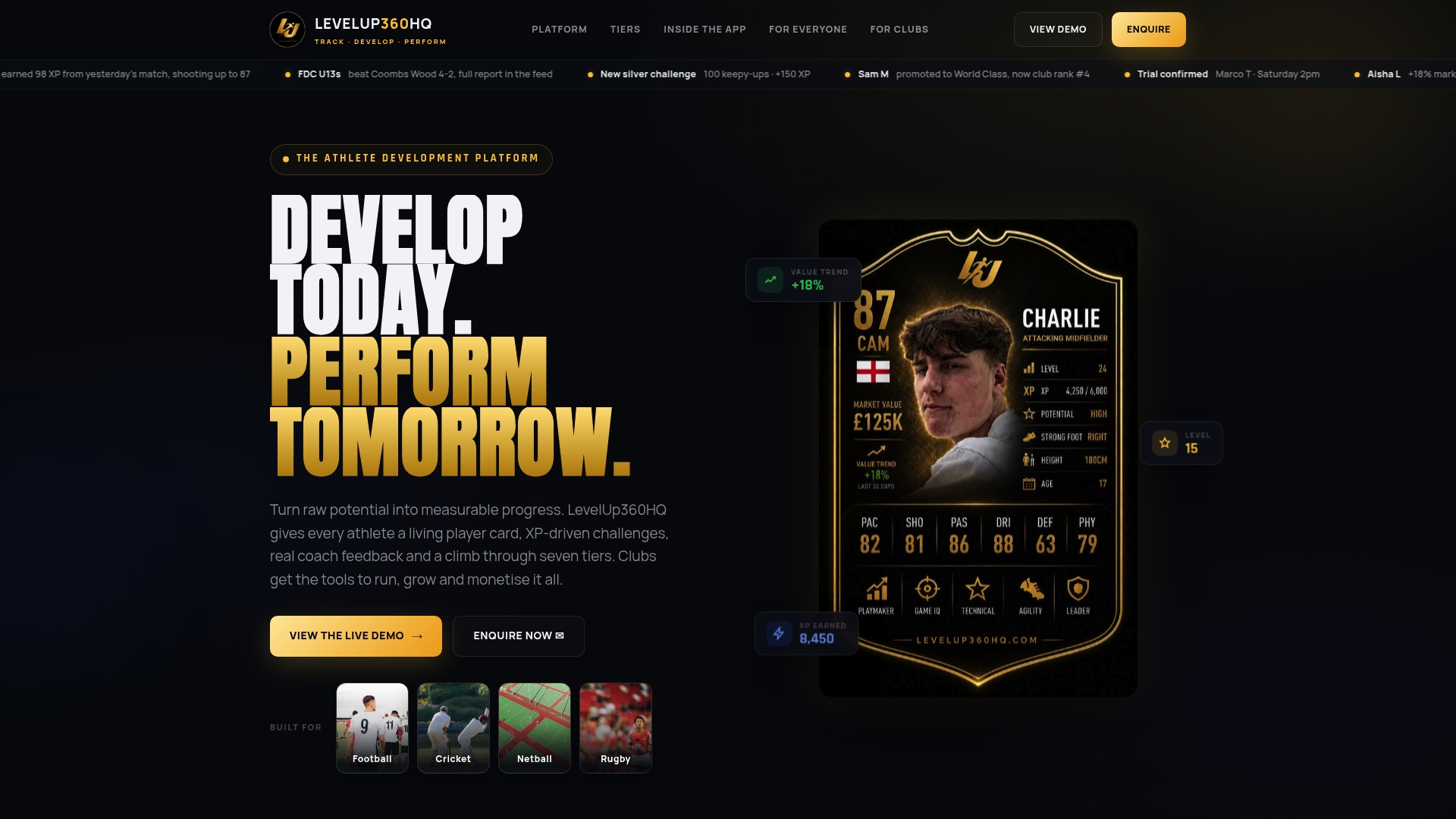
Levelup360hq is built for clubs that want complete control over how their brand appears to every athlete, coach, and member on the platform. From FIFA-style player cards and XP-driven challenges to CRM tools, subscription management, and store integrations, every feature sits under your club’s identity. Members see your logo, your colours, and your name across every touchpoint. Coaches manage sessions and assessments within your branded environment. If you are ready to put your club’s brand at the centre of your athlete development programme, explore Levelup360hq and see how the platform supports clubs across football, cricket, netball, and rugby.
FAQ
What does white-label branding mean for a sports club?
White-label branding means a vendor applies your club’s logo, colours, and name to their platform so members interact only with your brand. The vendor operates the product in the background while your identity appears at every touchpoint.
How long does it take to launch a white-label club app?
Allow at least two weeks from the point of submitting brand assets to your vendor. Apple and Google app store reviews typically take one to three business days, but revision cycles and DNS configuration add time.
Can clubs customise platform features with white-label branding?
White-label branding covers visual identity, not core functionality. Clubs can customise logos, colours, domains, and communications, but deeper feature changes require custom development beyond standard white-label agreements.
What brand assets do clubs need to provide to a vendor?
Vendors typically require a high-resolution logo in 1024×1024 PNG format with a transparent background, primary brand hex colour codes, and a live privacy policy URL before beginning the branding application process.
How do clubs remove vendor branding from URLs?
Clubs configure a custom subdomain (such as app.yourclub.com) by adding a CNAME record in their DNS settings pointing to the vendor’s servers, followed by domain verification and SSL provisioning to secure the connection.
Recommended
Turn potential into a player card.
LevelUp360 tracks every match, builds your child's player card, and shows their development over time.
Get started free