How to evaluate player skill growth effectively
Published 20 June 2026
Evaluating player skill growth is the systematic process of measuring progress in an athlete’s technical, tactical, physical, and mental abilities using diverse, evidence-based methods. Coaches and athletes who rely on gut feeling alone miss the patterns that structured assessment reveals. The most effective programmes combine observational coaching, standardised benchmarks, and technology-assisted tracking to build a complete picture of development. Platforms like Levelup360hq now make this process accessible across football, cricket, netball, and rugby, bringing performance analytics directly into the hands of coaches and athletes.
What are the essential metrics to assess player improvement?
Structured evaluation across technical, tactical, physical, and psychological domains is the foundation of fair and effective player assessment. Each domain captures a different dimension of performance, and missing one distorts the overall picture.
Technical skills are the most visible and measurable starting point:
- Passing accuracy and decision speed
- Shooting technique and conversion rate
- Ball control under pressure
- Sport-specific fundamentals (bowling line in cricket, set plays in netball)
Tactical awareness reveals how a player reads the game:
- Positioning relative to teammates and opponents
- Decision-making in transition
- Adaptability when a game plan breaks down
Physical attributes set the ceiling for technical execution:
- Sprint speed and endurance benchmarks
- Strength and agility scores against age-group norms
- Recovery rate between high-intensity efforts
Psychological traits are the hardest to quantify but the most predictive of long-term development:
- Composure under competitive pressure
- Coachability and response to feedback
- Consistency across varied conditions
Objective metrics, such as timed drills and GPS data, remove personal bias from the equation. Subjective observation from experienced coaches fills the gaps that numbers cannot capture. Combining multiple indicators such as tournament performance, adjusted scoring averages, and coaching evaluations provides a more reliable measure of development than any single metric. That combination is what separates a snapshot from a genuine developmental picture.
How to structure multi-session evaluations to track skill development

Experts recommend 2–4 evaluation sessions that progress from foundational skills through to tactical decision-making and competitive pressure scenarios. Spreading assessment across multiple sessions captures consistency rather than a one-off performance, which is far more useful for planning training.
A practical four-session structure works as follows:
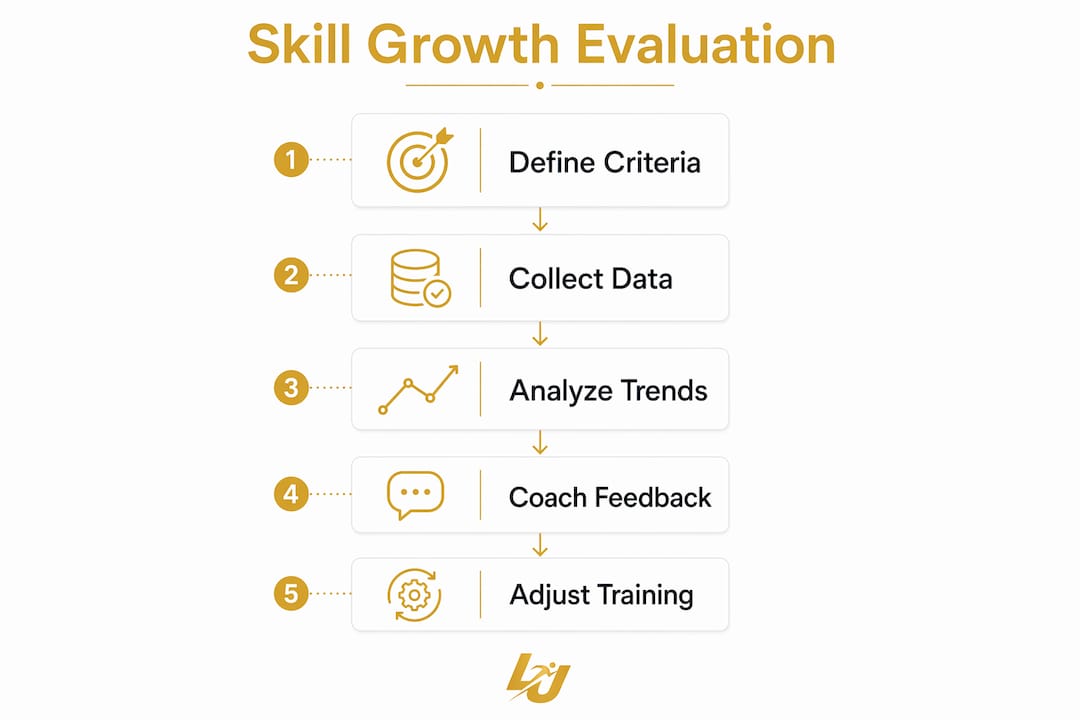
- Session one: technical baseline. Assess core technical skills in isolation. Use standardised drills with measurable outputs, such as passing completion rates or shooting accuracy from fixed positions. This gives you a clean starting point.
- Session two: physical and fitness benchmarks. Run timed fitness tests, agility circuits, and sport-specific movement patterns. Compare results against age-group norms to contextualise where the athlete sits relative to peers.
- Session three: tactical and decision-making scenarios. Move into small-sided games or position-specific drills that simulate real match conditions. Observe how the athlete applies technical skills when under tactical pressure.
- Session four: competitive pressure assessment. Use game-realistic scenarios, including opposition, time constraints, and score situations. This is where psychological traits such as composure and adaptability become visible.
Recording and maintaining longitudinal data from each session enables you to distinguish between genuine progress and temporary performance fluctuations. A player who performs well in session one but struggles in session four is telling you something important about their pressure response. That insight only exists because you tracked across multiple points.
Pro Tip: Standardise your documentation format from the very first session. Use the same scoring rubric, the same drill conditions, and the same evaluator wherever possible. Inconsistency in how you record data is just as damaging as inconsistency in how you train.
What role can technology play in evaluating player skill growth?
Technology is redefining athlete evaluation by automating skill identification and enabling more precise, scalable assessments across sports. The shift from clipboard notes to machine learning frameworks is not a future trend. It is happening now, and coaches who ignore it are working with incomplete information.
Advanced machine learning with 3D video analysis can achieve over 88% accuracy in action recognition and over 93% accuracy in evaluating specific basketball player skills. That level of precision removes the subjectivity that even experienced coaches carry into assessments. It also catches micro-movements and positioning patterns that the human eye misses in real time.
The table below summarises the key capabilities modern technology brings to skill evaluation:
| Technology | What it measures | Key benefit |
|---|---|---|
| 3D video analysis | Movement mechanics, positioning | Removes observer bias |
| Machine learning frameworks | Action recognition, skill execution | High accuracy at scale |
| GPS and wearable tracking | Sprint speed, distance, load | Objective physical data |
| Performance analytics platforms | Longitudinal progress trends | Identifies development patterns |
Video analysis and machine learning frameworks provide objective performance data that enhances training decisions. The practical implication is that coaches spend less time debating what they saw and more time acting on what the data confirms. For clubs working with large squads, automated tracking also scales in a way that manual observation never can.
Accessibility remains a genuine consideration. High-end 3D motion capture systems require significant investment. However, video-based analysis tools and platforms like Levelup360hq bring structured performance tracking within reach of community clubs and academies without specialist hardware. Video assessment features built into coaching platforms now allow coaches to review footage, annotate technique, and share feedback asynchronously.
Pro Tip: You do not need expensive equipment to start using video analysis. A fixed smartphone camera capturing training drills from a consistent angle gives you comparable footage across sessions. Consistency of camera position matters more than camera quality.
Traditional vs data-driven evaluation: which approach works better?
Neither traditional nor data-driven evaluation works best in isolation. The strongest evaluation programmes blend both, using each method where it has a genuine advantage.
| Method | Strengths | Limitations |
|---|---|---|
| Observational coaching | Contextual, relationship-aware | Subject to observer bias |
| Standardised skill tests | Objective, repeatable | Misses game-context performance |
| Tournament performance review | Real competitive data | Influenced by team quality and opposition |
| Automated video analytics | Scalable, bias-free, precise | Requires setup and technical literacy |
| Multi-source hybrid model | Comprehensive, longitudinal | Time-intensive to coordinate |
Multiple performance measures should be combined to guide coaching and training while prioritising long-term development transparency. A coach who only watches matches misses what happens in training. A system that only logs GPS data misses the tactical intelligence that no sensor captures. The hybrid model is not a compromise. It is the most accurate method available.
Percentile rankings and longitudinal tracking offer transparent views into long-term progress relative to peers. That transparency matters for athletes too. When a player can see their own data over time, development becomes concrete rather than abstract. Platforms like Levelup360hq use FIFA-style player cards with real-time ratings to make this visible in a format athletes actually engage with.
Youth swimming coaches at Peak Performance Swim Camp apply a similar philosophy, combining coach observation with performance benchmarks to track skill gains across training cycles. The principle transfers directly to team sports: no single method tells the whole story.
Common challenges when evaluating player skill growth
Observer bias and inconsistent evaluation timing are the two most common reasons skill assessments produce unreliable results. Standardising evaluation criteria and using multiple evaluators help address both problems directly.
The most frequent pitfalls coaches encounter include:
- Evaluating too infrequently. A single annual assessment captures a moment, not a trajectory. Quarterly or termly reviews give you the data to spot trends.
- Changing conditions between sessions. If session one uses a full-size pitch and session three uses a small-sided format, you are not comparing like with like.
- Relying on a single evaluator. One coach’s perception carries their own biases. A second evaluator or a video review adds a check on that.
- Ignoring psychological indicators. Technical scores without any record of composure or coachability miss half the picture.
- Failing to communicate findings to the athlete. Evaluation data that stays in a spreadsheet does not develop players. Transparent feedback conversations turn data into motivation.
Objective progress measurement is most effective when supported by coaching insights that explain how and why performance changes happen. Raw numbers tell you what changed. A coach’s contextual knowledge tells you why. Both are needed to design a training response that actually works.
Video analysis in swimming offers a useful parallel. Elite video analysis techniques show how automated systems identify technique flaws that coaches miss in real time, reinforcing the case for combining human observation with objective data across all sports.
Key takeaways
Effective player skill evaluation requires structured multi-session protocols, objective metrics, and coaching context working together across technical, tactical, physical, and psychological domains.
| Point | Details |
|---|---|
| Use four skill domains | Assess technical, tactical, physical, and psychological attributes for a complete picture. |
| Run 2–4 structured sessions | Progress from baseline drills to competitive pressure scenarios across multiple sessions. |
| Combine methods | Blend observational coaching, standardised tests, and video analytics for reliable results. |
| Document longitudinally | Track data across sessions to distinguish genuine progress from one-off performances. |
| Communicate findings | Share evaluation results with athletes directly to turn data into development motivation. |
What I have learned from years of watching evaluations go wrong
The biggest mistake I see coaches make is treating evaluation as a selection tool rather than a development tool. The moment assessment becomes about cutting players rather than growing them, the whole process loses its value. Athletes perform differently when they feel judged versus when they feel supported. That psychological shift shows up directly in the data.
The second thing I have noticed is that coaches who resist technology are often the ones who would benefit most from it. Subjectivity is not a strength. It is a liability when you are trying to track genuine progress over a season. A coach who has been watching a player for two years carries assumptions that cloud their reading of current performance. Video does not carry those assumptions.
That said, technology without coaching context is just numbers. Objective data needs a coach’s interpretation to become a training plan. The best evaluators I have worked with treat data as a starting point for a conversation, not a verdict. They sit down with the athlete, show them the numbers, and ask what the athlete thinks is driving the pattern. That dialogue produces better training outcomes than any algorithm alone.
The mindset shift that matters most is moving from “how good is this player right now” to “how fast is this player developing.” Rate of improvement is a better predictor of long-term potential than current ability. A player who improves consistently across six months of structured evaluation is worth more investment than a naturally talented athlete who plateaus.
— Chris
See your athletes’ progress in one place with Levelup360hq
Levelup360hq brings together everything coaches and athletes need to track skill development across sessions, sports, and seasons.

The platform’s performance analytics tools support multi-session monitoring with video assessments, coach approval workflows, and real-time player ratings displayed on FIFA-style player cards. Athletes see their own progress through XP-driven challenges, tier progression, and badge systems, which turns evaluation data into genuine motivation. Clubs and academies benefit from white-label branding and CRM tools that keep the entire development programme in one place. Explore the Levelup360hq demo to see how the platform handles skill tracking across football, cricket, netball, and rugby.
FAQ
What does it mean to evaluate player skill growth?
Evaluating player skill growth is the process of measuring an athlete’s progress across technical, tactical, physical, and psychological domains using structured, repeated assessments. It goes beyond a single test to track development over time.
How many evaluation sessions are recommended for accurate skill tracking?
Experts recommend 2–4 sessions that progress from technical baselines through to competitive pressure scenarios. Multiple sessions distinguish consistent progress from one-off performances.
How accurate is technology-based player evaluation?
Machine learning with 3D video analysis achieves over 88% accuracy in action recognition and over 93% accuracy in evaluating specific player skills. That level of precision significantly reduces observer bias.
What is the biggest challenge in assessing player improvement?
Observer bias and inconsistent evaluation timing are the most common reliability problems. Using standardised criteria and multiple evaluators addresses both issues directly.
Should coaches share evaluation results with athletes?
Transparent feedback is a best practice, not optional. Evaluation data shared directly with athletes converts assessment findings into motivation and gives players ownership of their own development.
Recommended
Turn potential into a player card.
LevelUp360 tracks every match, builds your child's player card, and shows their development over time.
Get started free