How to evaluate athlete market value in 2026
Published 30 June 2026

Athlete market value is defined as a multi-dimensional, data-driven estimate of an athlete’s financial worth to clubs, sponsors, and commercial partners. Accurately evaluating athlete market value requires quantifying four core pillars: performance, influence, exposure, and brand. Models like the On3 NIL valuation framework and platforms such as Transfermarkt have made this process more structured, but the methodology still demands careful interpretation. For athletes, agents, and sports professionals, getting this right directly shapes contract leverage and sponsorship income.
What key factors determine an athlete’s market value?
Performance is the foundation of any player valuation. On-field statistics, consistency across a season, and measurable achievements form the baseline from which all other factors build. A striker with 20 league goals carries a quantifiably different value than one with 8, even if their social profiles look identical.
Influence is the second pillar, and it carries more weight than most agents expect. Social media presence contributes 30–40% of total NIL valuation, weighted by platform-specific advertising spend. That figure means an athlete with 500,000 engaged followers on a high-CPM platform can command a significantly higher valuation than a peer with superior on-field numbers but minimal digital presence.

Exposure covers media visibility, market size, and league reach. An athlete competing in the Premier League receives far greater commercial exposure than one performing at the same level in a lower division. That exposure gap translates directly into sponsorship appeal and transfer fee expectations.
Brand is the fourth pillar, covering personal marketability, family-name recognition, and endorsement history. Athletes who have already secured commercial deals demonstrate proven brand demand. That history functions as evidence, not just aspiration.
Injury risk cuts across all four pillars. A 1% rise in serious injury probability corresponds to a 2.29% decrease in a football player’s market value. That relationship is statistically significant across European leagues, meaning injury history and physical profile must be factored into every valuation, not treated as a footnote.
- Performance: Goals, assists, minutes played, win contributions, and positional efficiency metrics
- Influence: Social media follower count, engagement rate, and platform ad-spend weighting
- Exposure: League tier, media coverage volume, and geographic market size
- Brand: Existing endorsements, public profile, and commercial track record
- Health: Injury history, current fitness status, and actuarial risk profile
Pro Tip: Never treat social media follower count as a proxy for influence value. Engagement rate and platform ad spend weighting determine commercial worth. An athlete with 100,000 highly engaged followers on a premium platform can outvalue one with 1 million passive followers on a low-CPM channel.
Which tools and data sources are essential to assess athlete market worth?
No single tool gives you the complete picture. Accurate valuation requires combining multiple data sources, each covering a different dimension of worth.
Transfermarkt is the most widely referenced public database for football player valuations. Its estimates are reliable for relative ordering within position and league, but they underestimate top-end transfers and do not account for contract-specific factors like buyer urgency or exclusivity premiums. Use Transfermarkt to benchmark, not to set a price.
Official league statistics databases provide the raw performance data that feeds into any credible model. Premier League, UEFA, and national federation databases publish verified match data that removes the subjectivity from performance assessment.
Social media analytics tools measure influence metrics. Platforms that track engagement rate, audience demographics, and estimated reach per post allow agents to translate follower counts into commercial value estimates with far greater accuracy than manual assessment.
Levelup360hq consolidates performance analytics, live player ratings, and market value tracking in one place. Its FIFA-style player cards update in real time, giving athletes and agents a single view of how performance changes affect overall valuation. That kind of live feedback loop is particularly valuable during contract negotiations, when conditions shift quickly.
Algorithmic models like On3 aggregate all four pillars into a single weekly-updated dollar figure. They are powerful, but algorithmic NIL models carry antitrust risk by potentially restricting fair compensation ranges through data-driven thresholds. Any agent relying solely on an algorithmic output without interrogating the underlying weightings is accepting someone else’s assumptions as fact.
| Tool or data source | Primary data input | Best use case |
|---|---|---|
| Transfermarkt | Transfer fees, age, position | Benchmarking relative value within league |
| Official league databases | Match statistics, appearances | Performance baseline assessment |
| Social analytics platforms | Follower count, engagement rate | Influence and NIL valuation inputs |
| Levelup360hq | Live ratings, performance logs | Real-time multi-factor valuation tracking |
| Algorithmic NIL models | All four pillars combined | Single-figure valuation for NIL negotiations |
Pro Tip: Cross-reference at least three data sources before presenting a valuation in a negotiation. A figure supported by Transfermarkt benchmarks, verified league stats, and social analytics carries far more credibility than one drawn from a single platform.
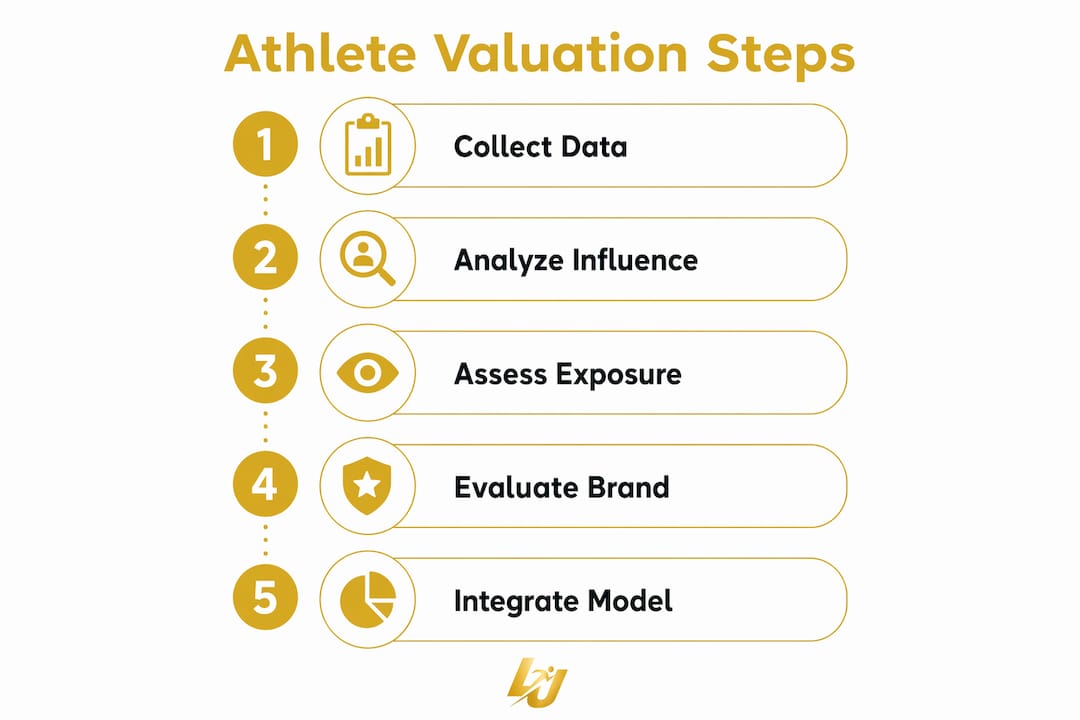
How to execute a step-by-step athlete valuation
A structured process removes guesswork and produces a defensible figure.
Step 1: Collect quantitative performance and health data. Pull verified statistics from official league databases covering the most recent 12–24 months. Include injury history, games missed, and any documented physical assessments. This is your baseline.
Step 2: Analyse influence through social media reach and engagement. Record follower counts across all active platforms, then calculate engagement rate per post. Apply platform-specific ad-spend weightings. Remember that social media influence accounts for 30–40% of NIL valuation, so this step materially affects the final figure.
Step 3: Assess exposure via media presence and market context. Document the athlete’s league tier, average broadcast audience, and volume of media mentions over the assessment period. An athlete in a top-five European league operates in a fundamentally different commercial environment than one in a regional competition.
Step 4: Evaluate brand strength. List existing endorsements, their contract values where available, and any measurable public profile indicators such as press coverage or speaking engagements. Athletes who have converted attention into income demonstrate commercial viability. Those with high influence volume but low commercial conversion leave revenue on the table by failing to translate reach into deals.
Step 5: Integrate inputs into a weighted model. Assign percentage weights to each pillar based on the sport and market context. A football player in the Premier League might weight performance at 40%, influence at 30%, exposure at 20%, and brand at 10%. Run the weighted calculation to produce a single estimated value. Then stress-test it: remove the top-performing pillar and see how much the figure drops. That sensitivity check reveals where the athlete’s value is most concentrated and most vulnerable.
Common pitfalls to avoid include over-weighting a single exceptional season, ignoring injury risk entirely, and treating the output as a guaranteed price rather than a negotiating anchor.
What are the common challenges when assessing athlete market value?
Valuation is not uniform across sports or leagues. La Liga models weight experience and speed more heavily, while Premier League models prioritise goals and assists. An agent who applies the same formula across both leagues will produce inaccurate figures in at least one of them. Valuation models must adapt to sport-specific priorities and market contexts to remain commercially relevant.
The distinction between relative ordering and absolute valuation matters enormously in negotiation. Transfermarkt values function best as relative-ordering tools for establishing negotiating leverage, not as precise contract price predictors. Presenting a Transfermarkt figure as a definitive asking price weakens your position the moment the other party questions the methodology.
Tax implications add another layer of complexity. Over-allocating income to image rights carries significant legal and financial risk. Image rights valuations must reflect commercial reality, and any contract must clearly define licensed rights and payment allocations. 68% of NIL deals are valued below £1,000, and self-employment tax adds a 15.3% burden on top of that. For athletes at the micro-influencer tier, tax structure can meaningfully affect net income from sponsorship deals.
Injury risk remains the most underestimated variable in most valuations. Agents frequently focus on peak performance data while discounting the probability of future unavailability. A player with a recurring hamstring problem carries a structurally different risk profile than the statistics alone suggest.
Key takeaways
Accurate athlete valuation combines performance data, social influence metrics, exposure context, and brand history into a weighted model that informs negotiation without replacing professional judgement.
| Point | Details |
|---|---|
| Four-pillar framework | Performance, influence, exposure, and brand must all feed into any credible valuation. |
| Injury risk is quantifiable | A 1% rise in serious injury probability reduces football market value by 2.29%. |
| Social media drives 30–40% of NIL value | Platform ad-spend weighting determines commercial worth, not follower count alone. |
| Relative ordering beats absolute pricing | Use valuations to establish negotiating leverage, not as fixed asking prices. |
| Tax and image rights require care | Image rights allocations must reflect commercial reality to avoid legal and financial risk. |
The number agents get wrong every time
The most common mistake I see is treating a valuation as a price tag. It is not. A valuation is an argument. It is a structured, evidence-based position you take into a room and defend. The moment you present a figure without being able to explain every input behind it, you lose credibility and leverage simultaneously.
What I have found works is building the valuation in layers, starting with the performance baseline and adding each pillar in sequence. That way, when a club’s negotiator pushes back on the headline figure, you can point to exactly which component they are disputing and why the data supports your position. Vague valuations invite vague counter-offers.
The other thing worth saying plainly: valuations go stale fast. A figure built on last season’s data is already outdated by pre-season. Markets shift, injuries happen, social audiences grow or shrink. Regular updates are not optional for serious career management. Platforms like Levelup360hq that update ratings and market values in real time give athletes and agents a live picture rather than a quarterly snapshot. That responsiveness changes how you approach negotiations entirely.
— Chris
How Levelup360hq supports athlete market value tracking
Knowing the factors that shape your value is one thing. Tracking them continuously is another.

Levelup360hq brings performance analytics, live player ratings, and market value tracking together in a single platform built for athletes, coaches, and clubs. Its FIFA-style player cards update in real time as performance data changes, giving you a live view of how your training and match outputs affect your commercial worth. Whether you are preparing for a contract renewal or building a sponsorship pitch, having structured, up-to-date data behind your position makes every conversation more credible. Explore the platform or view a live demo to see how it works in practice.
FAQ
What does market value mean for athletes?
Athlete market value is a data-driven estimate of an athlete’s financial worth to clubs, sponsors, and commercial partners. It combines performance metrics, social influence, media exposure, and brand strength into a single figure used for contract and sponsorship negotiations.
What is the biggest factor in player valuation?
Performance statistics form the baseline, but social media influence contributes 30–40% of NIL valuation in modern models. The relative weight of each factor varies by sport, league, and the specific commercial context of the deal.
How accurate are platforms like Transfermarkt for valuation?
Transfermarkt is reliable for comparing players within the same position and league, but it underestimates top-end transfer fees and does not account for contract-specific variables like buyer urgency. Use it as a benchmarking tool, not a definitive price.
How does injury risk affect an athlete’s market value?
Injury risk has a direct, measurable impact. A 1% increase in serious injury probability reduces a football player’s market value by 2.29%, based on data from the main European leagues.
Do valuation methods differ between sports and leagues?
Yes. La Liga and Premier League models weight attributes differently, with La Liga favouring experience and speed and the Premier League prioritising goals and assists. Any valuation model must be calibrated to the specific sport and market to produce accurate results.
Recommended
Turn potential into a player card.
LevelUp360 tracks every match, builds your child's player card, and shows their development over time.
Get started free