How to assign challenges to players effectively
Published 1 June 2026

Assigning challenges to players is the practice of designing and distributing personalised tasks that align with each athlete’s current skill level, development goals, and training context. Done well, it is one of the most direct levers a coach has for sustaining player engagement and accelerating skill growth. Generic, one-size-fits-all tasks lose players quickly. Structured, tiered player challenge assignments keep athletes motivated, give them a clear sense of progress, and make your sessions measurably more productive. Platforms like AccelByte Gaming Services, Kahoot, and frameworks such as APAR have formalised what experienced coaches have long known: the architecture of a challenge matters as much as the challenge itself.
What are the best tools to assign and manage player challenges?
Digital platforms have changed how coaches create challenges for players, reducing the administrative friction that once made personalised assignment impractical at scale. The right tool depends on your squad size, the sport, and whether you need synchronous or asynchronous delivery.
| Platform | Best use case | Key feature |
|---|---|---|
| AccelByte Gaming Services | Skill-tiered challenge assignment | Custom goal mix per player level via AGS Extend |
| Kahoot | Asynchronous knowledge and tactical tasks | Self-paced completion with shared PIN or QR code |
| Heroic Labs (Hiro) | Team-based recurring challenges | CRON-scheduled resets with dependency gating |
| Levelup360hq | Full athlete development cycle | XP challenges, badge systems, and video assessments |
AccelByte’s challenge module lets coaches assign goals per player using custom logic tied to player level, meaning a Level 66 athlete receives a different mix of easy, medium, and extreme sub-goals than a Level 20 teammate. That granularity is what separates a development tool from a glorified to-do list.

Kahoot takes a different approach. Asynchronous player assignments become available immediately after a coach publishes them, with participants completing tasks on their own devices before a set deadline. This suits tactical quizzes, video analysis tasks, or pre-session preparation work where gathering the whole squad simultaneously is not practical.
Pro Tip: When selecting a platform, prioritise one that tracks individual completion and progress rather than just group averages. Aggregate data hides the players who are struggling or disengaged.
The common thread across all effective platforms is reduced friction. Digital assignment delivery removes the need for simultaneous sessions and lets coaches monitor uptake in real time, which is particularly valuable for academies managing large squads across multiple age groups.
How to personalise challenges based on player attributes
Personalisation is not about giving every player a unique task from scratch. It is about varying the difficulty mix and the type of sub-goals based on measurable player attributes such as current rating, recent performance data, or tier progression.
The AccelByte model offers a practical template. Rather than assigning identical tasks, coaches can vary difficulty by level, giving lower-tier players more attainable goals alongside one or two stretch targets, while advanced players receive a heavier weighting of extreme goals. This keeps every athlete in a productive zone: challenged enough to grow, but not so overwhelmed that they disengage.
Heterogeneous squads, which describe almost every real-world training group, require this kind of differentiation. A U16 football academy might have players ranging from grassroots level to regional scholarship standard in the same session. Assigning the same passing drill challenge to both groups produces boredom at one end and anxiety at the other.
The APAR gamification framework provides a structural model for this. APAR separates the challenge experience into four stages: experience, feedback, achievement, and reinforcement. Each stage must be aligned to the player’s current position in their development arc. A player who has just mastered the basics needs feedback that confirms competence before being pushed toward the next achievement tier. Skipping that feedback stage is one of the most common reasons players plateau or lose motivation.
- Assess baseline attributes. Use performance data, session ratings, or coach observation to place each player in a tier before assigning tasks.
- Define the difficulty mix. For each tier, decide the ratio of attainable goals to stretch goals. A 60/40 split (attainable to stretch) works well for developing players.
- Align feedback to each sub-goal. Every completed task should trigger a response, whether that is a coach comment, a badge, or an XP award.
- Schedule a progression review. Set a fixed point, weekly or fortnightly, where tier placements are reviewed and challenge mixes are updated.
Pro Tip: Avoid assigning challenges based solely on age group. Two 15-year-olds can be two full development tiers apart. Use performance metrics, not birthdays, to set difficulty.
What step-by-step process should coaches follow to assign tasks?
A repeatable process for how to assign challenges removes guesswork and makes your programme scalable across multiple coaches and squads. The following framework draws on scaffolded learning research and practical platform workflows.
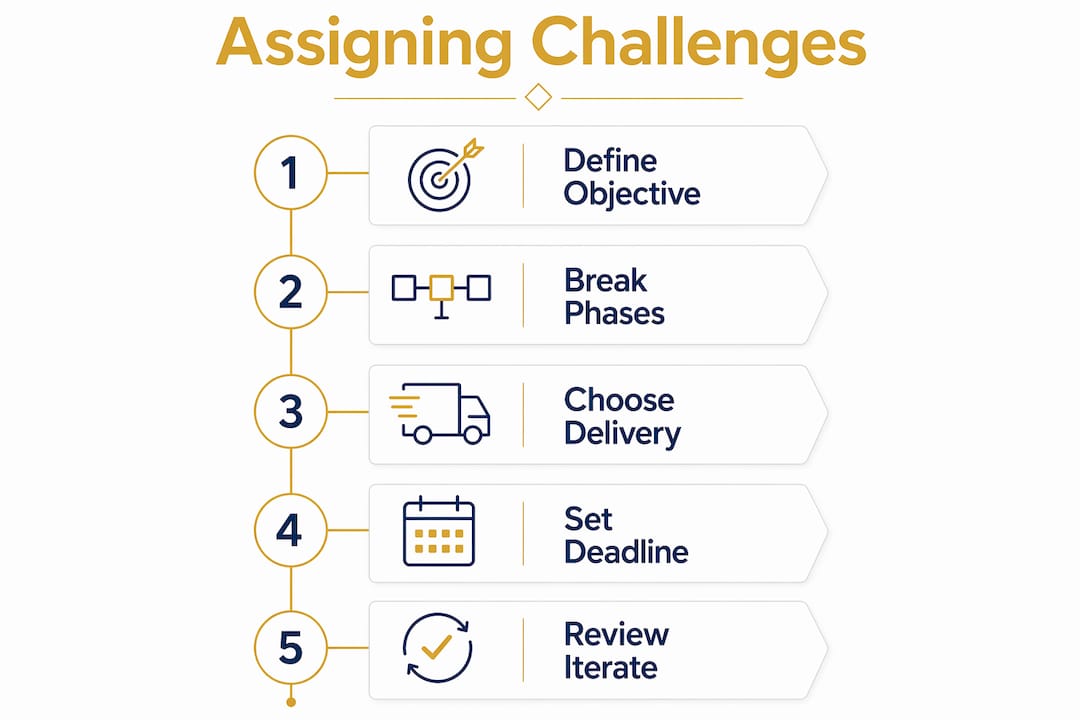
Step 1: Define the training objective
Every challenge must map to a specific, observable outcome. “Improve passing” is not an objective. “Complete 20 accurate short passes under pressure in a rondo drill” is. Specificity makes completion trackable and gives players a clear target.
Step 2: Break the challenge into phases
Three-stage scaffolding is the most evidence-backed structure for skill acquisition. The three phases are guided exploration, interactive practice, and reflective analysis. In a football context, this translates to: watch a video of the technique, practise it in a controlled drill, then review your own performance footage and identify one adjustment. Each phase builds on the last and prevents players from jumping straight to performance attempts without the necessary preparation.
Step 3: Choose synchronous or asynchronous delivery
Synchronous assignment works for on-pitch drills where real-time coaching feedback is available. Asynchronous delivery suits video tasks, tactical quizzes, or conditioning challenges that players complete independently. Kahoot’s workflow, using a game PIN, shared link, or QR code, is a clean model for the latter. Players access the task on their own device, complete it at their own pace, and the coach receives completion data automatically.
Step 4: Set a clear deadline and access method
Challenges without deadlines are wishes. Set a specific completion date, communicate the access method clearly, and confirm that every player has received the task. A simple tracking table helps here:
| Challenge | Player tier | Delivery method | Deadline | Completion status |
|---|---|---|---|---|
| Rondo passing drill | Developing | On-pitch | Session 4 | Pending |
| Tactical video quiz | All tiers | Kahoot link | 48 hours | Tracking |
| Defensive shape task | Advanced | Video review | 72 hours | Completed |
Step 5: Review and iterate
After the deadline, review completion rates and performance data. Adjust the difficulty mix for the next cycle. Performance improves when players first explore guided challenges, then practise interactively, followed by reflection to adjust strategy. That loop only works if the coach closes it with a review.
Pro Tip: Build your challenge review into your existing session planning schedule rather than treating it as a separate task. Fifteen minutes of data review after each session is enough to keep assignments calibrated.
How to implement recurring and team-based challenges
Recurring challenges are the mechanism that turns one-off tasks into a development system. Without scheduled resets and progression checkpoints, even well-designed individual challenges lose momentum after a few weeks.
Heroic Labs’ Hiro platform demonstrates the architecture clearly. Recurring team achievements can be configured with CRON-based scheduling, sub-achievement dependencies, and automated resets. In practice, this means a monthly team challenge resets on the first of each month, with sub-tasks that must be completed in sequence before the next tier unlocks. The structure creates anticipation and shared purpose.
For coaches working without dedicated gaming infrastructure, the same principles apply manually:
- Set a fixed reset cadence, monthly for team challenges, weekly for individual skill tasks.
- Design sub-achievements that gate access to the next challenge tier. A player must complete three defensive positioning tasks before unlocking the advanced pressing challenge.
- Use shared leaderboards or group progress displays to make team progress visible to all squad members.
- Reward completion at the group level as well as individually. Team-based rewards build collective identity and make individual effort feel connected to a larger goal.
The psychological mechanism here is well understood. Shared goals create accountability that individual targets cannot replicate. When a player knows their incomplete task is holding the team back from unlocking the next challenge tier, the social pressure to complete it is far more effective than any coach reminder.
Common mistakes when assigning challenges to players
The most damaging mistake coaches make is assigning uniform challenges to a diverse group. Customised assignments improve engagement and skill development precisely because they respect where each player actually is, not where the coach wishes they were.
Four other mistakes appear consistently across training programmes:
- Overloading players with simultaneous challenges. Three active challenges at once is a practical ceiling for most athletes. Beyond that, cognitive load reduces the quality of effort on each task.
- Omitting feedback loops. A challenge without a feedback mechanism is just a task. The APAR framework treats feedback as a structural requirement, not an optional extra.
- Setting difficulty too high too soon. Stretch goals motivate when players have a foundation to build from. Assigned without scaffolding, they produce anxiety and avoidance.
- Neglecting reflective phases. The third stage of scaffolded learning, reflective analysis, is the one most coaches skip under time pressure. It is also the stage where strategy adjustments happen and learning consolidates.
Pro Tip: After assigning a new challenge set, ask three players from different tiers to describe what they are working on and why. If they cannot articulate the purpose, the challenge design needs more clarity.
Key takeaways
Effective player challenge assignments require personalised difficulty, structured progression, and consistent feedback loops to produce measurable development gains.
| Point | Details |
|---|---|
| Personalise by player tier | Vary the mix of attainable and stretch goals based on each player’s current performance level. |
| Use scaffolded phases | Structure every challenge across exploration, practice, and reflection stages to consolidate learning. |
| Choose the right delivery method | Match synchronous or asynchronous assignment to the task type and squad availability. |
| Build recurring systems | Use scheduled resets and dependency gates to maintain momentum across weeks and months. |
| Close the feedback loop | Every completed challenge must trigger a response: a rating, badge, coach comment, or XP award. |
Why challenge assignment is the most underrated coaching skill
Most coaches spend the majority of their planning time on session design and almost none on how they distribute individual tasks between sessions. That imbalance is a mistake I have seen repeatedly across football academies and multi-sport clubs. The session is one hour. The week is 168 hours. What you assign players to do in the other 167 hours determines how quickly they develop.
The shift I have observed when coaches move from generic group tasks to tiered, personalised assignments is not subtle. Players who previously seemed disengaged turn out to have been bored, not unmotivated. Players who appeared to be underperforming were often just overwhelmed by tasks pitched too far above their current level. Calibrating the difficulty mix, as the AccelByte model demonstrates, is not a technical luxury. It is basic coaching hygiene.
The reflective phase is the piece I would argue hardest for. Coaches under time pressure cut it first. That is precisely backwards. A player who completes a drill and immediately moves to the next task retains far less than one who spends five minutes reviewing what worked and what to adjust. The three-stage scaffolding research confirms this, but any experienced coach who has run video review sessions already knows it intuitively.
The future of challenge assignment in sports is not more technology. It is better thinking about progression architecture. The tools exist. The frameworks exist. The gap is coaches treating challenge design as a deliberate, structured discipline rather than an afterthought.
— Chris
How Levelup360hq supports your challenge assignment process

Levelup360hq is built specifically for coaches who want to move beyond generic training tasks and into structured, personalised player development. The platform’s XP-driven challenge system lets you assign and track challenges across individual players and squads, with tier progression, badge rewards, and performance analytics that close the feedback loop automatically. FIFA-style player cards update in real time as athletes complete tasks, giving both coaches and players a live picture of development. Whether you coach football, cricket, netball, or rugby, Levelup360hq gives you the infrastructure to design, distribute, and monitor player challenge assignments without the administrative overhead that typically makes personalisation impractical at scale.
FAQ
What does it mean to assign challenges to players?
Assigning challenges to players means distributing personalised, structured tasks that align with each athlete’s skill level and development goals. The aim is to drive engagement and measurable improvement through targeted effort between and during training sessions.
How do I personalise challenges for different player levels?
Use performance data or tier ratings to vary the difficulty mix of each player’s tasks. AccelByte’s model recommends assigning a blend of easy, medium, and extreme sub-goals calibrated to each player’s current level rather than applying the same task to the whole squad.
How often should player challenges be reset or updated?
Weekly resets work well for individual skill challenges, while team-based challenges suit a monthly cadence. Heroic Labs’ recurring achievement system uses CRON-scheduled resets with dependency gates to maintain momentum and prevent stagnation.
What is the biggest mistake coaches make when assigning tasks?
Assigning uniform challenges to a diverse group is the most common and damaging error. Players at different development levels need different difficulty mixes to stay motivated and continue progressing.
Do I need a digital platform to assign challenges effectively?
A digital platform is not strictly required, but it significantly reduces friction and improves tracking. Tools like Levelup360hq, Kahoot, and AccelByte automate delivery, monitor completion, and provide feedback data that would take considerable manual effort to replicate without technology.
Recommended
Turn potential into a player card.
LevelUp360 tracks every match, builds your child's player card, and shows their development over time.
Get started free