Gamified Sports Training: What Works and How to Start
Published 13 November 2026

Gamified sports training applies game mechanics such as points, levels, badges and feedback loops to practice that athletes would otherwise find routine. It works best when the mechanics reward the right behaviours, such as good technique and turning up consistently, and when the coach stays in charge of the purpose. For clubs and academies, a platform that keeps live player cards, XP challenges, tiers and video assessments in one place makes that structure far easier to run, which is what LevelUp360HQ is built for.
TL;DR
- Gamification adds game elements (points, levels, leaderboards) to existing training. Game-based training replaces drills with modified games. Most strong programmes use both.
- Reward technique first, results second. Research on scoring mechanics suggests novices do best when feedback is about how they move, with outcome scoring added as they progress.
- Keep the feature set right-sized. More badges and meters do not automatically mean more motivation.
- With young athletes, protect enjoyment and long-term development: watch training load, avoid pressure, and follow safeguarding practice.
- Judge any gamified activity by whether attendance, effort and skill transfer improve, then adjust it.
Table of Contents
- What gamified sports training actually means
- Game mechanics that coaches can use
- What the research says about effects
- Matching the mechanics to the athlete
- Tracking progress without letting rewards take over
- Keeping young athletes safe and motivated
- How to tell whether a gamified activity is working
- Running it across a whole club
- Try it with your club
- Our perspective
- FAQ
- Sources
What gamified sports training actually means
Gamification is the use of game design elements in contexts that are not games. The idea took off around 2010, on the reasoning that if video games capture so much attention, applying their design elements to non-game activities should raise attention and engagement. In sport, that means the sprint session, the passing drill or the weekly fitness test gets a points system, a level to reach or a challenge to complete.
It is often confused with game-based training, which is a different thing. A game-based approach is a way of teaching and coaching in which modified games provide the framework for developing thoughtful, creative and skilful players. In that model, players start by playing a modified version of the sport, work through tactical and skill activity, then return to play, with the coach facilitating through questions and reflection.
The practical difference:
| Gamification | Game-based approach | |
|---|---|---|
| What changes | The wrapper: points, levels, badges, leaderboards | The activity itself: modified or small-sided games |
| Typical example | XP for completing a weekly skills challenge | A 3v3 game with a rule that forces quick passing |
| Coach’s role | Sets challenges, rewards and feedback | Designs constraints and asks questions |
| Main risk | Rewards become the goal | Games lack a clear learning purpose |
The two combine well. A small-sided game can carry a scoring rule tied to technique, and the results can feed a progression system that athletes see and care about.
Game mechanics that coaches can use
Score the behaviour you want
The most useful finding for coaches comes from a 2026 CHI Conference study. Researchers built a game to teach the optimal shooting arc for basketball free throws and compared scoring based on technique (knowledge of performance), on results (knowledge of results) and on both. Technique feedback proved essential to adopting a new technique, while results feedback improved engagement. Combining the two worked but could be overly complex for novices.

The translation to a training session is simple. If you want a winger to cut inside with the correct body shape, award points for the shape, not only for the goal. If you want a cricketer to keep a still head at the crease, score that. Outcome points alone teach athletes to chase outcomes, however they get them.
Give feedback on demand and just in time
A 2021 paper by Robertson and Woods draws 13 principles from good video game design for sport practice. Among them: co-designing practice tasks with athletes, giving on-demand and just-in-time feedback, and letting athletes lead parts of sessions so they have freedom to design activities they think will improve their performance. Games are good at this because the player always knows how they are doing and what to try next. Practice often is not.
Use constraints, not lectures
Small area games are one of the best vehicles for gamified practice. According to a coaching article by Barry Jones, they are scaled, representative, constrained and purposeful: smaller space, fewer players and tighter time, with decisions that reflect the real game, and rules that shape behaviour without dictating it. The athlete wrestles with the problem rather than listening to a step-by-step breakdown.

Close the gap between drill and match speed
Sprint coach Kyle Davey argues that gamified drills bridge the gap between technique work and game-speed performance, and that pairing technique work with gamified drills while coaching continues helps the technique carry over to the field. The coaching does not stop when the game starts.
What the research says about effects
The evidence is encouraging but specific, so it is worth being precise about what is and is not shown.
- Game-based approaches and decision-making. A 2025 systematic review and meta-analysis of 28 articles (n=1,600) found positive effects on decision-making in game situations and on motor skill in skill tests. The effect sizes were an increase of 11.41% for decision-making and g = 0.36 for skill tests.
- Gamified feedback. A 2026 quasi-experimental study of university physical education students found that a gamified AI movement assessment and feedback approach significantly improved movement skill performance and learning engagement compared with a conventional AI feedback approach.
- Youth players. In a 2017 study, a Teaching Games for Understanding intervention with 19 young sailors produced statistically significant gains in decision-making, skill execution, game performance and game involvement.
- Retention. The basketball study also showed that techniques learned in the training game were retained after playing, at least in the short term.
- Adherence. Davey’s argument is practical: fun drives attendance and attendance drives adherence, so an 80% effective programme attended fully for six months beats a 100% effective one attended 80% of the time for two months. This matters most with youth athletes.
The lesson is not that more game elements always help. A 2025 study in Frontiers in Psychology found an S-shaped relationship: exercise adherence intention rose from low to moderate feature richness, then weakened when feature sets became excessive. A small set of mechanics tied to clear goals beats a screen full of meters.
Matching the mechanics to the athlete
A single design will not fit a ten-year-old netball player and a 17-year-old academy striker. Three adjustments do most of the work.
Skill level. The CHI study recommends a progression: start novices with technique-based scoring to build confidence, then move to results and technique together as proficiency grows. In a tiered system this is natural. Early tiers reward process (correct grip, stance, scanning habit). Later tiers add outcomes (completion rates, match contribution).
Age. Younger athletes need short loops, visible progress and plenty of play. Older ones can handle more data and longer goals. In a study of 101 highly trained youth soccer players averaging 16.2 years, small-sided games improved fitness measures more appropriately than high-volume training for the U16 and U19 groups, which shows that game formats can carry real physical load.
Sport and goal. A football squad might run a weekly first-touch challenge. A cricket academy might track bowling accuracy against a target zone. A rugby side might score support-line decisions. The principle is the same: pick one skill, define what good looks like, and make progress visible.
Tracking progress without letting rewards take over
Progress tracking is where gamified training succeeds or goes wrong. Robertson and Woods stress that the timing and frequency of feedback shape learning, and that well-timed feedback can engage and motivate performers and reduce their reliance on an educator.
There is a caution too. A University of Florida study of US collegiate staff found that coaches are deliberate about sharing data, often simplifying it, and are careful about showing one athlete’s numbers to another because student-athletes are very competitive. The same care applies to leaderboards. Some rules of thumb:
- Rank effort and improvement as well as raw ability. A leaderboard that only shows the best players tells everyone else they are losing.
- Make personal progress the default view. Let athletes see their own trend first.
- Pair every metric with a decision. If a number moves, you should know what you will do about it.
- Keep individual work in the same picture. Strength and conditioning logs can sit alongside technical challenges, for example through a strength training app for Apple Watch that records sets, sleep and heart rate.
- Use rewards that point back to the sport. Unlocking a harder challenge is better than unlocking a cosmetic badge.
Keeping young athletes safe and motivated
Gamification adds competition, and competition needs guardrails, especially for children.
The American Academy of Pediatrics (2024) identifies training volume, overscheduling and pressure from parents, coaches or peers as risk factors for burnout, and notes that burnout rates are lower when success is defined by intrinsic goals rather than performance. It also associates controlling coaching, perfectionism and extrinsic motivation with higher burnout likelihood, while long-term development and communication are protective.
For gamified programmes, this means:
- Set challenges that reward learning, effort and consistency, not just winning.
- Cap how many challenges an athlete can take on in a week, so XP cannot push anyone into extra training.
- Keep training loads age-appropriate. The US Department of Health and Human Services youth sports report (2020) recommends that programme leaders minimise abuse, burnout, injury, overuse and stress, use age-appropriate training loads, run background checks on all adults interacting with youth, and require pre-participation evaluations.
- Decide who can see what. Parents, coaches and scouts do not all need the same view of a young player’s data.
If a child has a medical condition or an injury, the right person to set limits on training is their doctor or paediatrician, not a points system.
How to tell whether a gamified activity is working
Here the published evidence is thin, so treat this as a practical method built on the principles above rather than a proven protocol.
- Define the purpose before launch. Write one sentence: “This challenge exists to improve X.” If you cannot, drop it.
- Watch behaviour, not just scores. Are more athletes attending, trying the challenge unprompted and repeating it? Davey’s logic says attendance is the foundation of adherence.
- Check transfer. Does the skill appear in matches or full-speed play? The meta-analysis found gains in skill tests and decision-making but no significant effect on motor skill in game situations overall, so check transfer instead of assuming it.
- Ask the athletes. Co-design is one of the principles Robertson and Woods describe, and a quick five-minute conversation shows whether a mechanic is motivating or just noisy.
- Look for gaming of the system. If players chase points with shortcuts, your scoring rewards the wrong thing. Change the rule.
- Retire and rotate. If participation drops after a few weeks, or if the feature set has grown too large, remove elements. The S-shaped finding suggests that less is often more.
Review every four to six weeks, at the end of a training block, and keep what moved the behaviour you wanted.
Running it across a whole club
A single coach can run a points chart on a whiteboard. A club with several age groups, volunteers, parents and sports needs consistency: the same tiers, the same definitions of a skill, the same rules on who sees data.
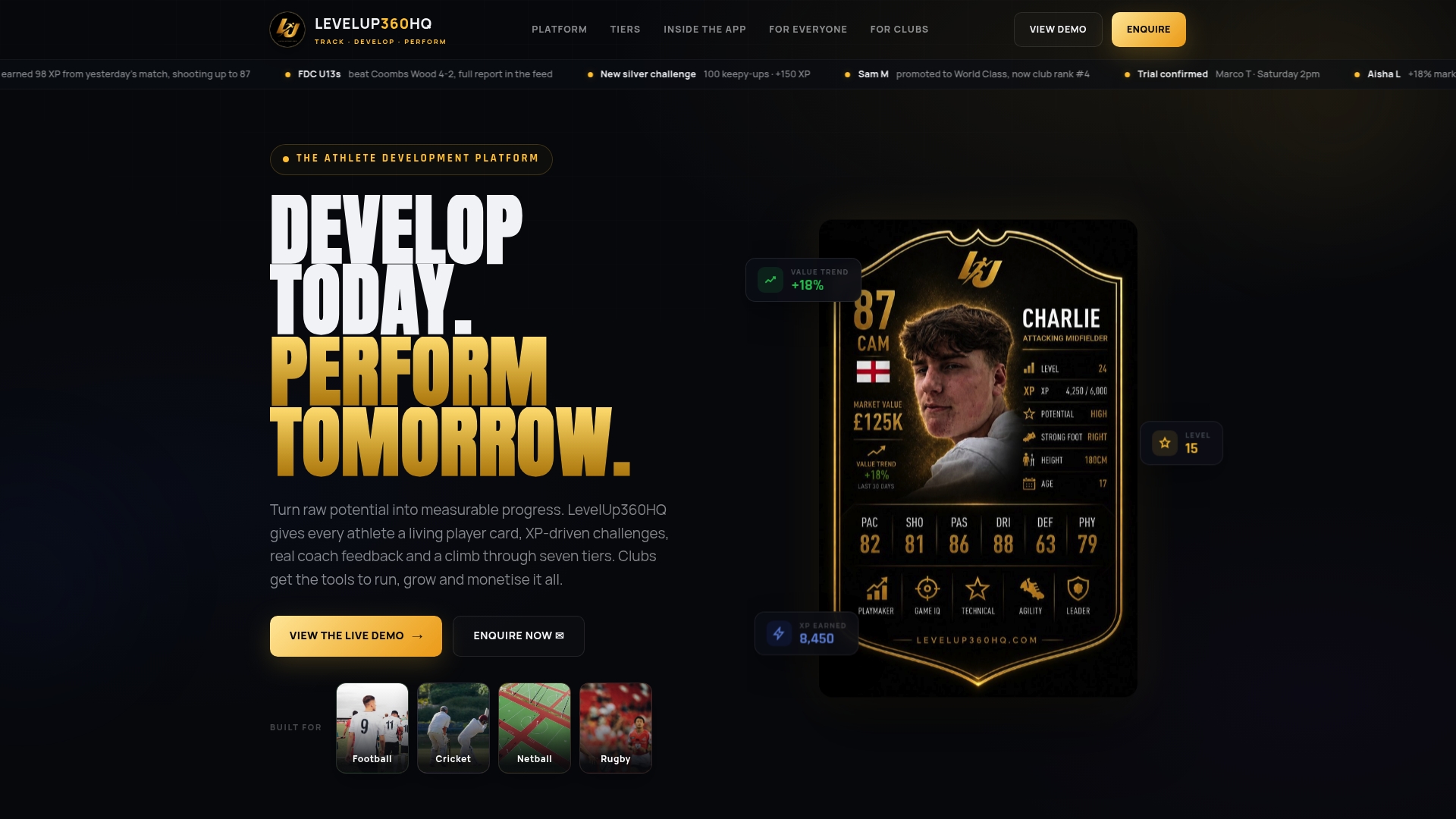
LevelUp360HQ is a gamified athlete development platform built for that. Athletes get FIFA-style player cards with real-time ratings and market values, XP-driven challenges, tier progression, badges and leaderboards. Coaches get video assessments with approval workflows and session management tools. Clubs and academies get white-label branding, CRM, subscription management, store integrations and monetisation tools, across football, cricket, netball and rugby. Its positioning includes built-in youth safeguarding and high configurability, so each club can decide how its own mechanics work.
Try it with your club
The Pro plan costs £49 per month, and there is an active athlete platform fee of £1.50 per month per active athlete. A revenue share applies to integrated payments, with no published price. You can see how the player cards, challenges and coach tools fit together in the LevelUp360HQ prototype.
For a club of 100 active athletes, the platform fee comes to £150 per month on top of the £49 Pro plan, so it is easy to model against your current admin time.
Our perspective
Most clubs we talk about start gamification with the reward. We would start with the athlete’s story. A young player wants to know three things: where do I stand, what do I do next, and who can see my progress.
That is why we built live player cards, XP challenges and tiers around development rather than around trophies. A rating that moves when you do the work gives a player a reason to come back on Tuesday. A coach’s video assessment, approved through a clear workflow, tells them what good looks like.
We also believe the club should own the design. A netball club and a cricket academy do not need the same leaderboard, and a youth squad needs safeguarding built in from day one, not added later. One platform for athletes, coaches and the club’s administration means the data that motivates the player is the same data that helps the coach plan and the club grow.
Keep the mechanics few, tie them to real skills, and let the athletes see their own progress first. That is where gamified training earns its place.
Chris
FAQ
Is gamified sports training only for kids?
No. The principles of clear goals, feedback and visible progress apply at every age. The mechanics change: younger athletes need shorter loops and more play, while older athletes can use longer goals and richer data. The research cited here includes university students and players aged 16 and over.
What is the difference between gamification and small-sided games?
Gamification adds points, levels or badges to an existing activity. Small-sided games change the activity itself into a modified, smaller version of the sport. They work well together when a scoring rule in the game rewards the technique you want to teach.
Do leaderboards motivate or discourage athletes?
They can do both. Coaches in a US collegiate study were careful about comparing athletes’ data because athletes are highly competitive. Showing personal progress by default and ranking improvement as well as ability keeps competition productive.
How many game elements should a programme use?
Fewer than you might think. A 2025 study found that adherence intention rose with moderate feature richness and weakened when feature sets became excessive. Start with one challenge type, one progression system and one feedback routine, then add only if athletes ask for it.
Sources
- Gamification in sport and exercise: design elements and engagement (Rutledge, Walsh et al., 2018)
- TGfU Advisory Board: overview of game-based approaches (2022)
- Comparing Scoring Mechanics for Encouraging Technique (CHI 2026)
- Learning by Design: What Sports Coaches can Learn from Video Games (2021)
- Scaling the Game: Small Area Games and Problem Design
- Putting the Fun in Fundamentals: gamify sprint training
- The effect of game-based approaches on decision-making (2025 meta-analysis)
- A gamified AI movement assessment and feedback approach (2026)
- Influence of Teaching Games for Understanding on game performance (2017)
- Frontiers in Psychology: an S-shaped impact of gamification feature richness (2025)
- Fitness improvements of young soccer players after small-sided games (2020)
- Coach, Data Analyst, and Protector: Exploring Data Use in Collegiate Athletics
- American Academy of Pediatrics: Overuse Injuries, Overtraining, and Burnout in Young Athletes (2024)
- PCSFN Science Board Report on Youth Sports (2020)
- Strength training app for Apple Watch
Turn potential into a player card.
LevelUp360 tracks every match, builds your child's player card, and shows their development over time.
Get started free