Gamified athlete development explained for coaches
Published 2 July 2026

Gamified athlete development is the process of applying game-design elements, such as scoring systems, challenges, badges, and progress feedback, to sports training in order to enhance athlete engagement and performance. The approach draws on Self-Determination Theory (SDT), a well-established psychological framework that identifies autonomy, competence, and relatedness as the three core drivers of intrinsic motivation. When training programmes are built around these principles, athletes do not just complete sessions. They invest in them. Platforms like Levelup360hq put this into practice through XP-driven challenges, tier progression, and live performance analytics that give athletes and coaches a shared language for development.
What is gamified athlete development and why does it work?
Gamified athlete development is not about turning training into a video game. It is about using the motivational architecture of games, clear goals, visible progress, immediate feedback, and social recognition, to make training more engaging and measurable. The distinction matters because poorly designed systems reduce to what researchers call “gamification theatre,” where points and rewards exist but connect to nothing meaningful in the athlete’s development.
SDT-supportive design produces more positive motivational and affective experiences by giving athletes visible progress and timely feedback. That is the mechanism. When an athlete can see their rating change after a session, or earn a badge for consistent attendance, they experience competence. When they choose their own challenge path, they experience autonomy. When they compete on a leaderboard with teammates, they experience relatedness.

A systematic review of 25 studies from 2015 to 2025 confirms that gamification generally improves motivation, engagement, and physical and motor skill development in sport and physical education settings. The evidence is positive, but the review also flags that context, design quality, and digital infrastructure determine whether those benefits materialise.
How does gamification enhance athlete motivation and engagement?
The three components of Self-Determination Theory each map directly onto specific game mechanics. Autonomy is supported by letting athletes choose challenges or set personal goals. Competence is reinforced through progress bars, skill ratings, and milestone rewards. Relatedness grows through team leaderboards, social feeds, and peer recognition features.
Game-based instruction produced a large effect size (dz=1.07) in engagement scores during a 12-week sprint and relay course at university level, while the control group showed no significant change. That is a meaningful gap. It shows that the structure of how training is delivered, not just the content, drives engagement.
Gamification also reduces the psychological distance between effort and reward. In conventional training, an athlete may work hard for weeks before seeing a measurable performance gain. A well-designed gamified system provides micro-rewards along the way, keeping motivation active between major milestones.
- Autonomy support: Let athletes select from a menu of weekly challenges rather than assigning identical tasks to every squad member.
- Competence feedback: Use live ratings or XP scores that update after each session, not just at the end of a season.
- Relatedness mechanics: Leaderboards and social feeds create accountability without requiring direct coach intervention.
- Feedback cadence: Rewards and progress updates should arrive within 24 hours of a session to maintain motivational momentum.
Pro Tip: Before choosing any game mechanic, identify which SDT component your athletes are weakest on. A squad that already trains hard but feels isolated needs relatedness features, not more points.
What are the measurable effects of gamified training on performance?
Traditional self-report questionnaires often miss the full picture of gamification’s impact. A 2026 applied soccer study found that biosignals captured motivational changes that neither self-report measures nor performance data detected. The best machine learning model distinguished the gamified condition with an 82.75% macro F1-score using eye-tracking features, specifically blink behaviour and pupil dynamics. That result tells coaches something important: athletes may be more engaged than they report, and measurement tools need to match the depth of the intervention.
Physiological proxies like eye-tracking provide objective measures that differ between gamified and non-gamified scenarios even when athletes rate their experience similarly on questionnaires. This is not a minor methodological footnote. It means that relying solely on athlete feedback to evaluate a gamification programme will underestimate its actual effect.
A meta-analysis of randomised controlled trials found that gamification alone is often ineffective short-term but shows stronger effects on moderate-to-vigorous physical activity over longer interventions exceeding 20 weeks, particularly when combined with wearables and social media tools. Short-term novelty fades. Long-term behaviour change requires sustained design.
| Measurement approach | What it captures | Key advantage |
|---|---|---|
| Self-report questionnaires | Perceived motivation and satisfaction | Low cost, easy to administer |
| Performance metrics | Speed, accuracy, output scores | Directly tied to sport outcomes |
| Eye-tracking and pupil dynamics | Attentional engagement and arousal | Detects changes invisible to self-report |
| Wearable biosensors | Heart rate, movement, physiological load | Continuous, real-time data |
| Machine learning classification | Pattern recognition across multimodal data | Identifies gamification effects at scale |
Pro Tip: Predefine the motivational state you want to measure, such as attention or arousal, before selecting your evaluation tools. Measuring everything at once produces noise, not insight.
What pitfalls must sports organisations avoid when implementing gamification?
The most common failure mode is not a bad idea. It is a good idea applied without infrastructure. Failures in engagement are most often caused by poor design fit and resource constraints, not by gamification as a concept. Organisations that rush to add points systems without connecting them to real training data create exactly the gamification theatre problem described earlier.
Digital literacy is a genuine barrier. Coaches who are unfamiliar with data platforms will not use them consistently. Athletes who do not understand how their rating is calculated will not trust it. Both problems are solvable, but they require deliberate onboarding, not just access to a platform.
- Avoid disconnected rewards: Points that do not reflect actual coaching-relevant improvement erode trust faster than no points at all.
- Match design to sport context: A gamification system built for individual athletics may not translate to a team sport like rugby or netball without significant redesign.
- Plan for the post-novelty phase: Engagement typically peaks in the first few weeks. Design for month three, not week one.
- Invest in coach training: The platform is only as effective as the coach who interprets and acts on the data it produces.
Pro Tip: Run a four-week pilot with a single squad before rolling out across a club. Identify which mechanics generate genuine behaviour change and which ones athletes ignore after the first session.
How can coaches and athletes apply gamification strategies effectively?
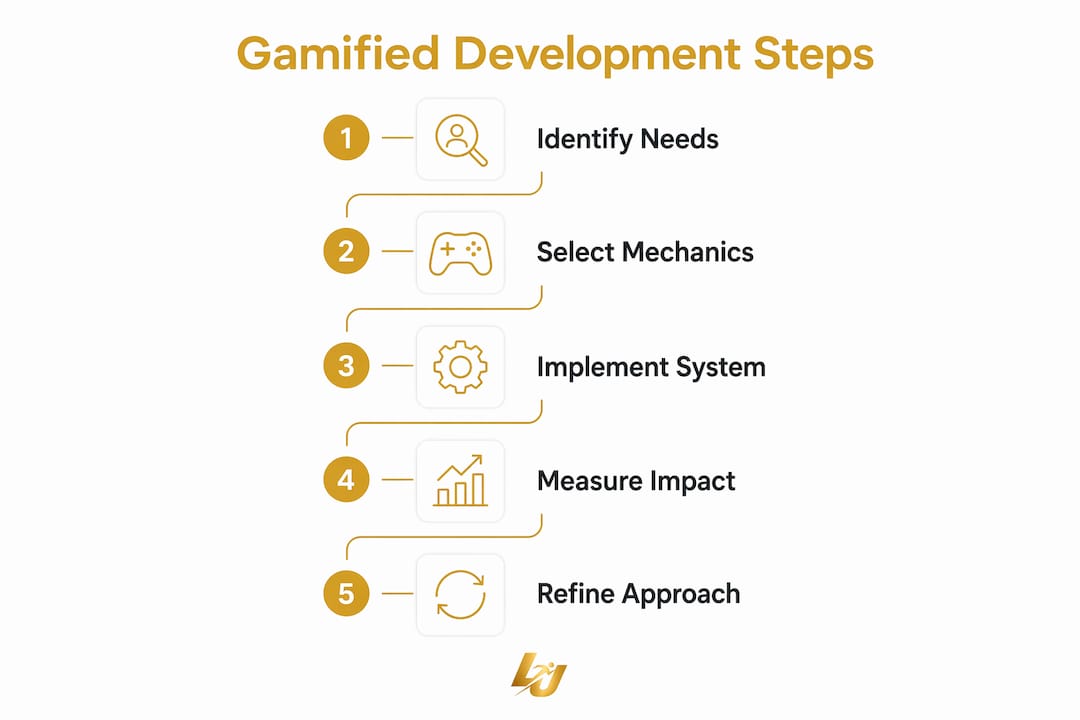
A structured approach prevents the common trap of adding game elements without a clear development purpose. The following progression gives coaches a repeatable framework.
- Define the motivational objective first. Identify whether you are targeting attendance, effort intensity, skill acquisition, or team cohesion. Each goal requires different game mechanics.
- Map real training data to feedback loops. Use session data, video assessments, or performance scores as the input for any rating or XP system. Feedback grounded in real data builds credibility.
- Select game elements that match the objective. Leaderboards suit competitive athletes chasing rankings. Badge systems suit athletes who respond to personal milestone recognition. Tier progression suits long-term development programmes.
- Set a feedback cadence and stick to it. Athletes need to know when updates arrive. Weekly rating refreshes work well for most training programmes. Daily micro-rewards suit high-frequency training environments.
- Evaluate with more than one measure. Combine self-report with performance data and, where possible, physiological indicators. The 2026 soccer study demonstrates that single-measure evaluation misses significant effects.
- Review and adjust at 20 weeks. Short-term effects differ from long-term behaviour change. The meta-analysis evidence shows that interventions exceeding 20 weeks produce stronger results, particularly when combined with digital tracking tools.
Levelup360hq applies this framework directly. The platform connects FIFA-style player cards with real-time ratings, XP-driven challenges, and coach-controlled approval workflows, so every reward an athlete receives is tied to a verified training action. Coaches access video assessments and session management tools that feed directly into athlete ratings, closing the loop between effort and recognition. For clubs managing multiple squads across football, cricket, netball, or rugby, the white-label and CRM features mean the same gamification logic scales without losing sport-specific context.
Key takeaways
Gamified athlete development works when game mechanics are grounded in Self-Determination Theory, connected to real training data, and evaluated with tools that capture both behavioural and physiological responses.
| Point | Details |
|---|---|
| SDT is the design foundation | Build game mechanics around autonomy, competence, and relatedness to drive intrinsic motivation. |
| Biosignals reveal hidden effects | Eye-tracking and pupil dynamics detect motivational changes that self-report questionnaires miss. |
| Long-term design outperforms novelty | Interventions beyond 20 weeks, combined with digital tools, produce stronger behaviour change. |
| Poor design causes failure, not the concept | Disconnected points systems and low digital literacy undermine gamification more than any other factor. |
| Real data closes the feedback loop | Ratings and rewards tied to verified training actions build athlete trust and sustained engagement. |
Why I think most clubs are gamifying the wrong thing
Clubs tend to reach for the most visible game element first. They add a leaderboard, hand out badges at the end of a season, and call it a gamified programme. The athletes engage for two weeks and then ignore it entirely. I have seen this pattern repeatedly, and the cause is almost always the same: the gamification was designed around the platform, not around the athlete’s motivational needs.
The 2026 biosignal research is the most important finding in this space right now. The fact that machine learning detected motivational differences at 82.75% accuracy using eye-tracking, when self-report showed nothing, should change how every coach thinks about evaluation. We are measuring the wrong things and drawing the wrong conclusions.
The future of this field sits at the intersection of biofeedback and structured progression systems. Wearables will feed real-time physiological data into platforms that adjust challenge difficulty automatically. That is not science fiction. The meta-analysis evidence already shows that wearables combined with social tools produce stronger effects on physical activity than gamification alone. The infrastructure is arriving faster than most clubs are prepared for.
My advice is to start with one question before touching any technology: what motivational state do you want to change, and how will you know if it has changed? Answer that clearly, and the right game mechanics become obvious. Skip that question, and you will spend money on a system that looks impressive in a presentation and does nothing in a training session.
— Chris
Levelup360hq: a platform built for evidence-based athlete development
Levelup360hq brings together the core elements of effective gamified training in one place, connecting real performance data to athlete-facing rewards and coach-facing analytics.
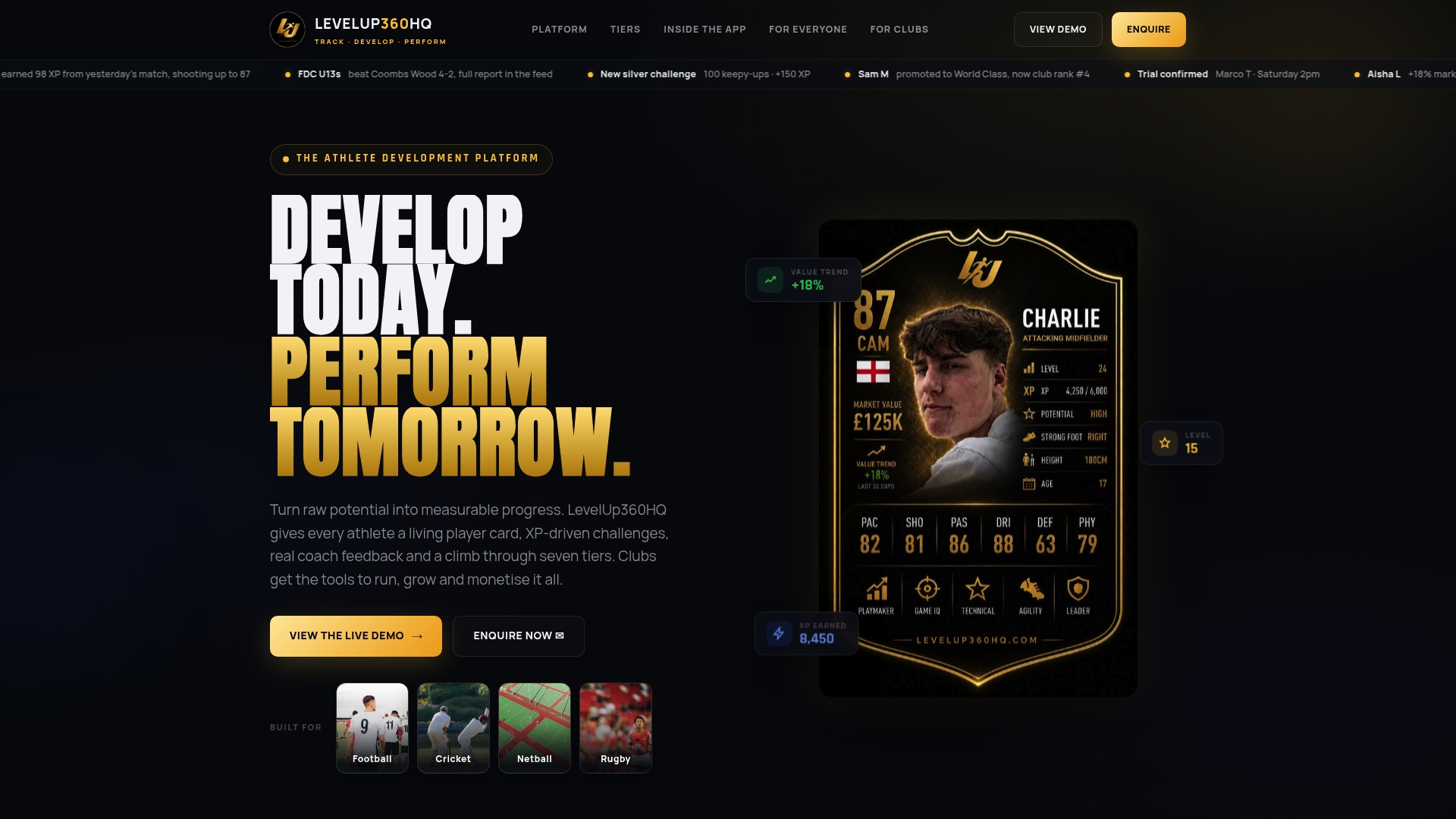
The platform’s FIFA-style player cards update in real time based on verified training activity, so athletes see their development reflected immediately rather than waiting for an end-of-season review. XP challenges, tier progression, badge systems, and the ‘Word on the Street’ social feed address all three SDT components in a single environment. Coaches manage video assessments and approval workflows that feed directly into athlete ratings, keeping every reward grounded in real data. Clubs across football, cricket, netball, and rugby use the white-label platform to run development programmes that scale without losing sport-specific context. Explore the full feature set at Levelup360hq.
FAQ
What is gamified athlete development?
Gamified athlete development is the application of game-design elements, such as XP systems, badges, leaderboards, and progress tiers, to sports training to increase athlete motivation, engagement, and performance tracking.
Does gamification actually improve athletic performance?
Research shows gamification improves motivation and engagement, with a large effect size (dz=1.07) recorded in a 12-week game-based training study. Long-term interventions exceeding 20 weeks show stronger effects on physical activity behaviour than short-term programmes.
What is Self-Determination Theory and why does it matter for gamification?
Self-Determination Theory identifies autonomy, competence, and relatedness as the three core drivers of intrinsic motivation. Gamification systems designed around these three components produce more sustained engagement than reward-only approaches.
Why do some gamification programmes fail in sports settings?
Failures are most often caused by poor design fit, insufficient digital literacy, and rewards disconnected from real training data. The concept itself is not the problem. Implementation quality determines outcomes.
How should coaches measure the impact of a gamified training programme?
Coaches should combine self-report measures with performance data and, where resources allow, physiological indicators such as wearable biosensors. Biosignals have been shown to detect motivational changes that questionnaires alone do not capture.
Recommended
Turn potential into a player card.
LevelUp360 tracks every match, builds your child's player card, and shows their development over time.
Get started free