Earn XP in sports challenges: athletes and clubs guide
Published 28 July 2026

You earn XP in sports challenge platforms by completing verified activities and having proof accepted before any points are assigned. That proof can be a timestamped video, a GPS track file, wearable telemetry, or a formal coach sign-off — the platform decides which it accepts, and your submission fails without it. Levelup360hq builds this verification model into every challenge: video assessments, coach approval workflows, and session timestamps are standard, not optional extras.
Three actions get you started:
- Register a verified account and link your club or coach credentials.
- Submit the correct proof type for your chosen challenge, with visible timestamps and required metadata.
- Track the approval workflow and check your XP assignment once the coach or moderator signs off.
Table of Contents
- How do you earn XP in sports challenges, step by step?
- What counts as verifiable proof, and how do you prepare it?
- How do XP, tiers, and skill-points actually work?
- How should coaches validate challenges and manage XP approvals?
- How can clubs and academies monetise XP challenge programmes?
- What are the most effective tactics to maximise XP legitimately?
- What integrity controls prevent XP abuse?
- How does Levelup360hq implement verified XP challenges?
- First challenge checklist for UK clubs and athletes on Levelup360hq
- Key takeaways
- Why verified XP is more than a points system
- Levelup360hq: verified XP challenges built for UK clubs
- Useful sources and next steps
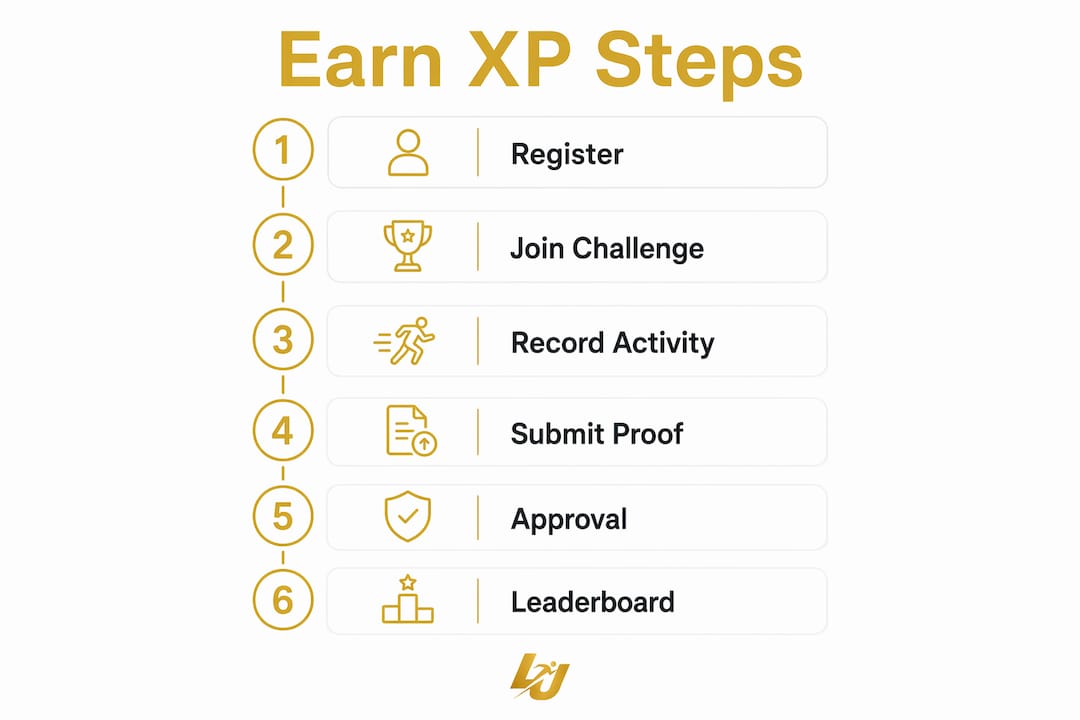
How do you earn XP in sports challenges, step by step?
Registration is the gate. Create your account, confirm your identity, and attach your club affiliation if the challenge requires it. Skipping this step means your submissions cannot be attributed to a verified athlete, and most platforms will reject them outright.
Once registered, join the specific challenge and read its eligibility rules carefully. Age brackets, sport type, and equipment requirements all affect whether your submission qualifies. A submission that meets the proof standard but fails an eligibility check earns nothing.
Record your activity using the platform’s accepted formats. Upload with clean filenames, correct file types, and explicit timestamps. Then notify your coach or moderator through the platform’s approval interface — do not assume the system alerts them automatically.

Pro Tip: Set a calendar reminder for the challenge deadline and submit at least 48 hours early. Late submissions during high-volume windows are often queued behind earlier ones, delaying XP assignment.
Monitor the approval queue and check your leaderboard position after sign-off. If a claim is rejected, appeal promptly with additional context — most platforms allow one resubmission with a coach note attached.
What counts as verifiable proof, and how do you prepare it?
Accepted proof types vary by platform, but the common formats are:
- Timestamped video: filmed during the activity, showing the athlete, the challenge action, and a visible date/time reference.
- GPS track files: exported from a head unit or watch, covering the full session with geolocation data intact.
- Wearable telemetry exports: heart rate, cadence, or power data from devices like Garmin or Wahoo, exported in the platform’s required file format.
- Coach-approved session logs: a formal sign-off within the platform UI, linking the session to the specific challenge.
Metadata is what separates an accepted submission from a rejected one. Timestamps, device IDs, session duration, and a brief activity description all need to be present. Missing any one of them gives a moderator grounds to reject the claim without further review.
The NBA ID 2K Challenge illustrates how cross-platform proof requirements work in practice: participants must link accounts and complete combined activities across multiple products to qualify for rewards. The principle transfers directly to any multi-sport platform — account linking and proof chain integrity matter as much as the activity itself.
How do XP, tiers, and skill-points actually work?
XP in gamified sports platforms typically comes from several sources, weighted differently depending on the platform’s design:
| XP source | Typical weighting | Notes |
|---|---|---|
| Participation base | Low–medium | Awarded for completing the activity regardless of outcome |
| Performance bonuses | Medium–high | Goals, assists, clean sheets, sport-specific metrics |
| Win or completion bonus | Medium | One-off award per challenge completed |
| Streak rewards | Low per session | Accumulates quickly with consistent participation |
| Seasonal milestones | High | Time-limited; often the highest single XP source available |
Early levels are front-loaded by design. The Pro Clubs XP model demonstrates this clearly: participation, goals, assists, clean sheets, match rating, and win bonuses all contribute, but progression slows markedly at higher tiers as required XP per level rises. This is the “XP cliff” — a deliberate design choice that forces athletes to diversify their XP sources rather than grinding a single action type.
Skill-points, unlocked at milestone levels, are where XP becomes genuinely useful for development. Allocating them to attributes like strength, endurance, or speed changes your in-platform rating and affects how the system values your future submissions. Platforms that tie XP to meaningful skill-point changes create a measurable development path rather than a simple high-score metric.
Pro Tip: Seasonal and limited-time challenges typically offer boosted XP and exclusive badges. Completing them in the first week of the window captures the full reward before the queue fills and approval times lengthen.
How should coaches validate challenges and manage XP approvals?
A reliable approval workflow follows four steps:
- Submission received: the athlete uploads proof and flags it for review within the platform.
- Coach review: the coach opens the submission, checks the proof against the challenge criteria, and adds a short assessment note with a performance rating.
- Accept or reject with feedback: accepted submissions trigger automatic XP assignment with a timestamp; rejected ones return to the athlete with a written reason.
- Audit record created: the platform logs the decision, the coach’s credentials, and the session metadata for future reference.
Assessment notes matter more than coaches often realise. A brief written observation that links the proof to the challenge criteria gives the platform’s audit trail something to work with if a submission is later queried.
For session management, group multiple athlete submissions into a single review session where the platform allows it. Bulk approvals reduce administrative time, but each individual submission still needs a distinct sign-off to maintain the integrity of the audit trail. Coaches should also schedule routine credentialing checks and document their approval policies — particularly if third-party validators or academy administrators review submissions independently. Timing and portal management advice from athletic staff portal best practices is worth reviewing before setting up your first approval cycle.
How can clubs and academies monetise XP challenge programmes?
Gamified XP challenges give clubs a concrete product to sell, not just a training tool to offer. The most direct monetisation routes are:
- Paywalled challenge series: premium seasonal cups or sponsor-branded challenges available only to paid subscribers.
- Subscription tiers: expanded challenge access, higher XP multipliers, or exclusive badge sets tied to membership level.
- White-labelled experiences: clubs can brand the entire platform environment, making the XP system feel native to their academy rather than a third-party add-on.
- In-platform stores: badges, kit, and digital collectibles redeemable with XP or purchased directly.
Pro Tip: Use aggregated XP and engagement data to segment your membership. Athletes who consistently complete seasonal challenges are your highest-retention cohort — target them with renewal offers before the season ends, not after.
Leaderboards and tiered rewards do the retention work that discounts cannot. An athlete chasing a top-ten position on a public leaderboard is far less likely to cancel a subscription mid-season than one who sees the platform as a passive training log. The data-driven approach to athletic decision-making reinforces why XP analytics, not just raw participation numbers, should inform how clubs structure their offers.
What are the most effective tactics to maximise XP legitimately?
- Target role-specific actions the scoring system rewards most. Attackers should prioritise high-value actions like goals and assists; defenders should focus on clean-sheet metrics and defensive contributions.
- Complete seasonal and time-limited challenges in the first week of the window to capture boosted XP and exclusive rewards before approval queues lengthen.
- Maintain submission hygiene: clear filenames, correct file formats, explicit timestamps, and a coach note attached wherever the platform allows it.
- Use streaks and short high-frequency sessions to accumulate XP during recovery or low-load weeks without overloading your training plan.
Pro Tip: Short “Rush”-style sessions — brief, focused activities that award smaller XP — are the most efficient way to maintain a streak without disrupting a structured training block. They bridge the gap between major challenge windows.
What integrity controls prevent XP abuse?
Common abuse attempts include fabricated video, manipulated GPS routes, replaying old session files, and collusive coach approvals. Platforms counter these with layered technical and process controls.
On the technical side: timestamp validation cross-references when a file was created against when it was submitted; device ID checks confirm the recording came from a registered device; wearable telemetry is compared against session metadata to flag inconsistencies.
Process controls add a second layer: coach credentialing, multi-step approval workflows, and public leaderboard transparency all make it harder to game the system without detection. To reduce false rejections on legitimate submissions, attach contextual coach notes and keep raw telemetry files available for audit. A moderator who can see the full data chain is far less likely to reject a genuine submission.
How does Levelup360hq implement verified XP challenges?
Levelup360hq is built around the verification model described throughout this guide. Its core features include:
- Video assessments and coach approval workflows with session timestamps, so every XP award has a documented chain of evidence.
- Wearable telemetry ingestion, allowing GPS and biometric data to be attached directly to challenge submissions.
- FIFA-style player cards that update in real time as XP is earned and skill-points are allocated, giving athletes a visible, shareable record of their progression.
- Public leaderboards and badge systems that drive engagement across football, cricket, netball, rugby, and other supported sports.
- White-labelling, CRM, subscription management, and an in-platform store for clubs that want to monetise their challenge programmes.
- Audit trails and admin-visible session metadata, giving coaches and club administrators the evidence they need for credentialing and third-party review.
The platform’s progression model maps XP directly to skill-point allocation, which changes an athlete’s in-platform rating rather than simply adding to a cosmetic score. That distinction matters for coaches using XP data to inform selection and development decisions.
First challenge checklist for UK clubs and athletes on Levelup360hq
Getting from registration to your first awarded XP takes four steps:
- Create and verify your club or athlete account at Levelup360hq and link administrator credentials to the club profile.
- Set up your first challenge: define accepted proof types, judging criteria, and XP rewards before opening it to athletes.
- Run a pilot session with a small group. Collect video proof and wearable files, execute coach approvals, and confirm the full workflow functions end to end.
- Publish results, award XP, and review any rejected submissions to identify metadata gaps or proof-format issues before the next round.
Pro Tip: Use the platform demo to walk through the coach approval interface before your first live session. Seeing the workflow in a test environment prevents avoidable errors when real athlete data is involved.
Key takeaways
Verified proof and coach sign-off are the single biggest determinants of whether XP is awarded — every other tactic depends on getting those two elements right.
| Point | Details |
|---|---|
| Proof quality decides everything | Timestamped video, GPS files, or wearable telemetry with full metadata is the minimum standard for acceptance. |
| XP cliff requires diverse sources | Front-loaded early levels give way to slower progression; seasonal challenges and streaks bridge the gap at higher tiers. |
| Coach workflow is the integrity layer | Timestamped approvals, assessment notes, and audit trails protect both athletes and clubs from disputed claims. |
| Clubs can monetise responsibly | Paywalled challenge series, subscription tiers, and XP analytics create revenue without compromising programme integrity. |
| Levelup360hq covers the full model | Video assessments, coach approvals, player cards, leaderboards, and club CRM tools are all available in one UK-ready platform. |
Why verified XP is more than a points system
The conventional view of gamification in sport is that XP is motivational scaffolding — a way to keep athletes engaged long enough to build real habits. That framing undersells what verified XP actually does when the system is designed properly.
When XP is tied to coach-approved, timestamped proof, it stops being a score and becomes a performance record. A coach reviewing an athlete’s XP history across a season can see which challenge types they completed, which they avoided, and where their submission quality dropped. That is selection-relevant information, not just a leaderboard position.
The risk is the opposite failure mode: platforms that award XP without meaningful verification produce data that coaches cannot trust. An athlete with a high unverified score and a low verified one tells you something important about their engagement with the process, not just their ability. Clubs that treat XP as a development metric rather than a participation trophy get something genuinely useful out of the system.
The XP cliff, which slows progression at higher tiers, is often treated as a design flaw. It is not. It forces athletes to engage with a wider range of challenge types and proof formats, which mirrors the breadth of real athletic development. The athletes who navigate it well are usually the ones doing the most varied, coach-supported training.
Levelup360hq: verified XP challenges built for UK clubs
Clubs that want verified XP without building the infrastructure from scratch get the full model through Levelup360hq: video assessments, coach approval workflows, session timestamps, wearable telemetry ingestion, white-labelling, and CRM tools in a single platform designed for football, cricket, netball, rugby, and more.

The platform handles the verification chain, the progression mechanics, and the monetisation tools so coaches can focus on development rather than administration. Whether you are running a grassroots academy or a multi-sport club, the onboarding process starts with a single verified account and a pilot challenge.
Request a demo or start your club setup at Levelup360hq — the approval workflow, player cards, and leaderboard are all live in the demo environment.
Useful sources and next steps
For platform exploration and further reading:
- Levelup360hq landing page — full feature overview, club subscription options, and contact details.
- Levelup360hq demo — interactive walkthrough of challenge workflows, coach approvals, and XP awarding.
- Pro Clubs XP explained — a detailed breakdown of action-based XP sources and progression curves.
- Data in athletic decision-making — how performance data informs coaching and selection at every level.
- Portal timing best practices — practical guidance for coaches managing approval cycles and submission windows.
Recommended
Turn potential into a player card.
LevelUp360 tracks every match, builds your child's player card, and shows their development over time.
Get started free