Build COPPA Compliant US Sports Apps Before April 22, 2026 for Developers and Clubs
Published 21 September 2026

Yes, COPPA applies to most youth sports apps that collect data from players under 13, and the safest assumption for any developer or club is coverage until proven otherwise. The single most urgent action right now is building a verifiable parental consent flow with a logged audit trail, method and timestamp included, because the FTC’s amended COPPA Rule sets full compliance for April 22, 2026.
TL;DR:
- Verifiable parental consent flows with logged timestamps and method details are essential before collecting any personal data from children under 13.
- Biometric identifiers and images used in recognition features are explicitly classified as personal information under the 2025 COPPA amendments.
- Public athlete profiles, rosters, and media that disclose children’s identities require stronger consent methods beyond simple email or text verification.
- Apps must classify their audience correctly and implement an honest age gate to avoid automatic COPPA obligations and ensure compliance.
- Implementing structured retention and deletion policies, along with comprehensive records of consent and data handling, is critical to meet regulatory expectations.
Table of Contents
- Does COPPA compliance apply to your sports app?
- What changed in the 2025 COPPA Rule amendments?
- Which sports app features actually trigger COPPA?
- A practical compliance checklist for sports apps
- How should you handle age screening and mixed audiences?
- Data retention, deletion, and security for youth sports apps
- What records will regulators expect to see?
- How Levelup360hq approaches COPPA compliance
- Running a sports app across multiple countries: what US COPPA means for you
- Talking to parents about privacy without sounding like a lawyer
- Common COPPA violations in sports apps and how to avoid them
- Author perspective: practical risk management for clubs and developers
- How Levelup360hq supports sports organisations meeting COPPA obligations
- Sources
- FAQ
Does COPPA compliance apply to your sports app?
COPPA covers any “operator” of a website or online service that is either directed to children under 13 or has actual knowledge it is collecting personal information from a child that age. A youth sports app clears both tests more easily than most developers expect.
The FTC’s complying-with-COPPA guidance uses a totality test for “directed to children”: subject matter, visual style, use of child-oriented incentives, advertising placed on the app, and whether models or actors depicted appear to be minors all count. A youth football app with cartoon mascots and age-group leaderboards leans child-directed regardless of what the terms of service claim.
“Actual knowledge” is often simpler to prove and harder to dodge. A date-of-birth field returning an under-13 age, a grade-level dropdown, a school or league mandate requiring the app for registration, or a parent emailing about their eight-year-old’s account all establish actual knowledge the moment they happen. Reporting on school-mandated platforms has flagged exactly this pattern: apps assumed to be general-audience while quietly gathering rich data on minors through mandated club or school use.
What changed in the 2025 COPPA Rule amendments?
The FTC finalised amendments to the COPPA Rule on April 22, 2025, and they reshape several areas that matter directly to sports apps. The final rule is published in the Federal Register, introduces a formal “mixed audience” category, letting a general-audience app with some child users apply neutral age screening before collecting personal information, rather than treating every visitor as a child from the first tap.
Biometric identifiers and government-issued IDs are now explicitly “personal information” under the Rule. Facial recognition in a highlight-reel feature, or a scanned school ID for roster verification, both fall inside COPPA’s scope in ways they may not have a year ago.
Consent methods gained a new option: text-plus, alongside the existing email-plus route, though its availability narrows if the operator discloses children’s data to third parties. Retention duties tightened too. Data must now be kept no longer than reasonably necessary, with more explicit deletion obligations. Safe Harbor programme reporting requirements also expanded. Full compliance is required by April 22, 2026.
Which sports app features actually trigger COPPA?
Most COPPA problems in youth sports apps trace back to a handful of recurring features. Auditing your product against this list is faster than guessing at legal exposure.
- Photos, video, and audio that identify an individual child, including highlight clips, team photos, and voice clips from post-match interviews.
- Geolocation data precise enough to reveal a street, training ground, or home town, even when collected for “find nearby matches” convenience features.
- Persistent identifiers, such as device IDs, advertising IDs, or cookies used to track a child across sessions.
- Public athlete profiles, roster listings, and published statistics, which practitioner guidance treats as disclosures that can rule out streamlined consent methods like email-plus.
- Third-party SDKs, analytics tools, and cloud storage that receive children’s personal information without a vetted data processing agreement.
Biometric templates generated by facial recognition or automated player-tagging features deserve special attention. Practitioner analysis of recruiting platforms confirms that recognition functions and raw images both count as covered personal information under the amended Rule, not just the templates themselves.
A practical compliance checklist for sports apps
Turning legal text into product tasks is where most teams stall. Work through this sequence in order, because later steps depend on the classification decision made in step one.
- Classify your app as child-directed, mixed audience, or general audience, and write down the reasoning. This document becomes your first line of defence if a regulator asks why you handled data the way you did.
- Build a neutral age gate for mixed-audience apps: a plain, unbranded date-of-birth field, not a “Are you over 13?” toggle that invites a child to lie.
- Block personal data collection until the age check clears, for any user who might be under 13.
- Build a verifiable parental consent flow, logging the method used, who consented, and the exact timestamp.
- Place parent notices clearly on the app’s home screen and, where required, at the point of download.
- Audit every third-party vendor touching player data. Remove or restrict data sent to vendors that cannot confirm COPPA-compatible handling.
- Automate retention and deletion, and give parents a visible way to review or delete their child’s data inside the app itself.
- Maintain an auditable consent database, with dated snapshots of every privacy policy and notice version you have published.
Pro Tip: Store your privacy policy snapshots as timestamped, version-controlled files rather than overwriting the live page. If a parent’s consent references a policy from March, you need to be able to produce that exact version months later.
How should you handle age screening and mixed audiences?
Age gates only work if they are honest. A free-text date-of-birth field, without hints or a “click here if you’re older” shortcut, meets the FTC’s expectation of a neutral screen. Anything that nudges a child toward entering a false age undermines the whole mechanism and can be treated as if no screening existed at all.
Classification carries real operational weight:
- Child-directed apps must treat every user as a child, with no age-gate exception, and apply full consent and retention rules from the first interaction.
- Mixed-audience apps can screen first and collect personal information only after confirming a user is 13 or older.
- General-audience apps avoid COPPA duties only until actual knowledge arises, at which point the same rules as child-directed apps kick in for that user.
Worth flagging: in February 2026, the FTC issued an Enforcement Policy Statement giving limited, temporary forbearance on certain age-verification technology requirements. It is non-binding and time-limited, not a suspension of COPPA itself, so treat it as breathing room for implementation rather than a reason to delay consent and retention work.
Data retention, deletion, and security for youth sports apps
“Reasonably necessary” retention has no fixed number in the Rule, but a defensible practice is a short archival window, often 90 to 180 days, after an account goes inactive, followed by automated deletion of roster and media data. Waiting for a manual clean-up sweep is how old highlight clips of nine-year-olds end up sitting on a server for years past relevance.
- Build automated deletion workflows tied to inactivity, not to staff remembering to run a script.
- Expose parent-facing deletion and review controls directly in the app’s settings menu, not buried in a support ticket process.
- Apply access controls and encrypted storage to anywhere player PII lives, including backups.
- Scrub personal information from application logs and error trackers before they reach a third-party monitoring dashboard.
What records will regulators expect to see?
An operator that can produce clean records moves through any FTC inquiry faster than one relying on memory. Keep three categories of evidence current.
Consent records need the method used, the parent’s identity, and the exact timestamp, alongside a stored copy of the notice the parent actually saw. A vendor inventory mapping every third party that touches children’s data, and what that party does with it, should sit alongside your data flow diagram. Finally, keep dated snapshots of your privacy policy, a log of every deletion carried out, and records of periodic security assessments. Rostered’s guidance for club administrators lists this kind of vendor audit and retention documentation as a baseline, not an advanced step.
How Levelup360hq approaches COPPA compliance
The platform builds several of these tasks directly into the system rather than leaving them to bolted-on scripts. Guardian-mediated accounts, coach approval workflows before any player profile or highlight goes public, and system-level audit logs support the consent and evidence-gathering work described above. White-label clubs have their own privacy controls and deletion workflows, so a club administrator can action a parent’s deletion request without waiting on a developer. Coach approval steps map directly to the “public profile” trigger covered earlier, helping catch a child’s data before it ever gets published.
Running a sports app across multiple countries: what US COPPA means for you
A sports app rarely stays inside one border for long. Clubs run international tournaments, families relocate, and app stores distribute globally by default. That does not change the basic rule: COPPA applies to any operator collecting personal information from US-based children under 13, regardless of where the company is headquartered or where its servers sit.
If your app has US users, even as a small fraction of a global base, you carry COPPA obligations for that segment specifically. A common mistake is designing a single global privacy flow around a stricter or more lenient foreign framework and assuming it automatically satisfies US law. It usually does not, because COPPA’s specific requirements, such as verifiable parental consent methods and the parental review-and-delete rights, are not identical to other countries’ children’s data regimes.
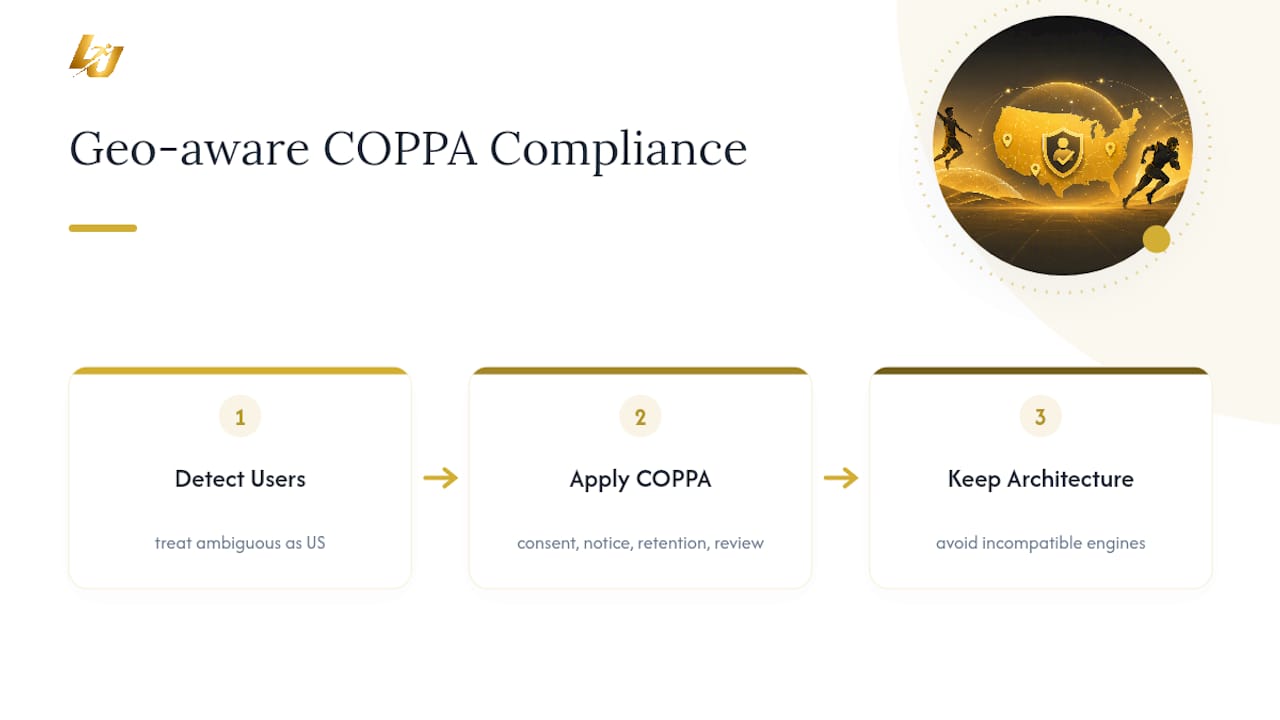
The practical fix is geo-aware compliance logic: detect US users (or, more conservatively, treat any ambiguous location as US-covered) and apply COPPA’s consent, notice, and retention rules to that segment without exception. Where your app also serves other markets, keep the underlying data architecture generic enough that you are not maintaining two incompatible privacy engines. A club-administration platform can borrow structurally from international guidance on club data handling, even outside COPPA’s scope. Polish guidance on sports club data obligations shows how a different jurisdiction approaches similar vendor and retention questions, useful as a design pattern even though its legal basis differs from US law.
Talking to parents about privacy without sounding like a lawyer
Parents skim privacy policies, or skip them entirely, unless the app gives them a reason to read. The fix is not a shorter legal document. It is separating the legal text from the plain-language explanation parents actually need at the moment they matter.
Put a short, specific notice on the account creation screen: what data you collect from their child, why, and how to review or delete it, in two or three sentences before any legal boilerplate. Repeat the core points inside the app itself, ideally in a settings section labelled clearly as “Privacy & Your Child’s Data” rather than folded into a generic “Legal” menu nobody opens.
Consent requests should state plainly what is being asked for and what happens if a parent says no, rather than presenting a wall of clauses. If your app uses text-plus or email-plus consent, tell the parent which method you used and give them a way to confirm or revoke it later, not just a one-time popup they cannot revisit.
Clubs have an advantage here that solo apps lack: an existing relationship with parents through registration forms, team meetings, and season communications. Use that channel to explain data practices in person or in a season handbook, not only inside app copy nobody reads carefully. A parent who hears about data handling from a coach at sign-up trusts the digital notice more when it appears later.
Common COPPA violations in sports apps and how to avoid them
Most enforcement risk in this category comes from a small set of repeated mistakes, not exotic edge cases.
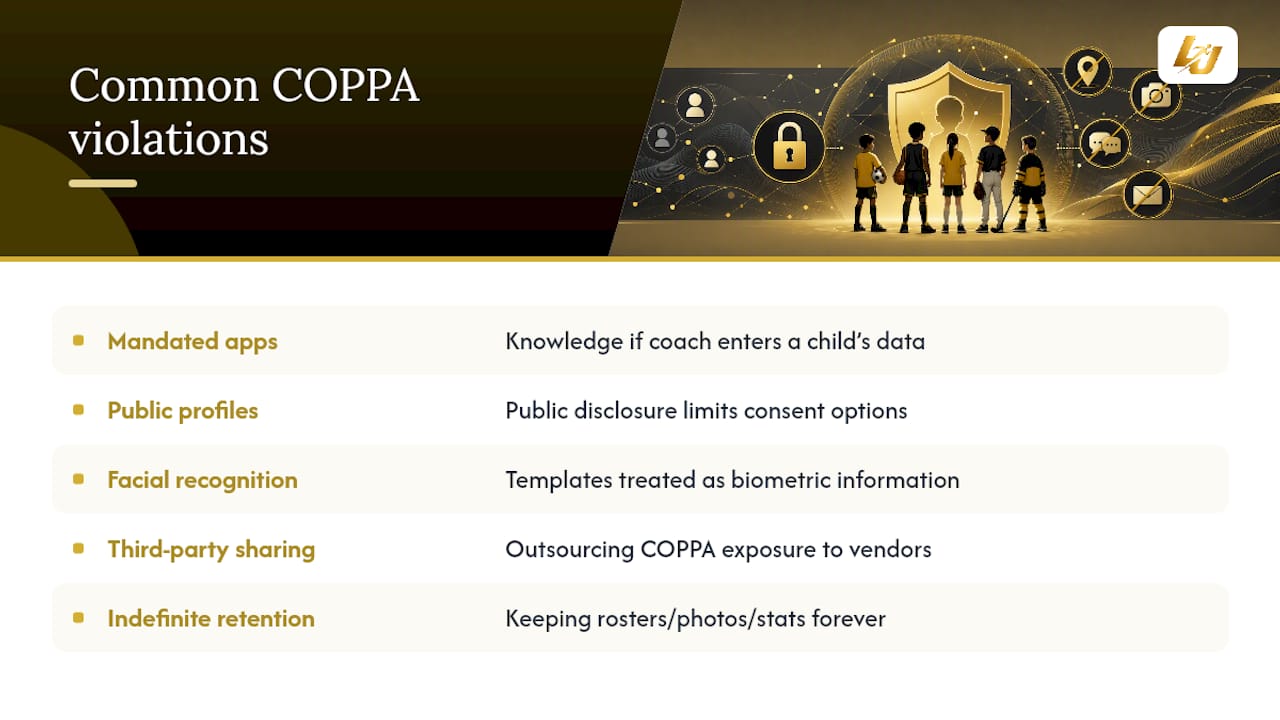
The first is treating a club-mandated app as general-audience because the company itself is not marketing to children. If a school or league requires the app for registration, actual knowledge exists the moment a coach enters a nine-year-old’s details, regardless of your marketing copy.
The second is publishing athlete profiles, rosters, or highlight reels without recognising that public disclosure limits which consent methods you can rely on. Once a child’s information is disclosed publicly, streamlined options like simple email-plus consent may no longer be available, and stronger verification is needed.
The third is running facial recognition or auto-tagging features on match footage without treating the resulting templates as biometric personal information. This is a newer trap since the 2025 amendments expanded the biometric category, and it catches apps that built recognition features before the rule change.
The fourth is sending player data to third-party analytics or cloud vendors without confirming those vendors handle children’s data appropriately, effectively outsourcing your COPPA exposure to a company that never agreed to carry it.
The fifth is indefinite retention: keeping rosters, photos, and stats forever because deletion was never built, rather than because anyone decided it was necessary. Each of these is fixable with the checklist covered earlier. None of them require rebuilding the app from scratch.
Author perspective: practical risk management for clubs and developers
Treat minimal collection as your default, not your fallback. Every field you don’t ask for is a field you never have to secure, retain, or explain to a regulator. Guardian-mediated account models, where a parent owns the account and a child operates inside it, sidestep entire categories of consent friction that plague child-owned accounts.
Document every classification decision as you make it, not retroactively when a vendor asks. Run vendor audits on a schedule, not only when something breaks, and make parent controls visible in the app itself rather than buried three menus deep.
— Chris
How Levelup360hq supports sports organisations meeting COPPA obligations
The compliance tasks covered above, guardian-mediated consent, coach approval before anything goes public, audit logging, and deletion workflows, are exactly what Levelup360hq builds into its platform rather than leaving clubs to assemble from spreadsheets and email chains. Coaches approve video assessments and player cards before they become visible, which catches the public-profile trigger before a child’s data ever reaches a roster page. White-label clubs get their own consent and deletion controls, so a parent’s request gets handled inside the platform, not routed through a developer backlog.

Clubs running player development on spreadsheets, group chats, and a patchwork of free tools carry this compliance burden with none of the structure to manage it. Levelup360hq’s Pro plan, priced at £49 per month plus a £1.50 per month active athlete platform fee, bundles the consent logging, coach approval workflow, and white-label privacy controls described throughout this article into one system a club administrator actually manages day to day. If your club or academy needs to move from ad-hoc data handling to something you could defend in an audit, request a demo and see how the platform maps to your specific sport and roster size.
This article is general information, not a substitute for advice from a qualified lawyer. Consult a qualified legal professional about your own circumstances before acting on anything here.
Sources
- Federal Register, Volume 90 Issue 76 (Tuesday, April 22, 2025)
- Complying with COPPA: Frequently Asked Questions | Federal Trade Commission
- COPPA and youth sports recruiting platforms: what actually triggers it — Athlete Contact
- COPPA and Youth Sports Apps: What Club Administrators Need to Know | Rostered
FAQ
Does COPPA apply to a general-audience sports app used by kids?
Yes, once you have “actual knowledge” that under-13 children are using it, such as a date-of-birth field returning a child’s age or a school mandating the app. At that point the same consent, notice, and deletion duties apply as if the app were child-directed from the start.
What is the deadline for full COPPA compliance under the 2025 amendments?
Operators must reach full compliance with the amended Rule by April 22, 2026, one year after the final rule’s publication. Retention, biometric, and consent-method changes all fall under this same deadline.
Can text messages be used for parental consent under COPPA?
Text-plus is now an accepted verifiable consent method under the 2025 amendments, but its availability narrows when an operator discloses children’s personal information to third parties. Published athlete profiles or public rosters can rule out streamlined methods like text-plus or email-plus entirely.
Do facial recognition features in a sports app trigger COPPA?
Yes. The 2025 amendments explicitly bring biometric identifiers, including templates generated by facial recognition and automated player-tagging, within COPPA’s definition of personal information. Raw images used for these features are also covered.
How does Levelup360hq help clubs manage COPPA compliance tasks?
Levelup360hq builds guardian-mediated accounts, coach approval workflows for public profiles, and audit logging directly into its club platform, covering several of the operational tasks COPPA requires. Pricing starts with the Pro plan at £49 per month plus a £1.50 per active athlete platform fee.
Turn potential into a player card.
LevelUp360 tracks every match, builds your child's player card, and shows their development over time.
Get started free