Club member engagement tools types: a practical guide
Published 4 July 2026

Club member engagement tools are digital or organisational solutions designed to enhance communication, participation, retention, and community within sports clubs. For clubs with 50–300 members, choosing the right club member engagement tools types is the single most consequential operational decision a manager makes. The four core categories are communication, member management, monetisation, and community building. Get these right and renewal rates improve. Get them wrong and members quietly disappear. This guide maps each category, identifies the features that matter most, and shows you how to match tools to your club’s size and maturity.
1. The four primary types of club member engagement tools
Effective engagement tools for sports clubs address four primary functions: communication, member management, monetisation, and community building. Each category solves a distinct operational problem, and clubs that treat them as separate silos create more work, not less.
Communication tools cover email campaigns, automated notifications, newsletters, and direct messaging platforms. They keep members informed about training schedules, match results, and club news without requiring manual outreach every time.

Member management tools include searchable databases, member profiles, CRM features, and tiered membership structures. They give administrators a single source of truth for who is active, who is lapsing, and who needs attention.
Monetisation tools handle online dues collection, ticketing, payment tracking, and merchandise sales. Clubs that automate payment collection reduce the administrative burden on volunteers significantly.
Community building tools include polls, gamification features, forums, leaderboards, and interest groups. These are the features that turn a transactional membership into a genuine community.
Pro Tip: Prioritise ease of use over feature quantity. A tool your members actually use beats a feature-rich platform that collects dust.
2. Core features every sports club should prioritise
Clubs with 50–300 members should build their tech stack around a searchable member database, automated dues collection, and integrated email tools. These three features scored the highest impact rating for small volunteer-run clubs. Everything else is secondary until these are working well.
The table below organises features by priority tier to help you decide what to adopt first.
| Priority tier | Features |
|---|---|
| Core | Searchable member database, automated dues collection, renewal reminders |
| Communication and events | Email announcements, event RSVPs, automated notifications |
| Financial | Payment tracking, online ticketing, merchandise integration |
| Nice to have | Resource libraries, mentorship modules, sub-community support |
Clubs often skip the core tier and jump straight to gamification or community forums. That is a mistake. Without a reliable member database and payment system, every other tool produces unreliable data.
Data integration is the feature most administrators underestimate. When your payment system does not talk to your member database, you end up reconciling spreadsheets manually. That time is better spent on actual member engagement.
Pro Tip: Start with a minimal viable tech stack. Add complexity only after your core features are working and your team is comfortable with them.
3. How the engagement ladder connects tools to retention
The engagement ladder framework is the most practical model for understanding how tools drive retention. It works by designing small, incremental participation steps rather than expecting members to jump from passive observer to active volunteer overnight. Each rung of the ladder corresponds to a tool function.
The first rung is awareness. A new member receives a welcome email, accesses their member profile, and sees upcoming events. Communication tools handle this automatically when configured correctly.
The second rung is participation. The member RSVPs to an event, joins a forum thread, or completes a poll. Community building tools create these opportunities. Without them, members have no low-stakes way to get involved.
The third rung is contribution. The member volunteers, mentors a junior player, or leads a sub-group. This level requires member management tools that identify who is ready and communication tools that make the ask personal.
The engagement ladder works because it meets members where they are. Tracking meaningful interactions such as event participation and forum activity gives a far better picture of member health than simply counting logins. A member who logs in daily but never attends an event is at higher churn risk than one who logs in monthly but shows up to every session.
The following strategies are directly supported by specific tool types:
- Automated onboarding sequences supported by communication tools
- Event RSVP tracking supported by member management tools
- Peer networking and interest groups supported by community building tools
- Gamification and leaderboards supported by community and monetisation tools
- Member spotlight features supported by communication and community tools
- Volunteer coordination supported by member management and CRM tools
4. Why the first 90 days determine long-term retention
The first 90 days of a member’s time with your club are the most critical window for retention. Clubs that use automated onboarding sequences, including a day-one welcome email and a personal outreach touchpoint, see notably higher renewal rates than those without. This is not a minor difference. It is the gap between a member who feels welcomed and one who wonders if anyone noticed they joined.
Automated onboarding is a communication tool function, but it depends on your member management system to trigger correctly. If your database does not record the join date accurately, the automation fires at the wrong time or not at all. This is why core features must come before community features.
Member portals that combine directories, events, resource libraries, and communication centres outperform separate platforms. They create a single destination for members rather than scattering attention across multiple apps and email threads. For a club manager, this also means one system to maintain rather than three.
Levelup360hq addresses this directly. Its platform combines performance analytics, badge systems, leaderboards, and a social feed called ‘Word on the Street’ into one environment. Members have a reason to return regularly because the platform reflects their actual progress, not just their membership status.
5. Selecting tools by club size and engagement maturity
The right tool combination depends on three factors: club size, budget, and how mature your existing engagement processes are. A volunteer-run club of 60 members needs a different setup than a semi-professional academy of 280 athletes.
| Club profile | Recommended approach | Key focus |
|---|---|---|
| Under 100 members, volunteer-run | Lightweight tools, core features only | Member database, email, dues collection |
| 100–200 members, part-time admin | Core plus communication and events | Add event RSVPs, automated reminders |
| 200–300 members, dedicated admin | Full stack with community features | Add forums, gamification, CRM |
| Growing academy, multiple sports | Integrated platform with analytics | Full engagement ecosystem |
The data integration trap is the most common mistake clubs make when scaling. Using disconnected ticketing, merchandising, and membership tools that do not synchronise data harms retention because administrators lose visibility over who is active and who is at risk. Automated data flow between your member database and payment system matters more than any individual feature.
Investing early in complex platforms is often a pitfall for smaller clubs. A focused minimal viable tech stack yields better results than an all-in-one platform that overwhelms your volunteer administrators. Build confidence in core features first, then expand.
Human engagement champions are equally critical. Recruiting active members to seed and moderate discussions prevents community portals from going quiet within weeks of launch. Without social proof and active stewardship, new platforms fail regardless of how well they are built.
A simple decision checklist for tool selection:
- Does this tool integrate with your existing member database?
- Can your volunteers learn it without formal training?
- Does it automate at least one task you currently do manually?
- Does it produce data you will actually use to make decisions?
- Can you start with a subset of features and expand later?
If the answer to any of these is no, reconsider before committing.
Key takeaways
The most effective member engagement strategy combines a reliable core tech stack with incremental community features matched to your club’s size and administrative capacity.
| Point | Details |
|---|---|
| Start with core features | Prioritise member database, dues collection, and email before adding community tools. |
| Use the engagement ladder | Design small participation steps to move members from passive to active over time. |
| Integrate your data | Disconnected tools that do not sync member data harm retention and create manual work. |
| Protect the first 90 days | Automated onboarding sequences significantly increase the likelihood of member renewal. |
| Appoint engagement champions | Active members who seed and moderate platforms prevent community tools from going quiet. |
What I have learned about picking the right tools
The clubs I have seen struggle most are not the ones with too few tools. They are the ones with too many. A manager signs up for a community forum, a separate payment processor, an email platform, and a scheduling app, and then spends more time managing the tools than managing the members.
The clubs that retain members well tend to do one thing consistently: they make it easy for members to feel seen. That does not require a sophisticated platform. It requires a welcome email that arrives on day one, a renewal reminder that does not feel like a debt collection notice, and at least one touchpoint a month that is genuinely relevant to that member’s activity.
Meaningful engagement metrics matter far more than vanity metrics. Event attendance and forum replies tell you whether your community is alive. Login frequency tells you almost nothing on its own.
My honest advice is to resist the urge to chase features. Pick tools your administrators will actually use, appoint one person to own the engagement function, and review what the data tells you every quarter. The clubs that do this consistently outperform those chasing the latest platform.
— Chris
Levelup360hq for sports club engagement
Levelup360hq is built for clubs that want more than a membership database. The platform combines performance tracking, gamified development tools, CRM features, and a social community feed into one environment designed for sports clubs across football, cricket, netball, and rugby.
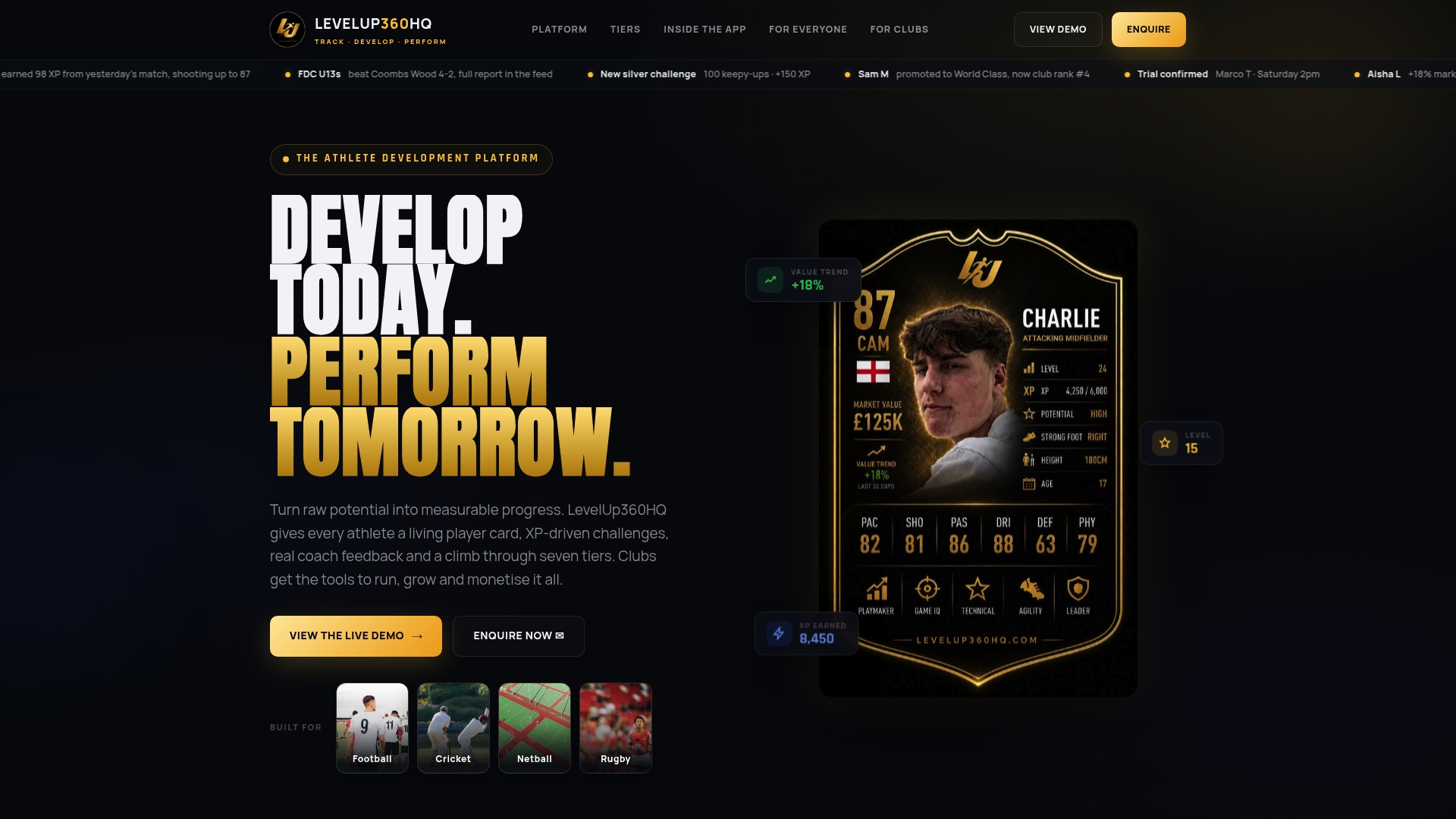
For clubs with 50–300 members, Levelup360hq covers communication, monetisation, and community building without requiring separate tools for each function. Features like XP-driven challenges, leaderboards, badge systems, and subscription management give administrators and athletes a shared reason to stay engaged. You can explore the platform to see how it fits your club’s current setup, or view the demo to walk through the core features before committing.
FAQ
What are the main types of club member engagement tools?
The four primary types are communication tools, member management tools, monetisation tools, and community building tools. Each addresses a distinct function within a sports club’s operations.
Which features matter most for small sports clubs?
Small clubs should prioritise a searchable member database, automated dues collection, and integrated email tools before adding community or gamification features.
How do engagement tools improve member retention?
Automated onboarding sequences and meaningful interaction tracking, such as event attendance and forum activity, are the strongest predictors of renewal. Tools that support these functions directly reduce churn.
What is the data integration trap in club management?
The data integration trap occurs when clubs use disconnected tools for ticketing, payments, and membership that do not synchronise. This creates manual reconciliation work and blind spots in member health data.
How many tools does a sports club actually need?
Most clubs with under 200 members need three to four core tools covering member data, payments, and communication. Adding community features is worthwhile only after the core stack is stable and well adopted.
Recommended
Turn potential into a player card.
LevelUp360 tracks every match, builds your child's player card, and shows their development over time.
Get started free