Club-level performance benchmarking: a practical guide
Published 16 June 2026

Club-level performance benchmarking is the structured comparison of a club’s sporting and management outcomes against peer references to identify where performance exceeds or falls short of expectations. The process covers both on-field results and off-field financial health, using agreed key performance indicators across players, coaches, and administrators. Tools such as the Soccer Performance Index and the InStat Index now give clubs measurable, position-specific data that was unavailable a decade ago. Whether you run a Premier League academy or a community rugby club, this guide explains exactly how the process works and how to use it well.
What is club-level performance benchmarking?
Club-level performance benchmarking is a structured process of comparing a club’s performance against peer or industry references to determine whether outcomes are above or below expectations and to identify specific improvement areas. The industry term for this practice is performance benchmarking, and it applies equally to sporting results and operational management. What makes it distinct from simple data collection is the comparison element. Without a reference point, a statistic tells you nothing about whether you are performing well or poorly.
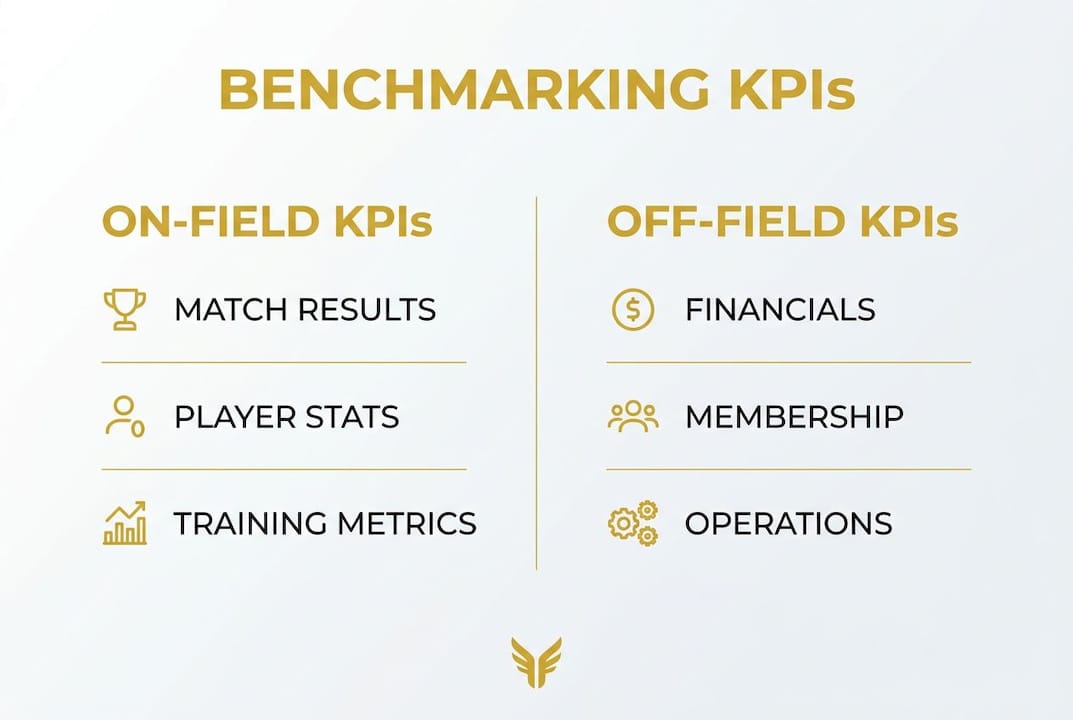
The process separates performance into two components. On-field benchmarking covers playing group outcomes: match results, athlete development rates, and tactical effectiveness. Off-field benchmarking covers financial and operational management: revenue per member, cost control, and staff efficiency. Treating these two components as one combined score obscures where problems actually originate. A club with excellent playing results but poor financial management will look average overall if you blend the two, masking the real issue entirely.

Clubs that use benchmarking effectively move from gut-feel decisions to evidence-based strategies. Benchmarking turns KPIs into a decision tool for managers and boards, replacing internal assumptions with comparative data drawn from peer organisations. That shift matters most when resources are limited and every decision carries real consequences for athlete development.
What kpis are used in club benchmarking, and who uses them?
KPIs in sports clubs are designed at multiple levels: players, teams and coaching staff, and management. Each level requires its own set of metrics because the decisions being made at each level are fundamentally different. A head coach needs to know whether a striker is creating high-quality chances. A finance director needs to know whether membership revenue covers operational costs. Giving both the same dashboard produces noise, not clarity.
Player-level KPIs focus on match and training performance:
- Expected goals (xG) and expected assists (xA) for attacking players
- Distance covered, sprint counts, and high-intensity running loads
- Duel success rates, aerial win percentages, and pressing metrics
- Development trajectory scores comparing current output to age-group norms
Team and coaching staff KPIs shift the focus to collective outcomes:
- Win rate relative to squad market value (a measure of coaching efficiency)
- Set-piece conversion and concession rates
- Squad availability and injury frequency per training block
- Player progression rates from academy to first team
Management KPIs split into sporting and financial categories:
- Sporting: recruitment hit rate, contract renewal success, and loan return value
- Financial: membership turnover, revenue per head, and operating cost ratios
Pro Tip: Never assign a single composite score to both sporting and financial KPIs. A professional soccer framework explicitly recommends keeping these dimensions separate so that decision-makers at each level receive metrics relevant to their actual responsibilities.
Designing KPIs for all sporting levels ensures metrics align with decision needs, making benchmarking a practical tool rather than a reporting exercise. The clubs that get the most value from this process are those that map each KPI to a specific decision, not just a spreadsheet column.
How do clubs implement benchmarking frameworks?
Moving from theory to practice requires a structured framework and reliable data sources. Most professional clubs follow a four-stage process.
- Define the peer group. Select clubs of comparable size, budget, and competitive level. Benchmarking a League Two club against Champions League sides produces misleading conclusions. Peer group selection is the single most consequential methodological decision in the entire process.
- Establish participation thresholds. Player data is only valid above a minimum activity level. A 2026 study developing a Soccer Performance Index for EPL centre forwards applied a minimum of 20 matches as the participation threshold, filtering out small-sample noise that would otherwise distort rankings.
- Select data sources. Internal club data covers training loads, contract values, and membership figures. External databases such as InStat, Opta, and nationwide financial datasets provide the comparative context. A study using FY2023 club financial data demonstrated how average membership turnover rates and revenue benchmarks give clubs a clear picture of where they stand relative to peers of similar size.
- Interpret and act. Data without interpretation is just storage. Each KPI result should map to a specific decision: adjust recruitment criteria, revise pricing, or change training protocols.
Pro Tip: When building your peer group for financial benchmarking, use club size bands rather than league tier alone. A large community club may have more in common financially with a small semi-professional outfit than with a similarly tiered club that operates on a fraction of the budget.
| Data Source | What It Covers | Best Used For |
|---|---|---|
| Internal club systems | Training loads, contracts, membership | Baseline performance tracking |
| InStat / Opta | Match event data, player indices | On-field player benchmarking |
| Industry financial databases | Revenue, cost ratios, membership turnover | Off-field management comparison |
| Peer benchmarking studies | Standardised cross-club datasets | Setting realistic performance targets |
Technology platforms now make this process accessible beyond elite clubs. Levelup360hq, for example, provides multi-level KPI monitoring across football, cricket, netball, and rugby, giving coaches and administrators a single environment for tracking both athlete development and club management metrics.
On-field vs off-field benchmarking: why separate measurement matters
The most important structural decision in club-level performance analysis is whether to measure sporting and financial performance separately or together. The answer, backed by research, is always separately.
A Monash University study using 2021 Australian football league data found that on-field performance exceeded off-field performance across the sample, with variability driven primarily by financial management inefficiency. That finding would have been invisible if researchers had combined both dimensions into a single overall score. The clubs appearing “average” in a blended model were actually strong on the field and weak in the boardroom. Knowing that distinction changes everything about where you direct improvement efforts.
The decomposition approach treats club management as two linked subprocesses:
- Playing group management: squad selection quality, training effectiveness, match preparation, and athlete development pathways
- Financial management: revenue generation, cost control, asset utilisation, and membership retention
“Decomposing overall management into on-field and off-field subprocess efficiencies allows clubs to focus improvement efforts where they truly matter, enhancing resource allocation and strategic planning.” — Monash University research on sports club efficiency
Separate measurement also protects coaches from being judged on factors outside their control. A head coach cannot fix a broken ticketing system or a poorly negotiated sponsorship deal. Blending financial underperformance into a coaching evaluation score is both analytically wrong and professionally unfair. Clean separation makes accountability clear at every level of the organisation.
Best practices and common pitfalls in club benchmarking
Effective club performance evaluation requires discipline in both design and interpretation. The following practices separate clubs that improve from those that merely collect data.
Use position-specific indices, not generic scores. A 2026 study built a position-specific Soccer Performance Index for EPL centre forwards using 109 metrics across 194 player-season observations from 2021 to 2024. The hybrid model weighted market value at 70% and the InStat Index at 30%, achieving an R² of 0.676. That level of specificity is what makes benchmarking useful for recruitment and development decisions. A generic “player rating” applied across all positions tells you almost nothing actionable.
Set participation thresholds before analysing data. Small sample sizes distort rankings. A player who scored in three of four appearances looks exceptional until you realise they played fewer than 200 minutes. Minimum thresholds, such as the 20-match rule used in EPL centre-forward research, filter out noise and make comparisons valid.
Avoid survivorship bias in peer selection. Clubs that have recently been relegated or dissolved rarely appear in benchmarking datasets. If your peer group consists only of currently successful clubs, your benchmarks will be skewed upward. Build your reference group deliberately, including clubs at different performance stages.
Map every KPI to a decision. Professional soccer frameworks recommend distinct KPIs for sporting and financial dimensions precisely because each metric should inform a specific choice. If a KPI does not change a decision, remove it from your dashboard.
Pro Tip: Review your KPI set at the start of each season, not just at the end. Metrics that were relevant during a rebuilding phase may become misleading once a club stabilises. Static dashboards create false confidence.
The most common pitfall is treating benchmarking as a reporting exercise rather than a decision tool. Evidence-based decisions replace assumptions only when the benchmarking process is designed around specific questions, not general curiosity. Ask “are we retaining members at the rate our peer group does?” before you build the metric, not after.
Key takeaways
Club-level performance benchmarking works only when sporting and financial KPIs are measured separately, mapped to specific decisions, and compared against a carefully selected peer group.
| Point | Details |
|---|---|
| Separate on-field and off-field KPIs | Blending sporting and financial scores hides the true source of underperformance. |
| Use position-specific indices | Generic player ratings miss role-specific demands; tailored indices improve recruitment accuracy. |
| Apply participation thresholds | Minimum activity levels filter out small-sample noise and make comparisons valid. |
| Select peer groups deliberately | Compare clubs of similar size and budget to generate benchmarks that are actually achievable. |
| Map every KPI to a decision | If a metric does not change a specific choice, it has no place on your dashboard. |
Benchmarking is only as good as the questions you ask
I have worked with clubs at various levels, and the pattern I see most often is this: a club invests in data collection, builds a dashboard, and then uses it to confirm what the coach already believed. That is not benchmarking. That is expensive reassurance.
The clubs that genuinely improve through performance evaluation are the ones that start with uncomfortable questions. Are we developing players at the rate our peer group is? Is our financial management as efficient as clubs with a similar membership base? Those questions feel threatening, which is exactly why most clubs avoid asking them directly.
What I find most valuable about the decomposition approach from Monash University is that it removes the politics from the conversation. When you can show a board that on-field performance is strong but financial management is the source of inefficiency, you redirect the conversation away from the coach and towards the systems that actually need fixing. That clarity is worth more than any individual metric.
The technology side of this has also shifted considerably. Platforms like Levelup360hq now give community and semi-professional clubs access to the kind of multi-level KPI tracking that was previously only available to fully resourced professional organisations. The barrier is no longer access to tools. The barrier is the willingness to ask honest questions and act on the answers.
Position-specific indices are the area I think deserves more attention at the grassroots level. The EPL centre-forward research is a professional example, but the principle applies at every tier. A winger at an under-18 academy should not be evaluated on the same metrics as a defensive midfielder. Role-specific benchmarking is not a luxury. It is the minimum standard for fair and useful athlete evaluation.
— Chris
See your club’s performance data in one place
Clubs that take benchmarking seriously need a platform that matches their ambition. Levelup360hq brings together athlete performance tracking, coach assessment tools, and club management analytics in one environment built for the entire sports ecosystem.

From FIFA-style player cards with real-time ratings to XP-driven development challenges and full CRM functionality, Levelup360hq gives coaches and administrators the structured data they need to make decisions with confidence. The platform supports football, cricket, netball, and rugby, making it genuinely versatile across club types. Explore the full platform to see how multi-level KPI monitoring works in practice, or walk through the interactive demo to see the benchmarking tools firsthand.
FAQ
What is club-level performance benchmarking?
Club-level performance benchmarking is the structured comparison of a club’s sporting and management outcomes against peer or industry references to identify where performance exceeds or falls short of expectations. It covers both on-field athletic results and off-field financial and operational efficiency.
Why should on-field and off-field kpis be measured separately?
Combining sporting and financial scores into a single overall metric obscures the true source of underperformance. Monash University research found that financial management inefficiency was the primary driver of variability in Australian football clubs, a finding that would have been invisible in a blended score.
What are position-specific performance indices?
Position-specific indices are composite scoring models built from metrics relevant to a single playing role. A 2026 study created a Soccer Performance Index for EPL centre forwards using 109 metrics and a minimum participation threshold of 20 matches, producing more accurate and less biased player evaluations than generic ratings.
How do clubs choose the right peer group for benchmarking?
Clubs should select peers of comparable size, budget, and competitive level rather than simply matching by league tier. Using club size bands for financial benchmarking and competitive tier for sporting benchmarking produces more relevant reference points and more achievable targets.
What is the biggest mistake clubs make with benchmarking?
The most common error is treating benchmarking as a reporting exercise rather than a decision tool. Every KPI should map to a specific choice. If a metric does not change how a coach selects players or how a board allocates budget, it adds no value to the process.
Recommended
Turn potential into a player card.
LevelUp360 tracks every match, builds your child's player card, and shows their development over time.
Get started free