Club CRM for sports academies explained: 2026 UK guide
Published 25 July 2026

A club CRM for sports academies is specialised software that centralises every member, coach, schedule, payment, and communication record into one managed system. Rather than juggling spreadsheets, WhatsApp groups, and disconnected booking tools, your academy operates from a single source of truth. The core idea is simple: when all your data lives together, you stop losing members to admin gaps and start making decisions based on what is actually happening.
Generic contact management tools treat members like sales leads moving through a pipeline. Sports academies need something different. Your members are athletes with attendance records, session histories, subscription statuses, and parents who expect timely updates. A purpose-built sports academy management system handles all of that natively, without workarounds.
Here is what a well-configured academy CRM typically handles:
- Member profiles: unified records combining registration, attendance, payment history, and communication preferences
- Automated renewals: renewal reminders sent without manual intervention, reducing lapsed memberships
- Session scheduling: booking management synced with coach availability and facility capacity
- Multi-channel communications: email, SMS, and push notifications triggered by member behaviour
- Payment processing: subscription billing, one-off fees, and overdue alerts in one place
- Performance tracking: athlete progress logs accessible to coaches and administrators
- Reporting dashboards: real-time views of attendance trends, revenue, and engagement metrics
The shift toward unified CRM platforms that synchronise data across coaches, parents, and administrators reflects where UK academies are heading in 2026. Levelup360hq sits squarely in that direction, combining athlete development tools with the CRM infrastructure clubs actually need.
Table of Contents
- What are the key features of CRM software for sports clubs?
- How does a CRM improve member retention and daily operations?
- Why Levelup360hq is the ideal CRM for UK sports academies in 2026
- Key takeaways
- Levelup360hq gives UK sports academies one platform for everything
What are the key features of CRM software for sports clubs?
The features that matter most in a sports club CRM are not the ones that look impressive in a demo. They are the ones your team will use every day without needing a developer on call.
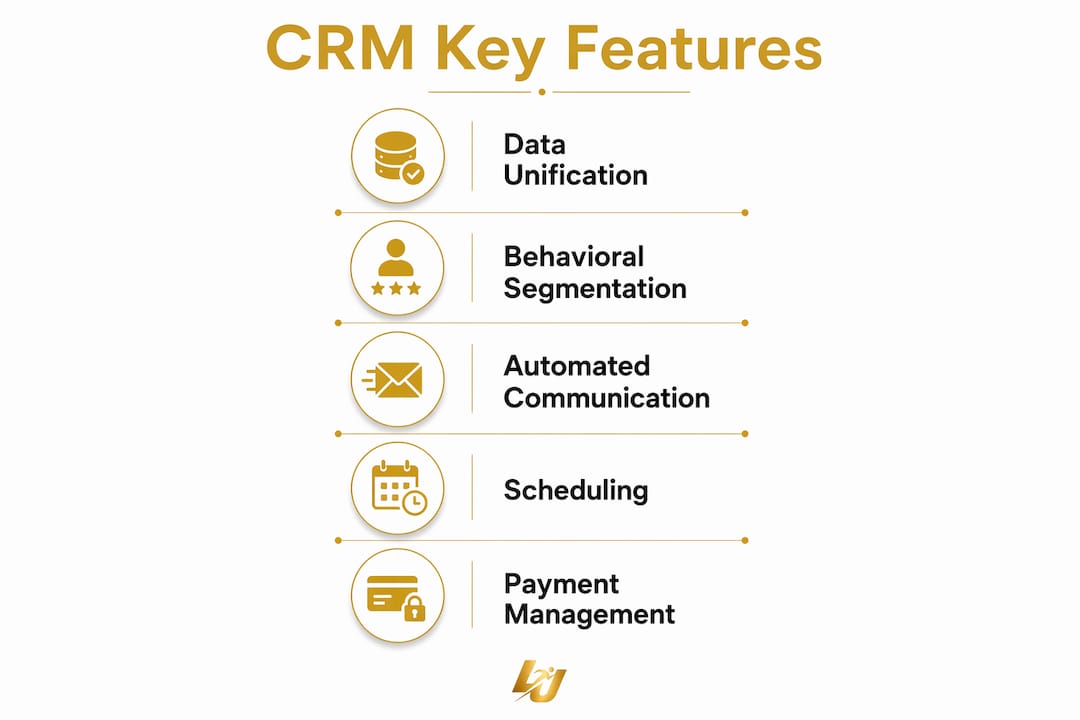
Data unification
A sports-specific CRM must consolidate member data from multiple touchpoints into a single “Golden Record” per member. That means ticket purchases, session attendance, online registrations, and payment records all merge into one profile. Generic tools often cannot do this without expensive customisation, because they were built for B2B sales pipelines, not athlete lifecycle management.

Behavioural segmentation
Knowing a member’s age and postcode tells you very little. Knowing a member’s attendance patterns and payment timeliness, always pay on time but have not booked since a coaching change tells you everything. Sports clubs need behavioural segmentation based on attendance frequency, spend patterns, and engagement recency rather than basic demographic filters. RFM analysis (Recency, Frequency, Monetary value) is the standard approach for scoring members automatically.
Automated communications
Multi-channel campaign automation covering email, SMS, push notifications, and in-app messaging is central to any modern sports CRM. Triggered workflows send a welcome message when someone registers, a reminder before their first session, and a re-engagement offer if they go quiet. The key is that these run without anyone manually pressing send.
Scheduling and session management
A CRM that integrates scheduling reduces double-bookings, automates confirmation messages, and gives coaches a live view of who is attending. Syncing with external calendar tools keeps everyone aligned without extra admin.

Payment and subscription management
Automated billing, failed payment alerts, and flexible subscription tiers are table stakes for any academy running recurring memberships. The best systems flag overdue accounts before they become cancellations.
Loyalty and engagement programmes
Strong engagement programmes go beyond discounts. Tier-based systems that reward attendance, referrals, and milestone achievements keep members motivated between sessions. For academies, this can mean badge systems, leaderboards, or progress-based unlocks tied directly to training activity.
Integration with ticketing and operational tools
A CRM integrated bidirectionally with ticketing systems distinguishes between a ticket purchased and a session actually attended. That distinction changes how you follow up. A member who bought but did not show needs a different message than one who attended and stayed late.
Key benefits at a glance:
- Fewer admin hours spent on manual data entry and chasing renewals
- Personalised communications that feel relevant rather than generic
- Fewer errors from data living in multiple disconnected systems
- Real-time visibility into which programmes are growing and which are losing members
- Faster onboarding for new coaches and administrators
How does a CRM improve member retention and daily operations?
Retention is where a sports academy CRM earns its keep. Most academies lose members not because the coaching is poor, but because the experience around it is inconsistent. A missed renewal reminder, a scheduling confusion, or three weeks without any contact from the club is often enough to push someone to cancel.
Behavioural data tracking changes that dynamic. When your CRM flags that a member’s attendance has dropped from three sessions per week to one, you can act before they leave rather than after. An automated message offering a catch-up call, a discounted block booking, or simply acknowledging the gap can recover a relationship that would otherwise quietly lapse.
Practical retention and efficiency gains:
- Automated attendance monitoring with alerts when members go below a set threshold
- Personalised renewal offers triggered by membership tier and engagement history
- Parent communication workflows that keep families informed without burdening coaches
- Scheduled session reminders that reduce no-shows without manual follow-up
- Real-time dashboards showing which age groups, sports, or coaches have the highest churn
The operational side is just as significant. Academies that move routine workflows into a CRM typically free up hours of administrative time each week. Renewals process automatically. Session confirmations go out without anyone drafting them. Equipment and facility records stay current because the system updates them as bookings are made.
Synchronised data across coaches, parents, and administrators in real time is what separates a well-run academy from one that relies on individual staff members holding everything in their heads. When a coach is ill and a session needs rescheduling, a CRM handles the notifications, the rebooking, and the attendance update without a single phone call.
The multiplier effect comes from connecting all three audiences: athletes see their progress, parents receive timely updates, and administrators have a complete operational picture. That alignment is what turns a good academy into one members actively recommend.
Pro Tip: Set up a re-engagement workflow that triggers soon after inactivity begins, not 30. Members who drift for a fortnight are far easier to recover than those who have already mentally moved on.
Why Levelup360hq is the ideal CRM for UK sports academies in 2026
Most CRM platforms were built for businesses that sell products or services to customers. Levelup360hq was built for the athlete ecosystem, which is a fundamentally different thing. The platform combines gamified athlete development with the CRM infrastructure clubs need to manage members, coaches, and revenue in one place.
The clearest illustration of that difference is the FIFA-style player card system. Each athlete gets a live card displaying real-time ratings, market values, and performance metrics that update as they train and progress. For a 14-year-old in a football academy, that card is a motivation tool. For the academy administrator, it is a performance record tied directly to the member profile. Both needs are served by the same feature.
Platform highlights for UK academies:
- Multi-sport support: football, cricket, netball, and rugby are all natively supported, with no need to adapt a single-sport tool
- XP-driven challenges: experience points and tier progression keep athletes engaged between sessions
- Coach tools: video assessments, approval workflows, and session management give coaches a structured development environment
- White-label branding: academies can present the platform under their own brand, maintaining identity while using Levelup360hq’s infrastructure
- Subscription and store management: built-in monetisation tools covering membership billing, merchandise, and programme upsells
- Social engagement: the ‘Word on the Street’ feed creates a community layer that keeps athletes and parents connected to the club
The CRM functionality sits underneath all of this. Member profiles, communication workflows, renewal management, and reporting are all present, but they are contextualised for sports rather than bolted on from a generic sales tool.
For UK academies specifically, the platform’s support for multiple sports under one system is particularly useful. Many clubs run football in winter and cricket in summer, or manage netball and rugby programmes simultaneously. Switching between disconnected tools for each sport creates exactly the data fragmentation that a CRM is supposed to solve.
Complexity is one of the most common reasons CRM adoption fails in sports clubs. Practical training and an intuitive interface are not optional extras; they determine whether your team actually uses the system six months after launch. Levelup360hq’s design prioritises usability for administrators and coaches who are not technical specialists, and the platform’s demo environment lets teams explore the full feature set before committing.
Data ownership is another area where UK academies need clarity. The ideal CRM gives you full export rights and avoids vendor lock-in, so your member history remains yours regardless of what happens with the platform. For academies operating under UK GDPR obligations, that control over data is not just a preference; it is a compliance requirement.
Pro Tip: When evaluating any sports CRM, run a live scenario with your actual team: build a segment of members who attended fewer than three sessions last month, then trigger a targeted communication. If your team cannot complete that in under 30 minutes, the platform is too complex for day-to-day use.
The unified scheduling and payments approach that leading sports organisations are adopting in 2026 reflects a broader shift away from fragmented legacy tools. Levelup360hq’s architecture is built around that principle from the ground up, rather than trying to retrofit it.
Key takeaways
A sports academy CRM that unifies member data, automates communications, and integrates performance tracking is the single most effective operational change a UK club can make in 2026.
| Point | Details |
|---|---|
| Data unification is foundational | A single “Golden Record” per member, pulling from all touchpoints, is what separates a sports CRM from a generic contact tool. |
| Behavioural segmentation drives retention | Attendance frequency and spend patterns reveal at-risk members far earlier than demographic data alone. |
| Automation reduces admin and churn | Automated renewals, session reminders, and re-engagement workflows free up staff time and recover lapsing members before they cancel. |
| UK GDPR requires data ownership | Academies must confirm full export rights and no lock-in clauses before committing to any CRM platform. |
| Levelup360hq combines CRM with athlete development | The platform serves athletes, coaches, and administrators in one system, with multi-sport support and white-label options for UK academies. |
Levelup360hq gives UK sports academies one platform for everything
Running a sports academy in 2026 means managing athletes who expect a professional development experience, parents who want visibility, and coaches who need structured tools, all while keeping the administrative side from consuming every spare hour. Most CRM platforms solve part of that. Levelup360hq solves all of it.
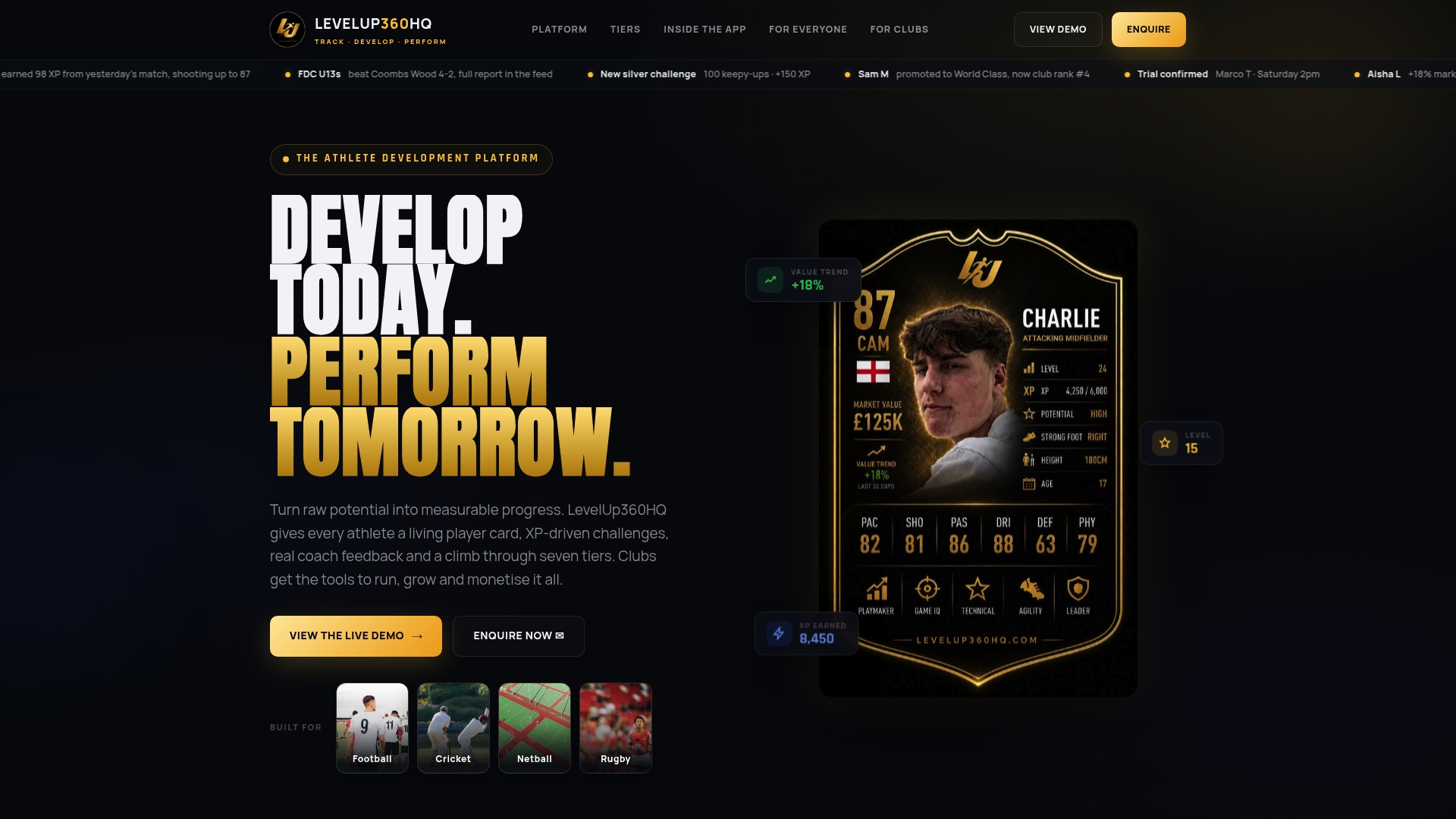
The platform’s gamified development layer, live player cards, XP challenges, badge systems, and leaderboards do something generic CRM software cannot: it gives athletes a reason to stay engaged with the club beyond their next session. That engagement feeds directly into the CRM data, creating richer member profiles and more accurate retention signals for administrators.
For UK academies managing multiple sports, the white-label option means you present a branded, professional platform to members without building anything from scratch. Subscription management, store integrations, and monetisation tools mean the platform supports revenue growth alongside athlete development, not as a separate system bolted on later.
The practical next step is straightforward. Explore the full platform to see how Levelup360hq fits your academy’s specific setup, or walk through the live demo with your team to test the CRM and development features against your real workflows.
Recommended
Turn potential into a player card.
LevelUp360 tracks every match, builds your child's player card, and shows their development over time.
Get started free