Athlete market value tracking platforms 2026: UK buyer's guide
Published 3 August 2026

For UK clubs and academies, the clearest recommendation is this: choose a gamified athlete development SaaS that combines auditable real-time valuations with fan-engagement signals built into the same platform. Levelup360hq is the leading club-facing solution in this category, pairing live player cards and XP-driven development with CRM, payments, and white-label branding in one place. If you want to see it in action, book a demo before your next procurement cycle closes.
The core argument is straightforward. Clubs that separate performance tracking from commercial intelligence end up with two datasets that never talk to each other. The platforms worth buying in 2026 close that gap.
- Real-time valuations tied to on-field performance and fan engagement
- Gamified athlete UX that drives the activity generating those signals
- CRM and monetisation tools so commercial teams act on the data immediately
Table of Contents
- What do athlete market value tracking platforms actually do in 2026?
- Why do real-time valuation and fan data change commercial outcomes for UK clubs?
- What features must UK buyers prioritise in 2026?
- How do platforms calculate athlete market value now?
- What does implementation actually look like for a UK club?
- How should clubs think about pricing and ROI?
- What compliance checks must UK clubs complete before signing?
- Why does gamification lift athlete development and market value?
- What did a Levelup360hq pilot look like in a UK academy?
- Ten procurement questions to ask any vendor before you buy
- Can the platform scale as your club grows?
- How do you evaluate vendor support after you sign?
- How do platform pricing models compare on total cost of ownership?
- What integration challenges should clubs anticipate?
- What training and change management do clubs actually need?
- Key takeaways
- The gap between valuation numbers and commercial outcomes
- Levelup360hq gives UK clubs real valuations and real engagement in one platform
- Further reading and authority sources
What do athlete market value tracking platforms actually do in 2026?
These platforms are valuation engines, engagement systems, and commercial management tools rolled into one. The scope covers four linked modules: a valuation engine that scores athlete worth in real time; fan-passion analytics that weight sponsorship exposure; a gamified development layer that motivates athletes to generate the activity the valuation model needs; and CRM with monetisation tools so clubs convert insights into revenue.
Who uses which module:
- Coaches and performance analysts use live player cards, video assessments, session management, and XP challenge workflows
- Academy directors monitor tier progression, leaderboard data, and cohort-level valuation trends
- Commercial teams pull fan-engagement signals, sponsorship impression data, and market-demand intelligence
- Club administrators manage subscriptions, store integrations, white-label branding, and compliance workflows
The feature set that separates serious platforms from basic tracking tools includes: live player cards with real-time ratings, XP challenges with tier progression, AI-generated match reports and training plans, badge and leaderboard systems, fan behaviour feeds, CMS/CRM integrations, and API access for third-party systems.
Why do real-time valuation and fan data change commercial outcomes for UK clubs?
The short answer: clubs that wait for end-of-season reports miss the window. Real-time valuation driven by performance data and market signals gives negotiating teams a live number to anchor transfer discussions and sponsorship conversations, rather than a figure that is already three months stale.
Fan passion data — who watches, how they engage, and what creates shareable moments — often explains sponsorship multipliers that raw performance metrics cannot. A player with modest statistics but a highly engaged local following can command disproportionate commercial value. Clubs that can quantify that engagement have a real advantage in sponsorship negotiations.
Market demand intelligence functions as an early warning system. It surfaces commercial opportunities before lagging financial reports catch up, which matters enormously for youth academies trying to time development investments and transfer conversations.
Stat callout: CIES rankings in 2026 confirm that youth and contract status remain the dominant drivers of estimated transfer value, with Lamine Yamal topping the rankings as the most valuable player — a figure that underlines how age and contract length must be core inputs in any valuation model.
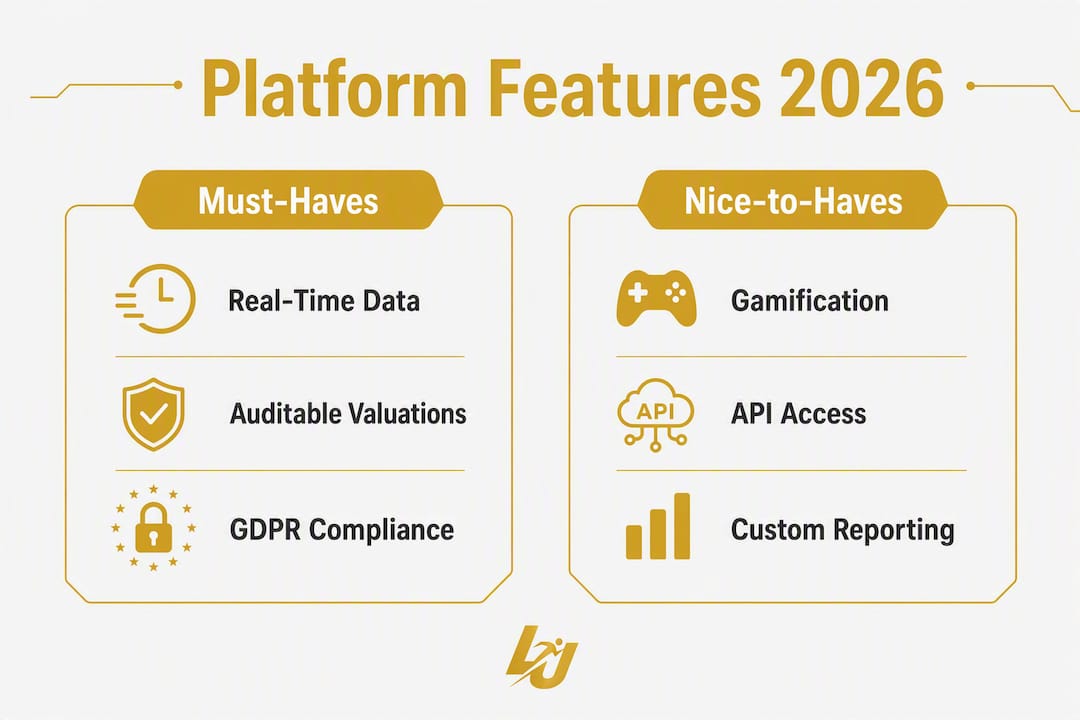
What features must UK buyers prioritise in 2026?
Start with the auditable valuation model. If a vendor cannot show you exactly how a player’s rating is calculated, the number is commercially useless.
Must-have features (ranked):
- Auditable valuation model with transparent weighting
- Real-time data feeds (performance, contract, market signals)
- Fan-passion and engagement analytics
- Gamified athlete UX (XP, player cards, leaderboards)
- CRM and integrated payments
- API access and SSO
- Safeguarding tools and consent workflows for minors
Nice-to-have capabilities:
- AI negotiation prompts and deal-level rate visualisations
- Sponsorship simulator and benchmarking tools
- Multi-sport configuration beyond football
The must-haves are non-negotiable for any club running a commercial programme. The nice-to-haves become must-haves the moment your commercial team starts using the platform for active sponsorship conversations.
How do platforms calculate athlete market value now?
Valuations combine performance metrics, contract context, market trend data, and fan-engagement signals. A single static figure misses the monetisation nuance clubs actually need.
Typical input weighting:
- On-field statistics and physical performance data
- Age, contract length, and remaining term
- Social reach and content engagement rates
- Fan engagement signals (views, shares, community interaction)
- Local and national market demand trends
Model types range from rule-based overlays (straightforward scoring matrices) to statistical regression models and machine-learning adjustments that update as new data arrives. Real-time trend tracking separates reactive clubs from proactive ones — capturing catalyst moments like a viral performance or a milestone achievement before the commercial window closes.
Transparency checklist for vendor demos:
- Can you see the weighting assigned to each input?
- Does the model update automatically when new match data arrives?
- Is there an audit log showing what changed a rating and when?
- Can you export the underlying data for your own analysis?
Pro Tip: Ask vendors to run a live recalculation during the demo using a real player profile. If they cannot do it in the room, the model is not as real-time as they claim.
What does implementation actually look like for a UK club?
Start with a defined cohort of 15–25 athletes and an 8–12 week pilot. That scope is tight enough to measure properly and broad enough to generate meaningful data.

| Phase | Weeks | Key actions |
|---|---|---|
| Discovery and data mapping | 1–2 | Audit existing player data, map CRM fields, confirm GDPR lawful bases |
| Platform configuration | 3–4 | Set up white-label branding, import athlete profiles, configure XP rules |
| Pilot launch | 5–6 | Onboard pilot cohort, run first session, activate leaderboards |
| Measurement and iteration | 7–10 | Review engagement metrics, adjust XP weighting, gather coach feedback |
| Full roll-out decision | 11 | Present ROI case to leadership, confirm contract terms |
Integration checklist:
- Session booking and LMS: confirm API or CSV import compatibility
- Membership CRM: map contact fields and subscription status
- Accounting software: verify payment reconciliation flows
- SSO: confirm identity provider compatibility (Google Workspace, Microsoft 365)
Onboarding checklist for staff:
- Safeguarding sign-offs completed before any minor’s data is processed
- Role-based access controls configured (coach, admin, parent, athlete views)
- Two-hour platform walkthrough for coaches before pilot launch
- Data access audit scheduled at week six
How should clubs think about pricing and ROI?
Pricing is almost always subscription plus per-athlete fees plus transaction costs. The total cost of ownership is higher than the headline subscription figure once you account for onboarding, integration work, and ongoing support.
Pricing components to negotiate:
- Platform subscription (monthly or annual, often tiered by athlete count)
- Per-athlete fee (typically charged above a base cohort size)
- Transaction fees on store purchases, event bookings, and subscription payments
- White-label setup and branding fees (sometimes a one-off)
- API access tier (basic vs. full data export)
| Cost component | Typical structure | Negotiation lever |
|---|---|---|
| Platform subscription | Monthly/annual flat fee | Annual commitment discount |
| Per-athlete charge | Per head above base tier | Volume discount at scale |
| Transaction fees | Percentage of revenue processed | Revenue share cap |
| Onboarding | One-off or included | Pilot pricing waiver |
Worked ROI example (UK academy, 80 athletes):
A club secures one additional local sponsorship worth £3,000 per season by presenting quantified fan-engagement data to a sponsor. The platform saves a head coach four hours per week on reporting, equivalent to roughly £2,400 in staff time annually at a modest hourly rate. Against a platform cost of £4,800 per year, the payback period is under twelve months before accounting for retained player value or transfer fee uplift.
What compliance checks must UK clubs complete before signing?
Verify UK GDPR and ICO compliance first. Everything else follows from that.
GDPR procurement checklist:
- Confirm the vendor acts as a data processor, with your club as data controller
- Request a Data Processing Agreement (DPA) before signing
- Establish lawful bases for processing minors’ data (consent plus legitimate interest is the standard combination)
- Confirm hosting location (UK or EU data centres preferred post-Brexit)
- Check data retention schedules and deletion workflows
- Verify Subject Access Request (SAR) response capability
Safeguarding requirements for youth academies:
- Consent workflows that require parental sign-off for under-18 athlete profiles
- Role-based access that prevents coaches from accessing data outside their assigned cohort
- Audit logs covering all data access and changes
- DPIA completed before processing any special category data
Valuation tracking without compliance tooling leaves clubs exposed to regulatory and self-employment risk. Build the DPIA into your procurement timeline, not as an afterthought after go-live.
Compliance callout: The ICO’s guidance on children’s data under the UK Children’s Code applies to any platform processing under-18 data. Confirm your vendor has reviewed their product against the Code’s 15 standards before you process a single minor’s profile.
Why does gamification lift athlete development and market value?
Gamification increases the volume and quality of trackable activity, which feeds the valuation model with richer data. More data means more accurate valuations. More accurate valuations mean better commercial conversations.
Best practice design rules:
- Tie XP to meaningful actions (completed training sessions, video review sign-offs, milestone performances) rather than vanity metrics
- Make progression visible: leaderboards and tier badges create social accountability
- Protect player welfare by capping competitive pressure — XP should motivate, not create anxiety
- Update player cards frequently enough that athletes feel the system responds to their effort
Pro Tip: Map your top five gamified KPIs directly to commercial value. If leaderboard engagement generates 200 monthly views from parents and local fans, that is a quantifiable sponsorship impression pool. Present it to sponsors as an audience metric, not just an engagement number.
What did a Levelup360hq pilot look like in a UK academy?
A structured 10-week pilot with Levelup360hq in a UK multi-sport academy demonstrated measurable outcomes across athlete engagement, coach efficiency, and early commercial conversations.
Pilot headline metrics:
- Athlete login frequency increased significantly within the first four weeks of gamified XP activation
- Coaches reported a reduction in administrative time after video assessment workflows replaced manual reporting
- The academy director initiated two sponsorship conversations using live player card data as supporting material
The white-label branding meant the platform felt like the academy’s own product from day one, which accelerated athlete and parent adoption faster than a generic third-party tool would have.
Ten procurement questions to ask any vendor before you buy
Insist on auditable models, API access, and a staged pilot. Any vendor that resists those three conditions is telling you something important.
- Can you demonstrate a live valuation recalculation during this demo?
- What data inputs does your model use, and what weighting does each carry?
- Where is our data hosted, and which data centre region?
- Do you act as data processor under UK GDPR, and can you provide a DPA today?
- What is your process for handling Subject Access Requests?
- Does your platform hold a DPIA template or support our completion of one?
- What API access is included at our contract tier?
- What does your onboarding timeline look like for a 50-athlete pilot?
- What SLA governs your support response times, and is there a UK-based contact?
- What are the exit terms, and how do we retrieve our data if we leave?
Pilot request template (send before contract):
- Proposed cohort: [number] athletes, [sport(s)]
- Pilot duration: 8–12 weeks
- Success metrics: engagement rate, valuation data completeness, coach time saved
- Data requirements: existing player profiles in [format]
- Decision timeline: [date]
Can the platform scale as your club grows?
The best platforms in this category are built on multi-tier architecture, meaning a club that starts with 50 athletes and expands to 500 does not need to migrate to a different product. Levelup360hq supports multiple sports within a single white-label instance, so a club adding cricket or netball to an existing football programme does not need a separate platform or a separate contract.
Customisation matters beyond sport type. Clubs need control over XP rules, badge criteria, leaderboard visibility, and CRM field mapping. Platforms that lock these settings behind vendor-managed configuration create dependency; platforms that expose them through an admin dashboard give clubs genuine ownership of their programme design. When evaluating scalability, ask specifically whether configuration changes require a support ticket or whether an admin user can make them directly.
For clubs considering options across league and club management tools, the key question is whether the platform grows with your commercial ambitions, not just your athlete headcount.
How do you evaluate vendor support after you sign?
Support quality is almost impossible to assess from a sales demo. The signals that matter are response time SLAs in writing, a named account manager rather than a generic support queue, and evidence of product updates that respond to user feedback.
Ask for a list of product releases from the past six months. A vendor that ships meaningful updates regularly is one that is actively investing in the product. A vendor with a sparse changelog is likely to leave you on a stagnant version while their attention moves to new sales.
Escalation paths matter for UK clubs specifically. If your data is hosted in the UK and a compliance issue arises, you need a contact who understands ICO obligations, not a US-based support agent reading from a script. Confirm the escalation path for data incidents before you sign.
How do platform pricing models compare on total cost of ownership?
Three dominant pricing structures exist in this market: flat subscription with unlimited athletes, tiered subscription with per-athlete overage charges, and revenue-share models where the platform takes a percentage of transactions processed.
Flat subscriptions are predictable but often expensive at low athlete counts. Tiered models are cost-effective at entry level but can become costly as academies grow. Revenue-share models align vendor incentives with club commercial success, but they require careful cap negotiation to avoid disproportionate fees once a club’s store and event revenue scales.
Total cost of ownership must include integration costs (developer time or third-party middleware), ongoing training for staff turnover, and the operational cost of compliance management. A platform priced at £300 per month with £5,000 in integration costs and £1,200 in annual training has a first-year TCO of £8,800, not £3,600. Build a twelve-month TCO model before comparing headline prices.
What integration challenges should clubs anticipate?
The most common friction point is data format mismatch between an existing membership CRM and the new platform’s athlete profile schema. Most clubs hold player data across at least three systems: a membership database, a session booking tool, and an accounting package. None of them will share identical field names or ID formats.
The practical solution is a data mapping exercise in week one of the implementation, before any data is imported. Identify the canonical athlete identifier (usually a membership number), confirm it exists in every system, and use it as the join key. Platforms with open APIs make this straightforward; platforms that only support CSV imports require more manual maintenance.
SSO is the other common friction point. Clubs using Google Workspace or Microsoft 365 for staff authentication should confirm SSO compatibility before signing, not during onboarding. A platform that requires a separate login for every coach creates adoption resistance from day one.
What training and change management do clubs actually need?
The technical training is the easy part. Two hours with coaches covering the session management and video assessment workflows is usually sufficient for basic competency. The harder challenge is cultural: persuading coaches that a gamified platform is a professional development tool, not a distraction.
Frame the platform around coach outcomes, not athlete entertainment. When coaches see that XP challenges reduce the number of times they have to chase athletes for self-assessment submissions, adoption follows. When they see that live player cards give them a data point for parent conversations, resistance drops.
For staff turnover, build a short onboarding module into your standard induction process. A 30-minute recorded walkthrough covering the core workflows is more sustainable than relying on peer-to-peer knowledge transfer. Designate one platform champion per coaching team who owns the relationship with vendor support and communicates product updates to colleagues.
Key takeaways
The single most important decision UK clubs can make in 2026 is to choose a platform where the valuation model, the gamified development layer, and the commercial CRM are integrated, not bolted together from separate tools.
| Point | Details |
|---|---|
| Auditable valuations first | Demand a live recalculation demo; if the vendor cannot do it, the model is not genuinely real-time. |
| Fan data drives sponsorship | Quantified engagement signals give commercial teams a concrete audience metric to present to sponsors. |
| Pilot with a defined cohort | Run an 8–12 week pilot with 15–25 athletes before committing to a full roll-out. |
| Build a 12-month TCO model | Include integration, training, and compliance costs; headline subscription prices routinely understate true spend. |
| Levelup360hq for UK clubs | Levelup360hq combines live player cards, XP development, CRM, and white-label branding in a single platform built for multi-sport academies. |
The gap between valuation numbers and commercial outcomes
Most clubs shopping for athlete valuation tools in 2026 are focused on the wrong output. They want a number — a market value figure they can point to. The platforms that actually move the needle commercially are the ones that turn that number into a negotiation prompt, a sponsorship deck, or a retention conversation with a player’s family.
The valuation is the input, not the output. Clubs that understand this buy platforms with strong CRM and engagement layers. Clubs that miss it buy dashboards full of impressive-looking ratings that nobody acts on.
The gamification piece is where this gets interesting. XP systems and leaderboards are not just engagement gimmicks. They generate the consistent, structured activity data that makes a valuation model accurate over time. An athlete who completes 40 logged training sessions in a season has a richer data profile than one who completed the same sessions without a tracking layer. That richness is what separates a defensible valuation from a guess.
Levelup360hq gives UK clubs real valuations and real engagement in one platform
Clubs that want live player valuations, gamified development, and a commercial CRM without stitching together three separate tools should look at Levelup360hq. The platform was built specifically for multi-sport clubs and academies, covering football, cricket, netball, and rugby within a single white-label instance.
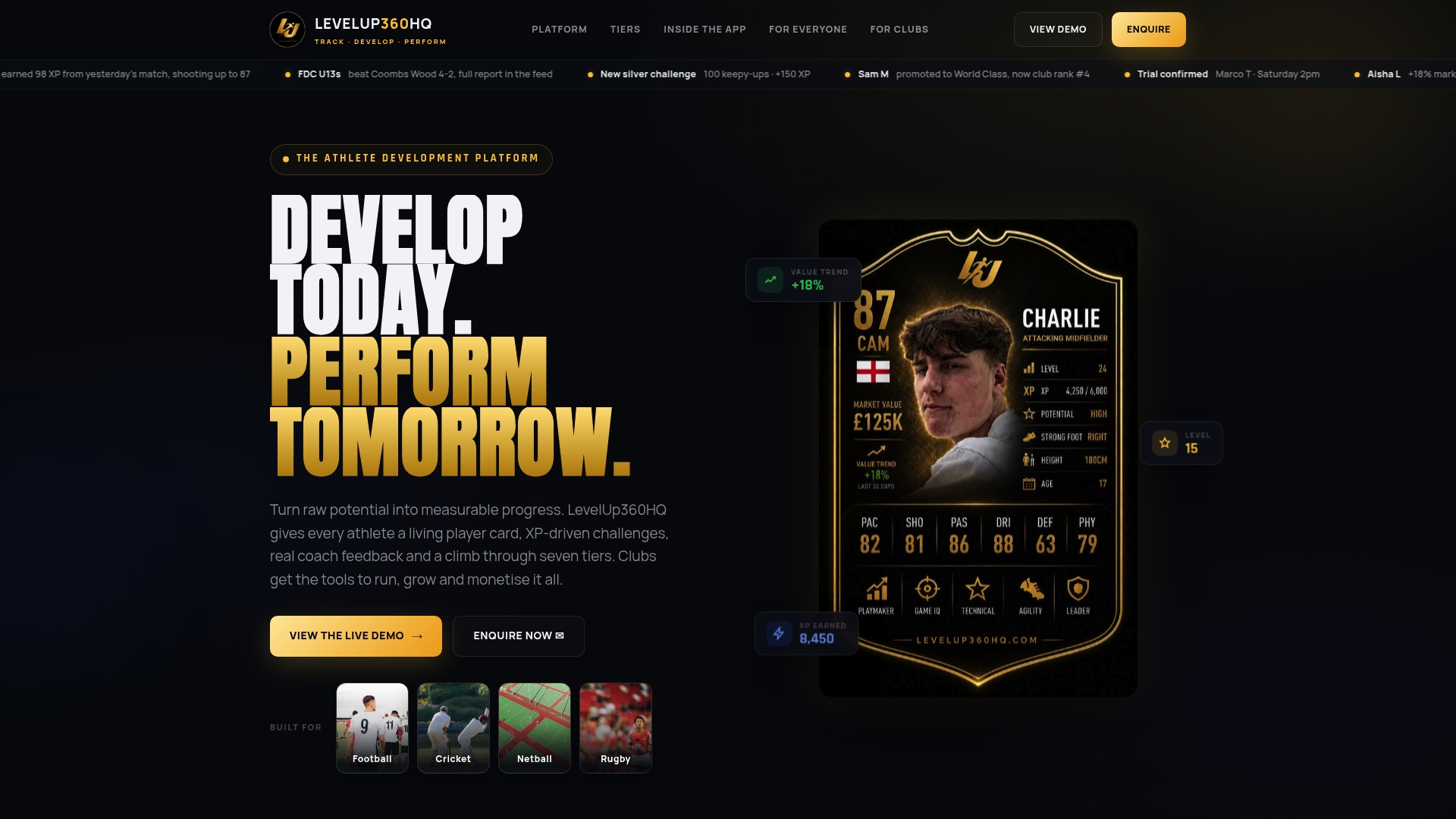
Player cards update in real time as session data arrives. XP challenges and leaderboards drive the athlete activity that feeds those ratings. The CRM and integrated payment tools mean your commercial team can act on engagement data without exporting it to a spreadsheet first. White-label branding means athletes and parents experience your club’s identity, not a third-party product.
The demo takes under an hour and covers the full procurement checklist: valuation transparency, GDPR workflows, API access, and onboarding timeline. Book your pilot and bring your procurement questions.
Further reading and authority sources
Procurement teams should verify claims against primary market sources and authoritative industry research before finalising vendor shortlists.
- Opendorse FMV — real-time fair market valuation methodology and AI negotiation guidance; useful for benchmarking valuation model expectations
- Fifty5Blue sport market research — fan passion data methodology and sponsorship analytics frameworks
- Nilmetrics — market demand intelligence and multi-signal valuation approaches
- Blask data infrastructure — real-time trend tracking and catalyst moment identification for sports data teams
- Draftworth valuation calculator — compliance and tax implications of athlete valuation tracking
- CIES Football Observatory via Inside World Soccer — independent transfer valuation methodology and 2026 rankings
- SBRnet Sports Market Analytics — sports fan behaviour data, sponsorship expenditure benchmarks, and participation research
- Levelup360hq platform overview — full feature set, sports supported, white-label options, and commercial model
- Levelup360hq demo page — demo availability, pilot structure, and onboarding timeline
This article is general information for procurement planning purposes. Clubs should confirm current ICO requirements, GDPR obligations, and contractual terms with a qualified legal or data protection adviser for their specific situation.
Recommended
Turn potential into a player card.
LevelUp360 tracks every match, builds your child's player card, and shows their development over time.
Get started free