Athlete Data Quality: Accuracy, Ownership and Trust
Published 6 November 2026

Athlete data is good when it is accurate, complete, current, consistent and handled with the athlete’s knowledge. A rating, a sprint time or a wellness score only helps if everyone reading it can trust where it came from and who is allowed to see it. This guide covers what to collect, how to check it, and who owns it in the United States, whether you are an athlete, a parent, a coach or a club administrator.
TL;DR
- Quality data is captured in one reliable place, kept up to date, and tied to clear rules on who can see it. Messy or outdated records lead to wrong decisions and lost visibility.
- Check accuracy by testing consistency, comparing self-reported marks with official results, and treating a single odd number as a question, not a verdict.
- In the US there is no single federal law covering athlete biometric data. Ownership depends on state law, contracts and institutional policy, so write the rules down.
- For young athletes, consent should come from a parent or guardian, be specific about which data is shared, and have an end date.
- Metrics support a coach’s judgement. They never replace it.
Table of Contents
- What athlete data quality actually means
- The types of data you are likely to collect
- How to check whether your data is accurate
- Using data without being misled by it
- Who owns athlete data in the United States
- Rights and safeguards for young athletes
- Sharing and keeping data responsibly
- Our perspective on athlete data
- Putting it into practice with LevelUp360HQ
- FAQ
- Sources
What athlete data quality actually means
Athlete data management is the structured way of capturing profiles, training, wellness, performance, medical and availability information, storing it in one reliable place, controlling who can access what, and turning it into decisions. Sports First describes the payoff as faster staff decisions, earlier spotting of patterns such as workload spikes or low wellness trends, and development plans built on trends over months rather than single sessions.
Quality is therefore more than accuracy. Five questions cover most of it:
- Accurate: does the number reflect what really happened?
- Complete: are the fields that matter filled in?
- Current: is it from this season, not three years ago?
- Consistent: is it measured the same way each time, by the same method?
- Governed: does the athlete know it exists, and is access limited to people with a reason to see it?
A small error matters more than it looks. One 2024 study of 21 sports organisations, summarised by CampTechWise, found that analytics systems had strong effects on performance and operations, but adoption was held back by skills gaps, costs and ethical risks. The same write-up frames data quality as a coaching issue: a minor operational slip becomes a coaching error when it changes how someone reads a player’s readiness, effort or progress.
Why it matters for visibility
For athletes chasing recruitment, data quality is also a visibility issue. A US recruiting blog reports that profiles with accurate, complete information show up correctly in the filtered searches college coaches use, while profiles with missing fields often do not appear, and that recent video affects ranking. The practical lesson is simple: an athlete who keeps a profile complete and current is easier to find than one who uploads once and forgets.
The types of data you are likely to collect
According to a report from the Australian Academy of Science, routine athlete data collection typically falls into four categories: geospatial (such as GPS tracking), biomechanical (movement profiles), physiological (such as heart rate) and player management or wellbeing data (such as self-reported wellness).
Each type has its own quality risks:
| Data type | Typical example | Common quality problem |
|---|---|---|
| Geospatial | GPS distance, speed | Device differences between units or sessions |
| Biomechanical | Movement profiles, technique video | Different camera angles or test conditions |
| Physiological | Heart rate, sleep | Sensor error, missing nights |
| Wellbeing and management | Wellness surveys, attendance, availability | Inconsistent honesty, skipped entries |
| Performance and skill | Match ratings, test results, coach assessments | Subjective scoring, outdated records |
Recovery and sleep data are the area where athletes most often mix good numbers with poor habits. If you track them, it helps to pair the figures with a sensible daily recovery routine for athletes, so that a low reading leads to a concrete action rather than just a worry.
How to check whether your data is accurate
You do not need a sports science lab. You need a few repeatable habits.
Test your devices
Academic guidance on wearables recommends assessing reliability through routine testing of intradevice and interdevice consistency, often expressed as coefficient of variation and typical error. In plain terms: does the same device give similar readings under the same conditions, and do two devices agree with each other? If two units disagree, do not mix their numbers in one trend line.
Standardise how you measure
Most bad data is inconsistent data. Fix the protocol and write it down:
- Same test, same surface, same warm-up, same time of day where possible.
- Same person scoring video assessments, or a shared scoring guide so two coaches rate a skill the same way.
- One agreed definition for each wellness question, so that a 3 out of 5 means the same thing every week.
Verify what can be verified
Self-reported marks are where errors creep in. A US track and cross-country recruiting platform’s blog notes that athletes mistype times, list wind-aided performances as legal or carry forward outdated personal records, and that checking against official meet results removes doubt for college coaches. Another US source makes the same case: data confirmed through trusted third parties such as schools or official combines supports faster, more reliable recruiting decisions than self-reported figures.
A workable rule for any club: record where each number came from (timed by a coach, official result, device, self-reported) and show that label next to it.
Look at trends, not single readings
One bad night of sleep or one weak match rating tells you little. Months of consistent entries tell you a great deal. Build in a habit of asking “what happened that day?” before acting on an outlier.
Using data without being misled by it
Good data can still mislead when it is read without context. The Australian Academy of Science report voices concern that unrestricted collection can treat the sporting workplace as a 24/7 monitoring zone and that unvalidated, data-driven decisions could displace expert judgement. It also warns that complex human function can be reduced to shallow metrics that lack context.
The constructive answer is to use numbers to start conversations:
- Pair every metric with an observation. A drop in a sprint time plus a coach’s note about a minor knock is more useful than either alone.
- Collect fewer things, better. Ten measures you trust beat fifty you do not.
- Explain the purpose. Tell athletes what is collected and why. Their honesty in self-reported entries depends on it.
- Keep the coach in charge. Ratings and analytics inform selection and development plans, and coaches make the call.
Who owns athlete data in the United States
There is no single federal law that comprehensively governs athlete biometric data. Fisher Phillips notes that organisations must navigate overlapping state privacy laws, institutional policies and contracts. A Mintz analysis makes the same point: the rules that apply depend on who the athlete is, who collects the data, the jurisdictions involved, the type of biometric data and any contractual commitments.
It helps to separate four things that people often lump together as “ownership”: ownership itself, access, control (such as deletion) and permission to use it commercially.
What professional leagues have agreed
Professional collective bargaining agreements show how far the rules can go when they are written down:
- The NFL agreement treats digital biometric data as health data and gives each player ownership rights over personal data. A 2025 legal review adds that the 2017 WHOOP agreement gave players access to, ownership of and the option to commercialise their own health data, and that team staff may access biometric data but cannot use it in contract negotiations.
- In MLB, an Indiana Journal of Law and Sport analysis explains that players can ask teams to restrict who sees wearable data and to destroy it at any time. Teams are not required to restrict access but must delete on request, and commercial use of a player’s data by a team or league is prohibited.
Colleges and clubs have less clarity
Outside the pros, the picture is less settled. Sports Business Journal reports that few schools have defined precisely who owns student-athlete biometric and performance data, and that experts advise treating athlete data as a major asset category, defining ownership and use rights explicitly and putting athlete communication at the centre of the rollout.
State law can help. Virginia’s code bars institutions from disclosing an enrolled student-athlete’s biometric data outside the institution without prior written consent, and prevents anyone from making rights to that data a condition of an NIL contract without separate written consent. That is one state, so check the rules where you live.
Rights and safeguards for young athletes
Parents and guardians carry most of the weight here, because most club athletes are minors.
- Schools and FERPA. Under the Family Educational Rights and Privacy Act, schools generally cannot disclose personally identifiable information from education records, including biometric records, without consent, unless it has been properly designated as directory information.
- Under-13s and COPPA. The Children’s Online Privacy Protection Act requires online services directed to children under 13 to notify parents and obtain verifiable consent before collecting personal information. The FTC’s enforcement announcement confirms that biometric and health information is covered when collected with other personal data.
- Health data outside HIPAA. The FTC enforces Section 5 of the FTC Act against unfair or deceptive privacy and security practices, which extends protection to health and biometric data that may fall outside HIPAA.
- Revocable consent. Even where consent is given, it can be withdrawn. An NCAA authorisation form, for example, lets student-athletes revoke consent in writing at any time.
If you are a parent, ask any club or app three questions: what is collected, who can see it, and how do I have it corrected or deleted?
Sharing and keeping data responsibly
The hardest quality question is often not accuracy but access. Athletes can feel watched. In a University of Florida study of US collegiate athletes using wearables, some interviewees said they would not want coaches seeing their sleep data every night, partly for fear of being judged. Trust drops when athletes feel data is taken from them rather than shared with them.
One youth club has published draft standards that show what a careful approach can look like. Solstice FC’s data standards allow scouts and colleges to see player data only with explicit per-request family consent, including written opt-in from a parent or guardian, a defined list of shared fields, time-limited access (90 days by default, renewable) and an audit trail the family can see. They rule out open dashboards for minors and bulk exports to outside parties.

Fisher Phillips and Foley & Lardner both advise clear governance policies on ownership, access and retention, plus open communication with athletes about what is collected and why.
A short data policy any club can adopt
- List every data type you collect and why.
- Name who can see each type (coach, admin, parent, athlete, scout).
- Set a time limit on any external access, and require written parental consent for minors.
- Label each record with its source.
- Give athletes and parents a simple way to request corrections or deletion.
- Review the list every season.
Our perspective on athlete data
We built LevelUp360HQ on a simple belief: the athlete should be able to see their own development, not just be measured by it. When a player has a live player card with ratings, XP and tier progression, the data stops being something done to them and becomes something they can act on.
Quality starts with consistency. When coaches score video assessments through an approval workflow, and sessions and syllabus sit in the same place as the ratings, a number has a clear origin and a clear owner. That is how a rating earns trust from the athlete, the parent and the next coach.
We also think visibility and safeguarding belong together. Youth safeguarding is built into the platform, because a profile that helps a young athlete be seen should never expose them carelessly. Clubs set the rules, athletes see their progress, and everyone works from the same record.
Data should support the coach’s eye, not replace it. Our aim is a single, well-organised picture of each athlete that makes the conversation between player and coach better.
Chris
Putting it into practice with LevelUp360HQ
If you run a club or academy, the work above is much easier when player cards, coach assessments, sessions, payments and club administration live in one system rather than in spreadsheets and chat threads. LevelUp360HQ is a gamified athlete development platform with live player cards, real-time ratings, XP-driven challenges, badges and leaderboards, video assessments with approval workflows, and white-label club tools with CRM, subscriptions and store integration. It supports football, cricket, netball and rugby.
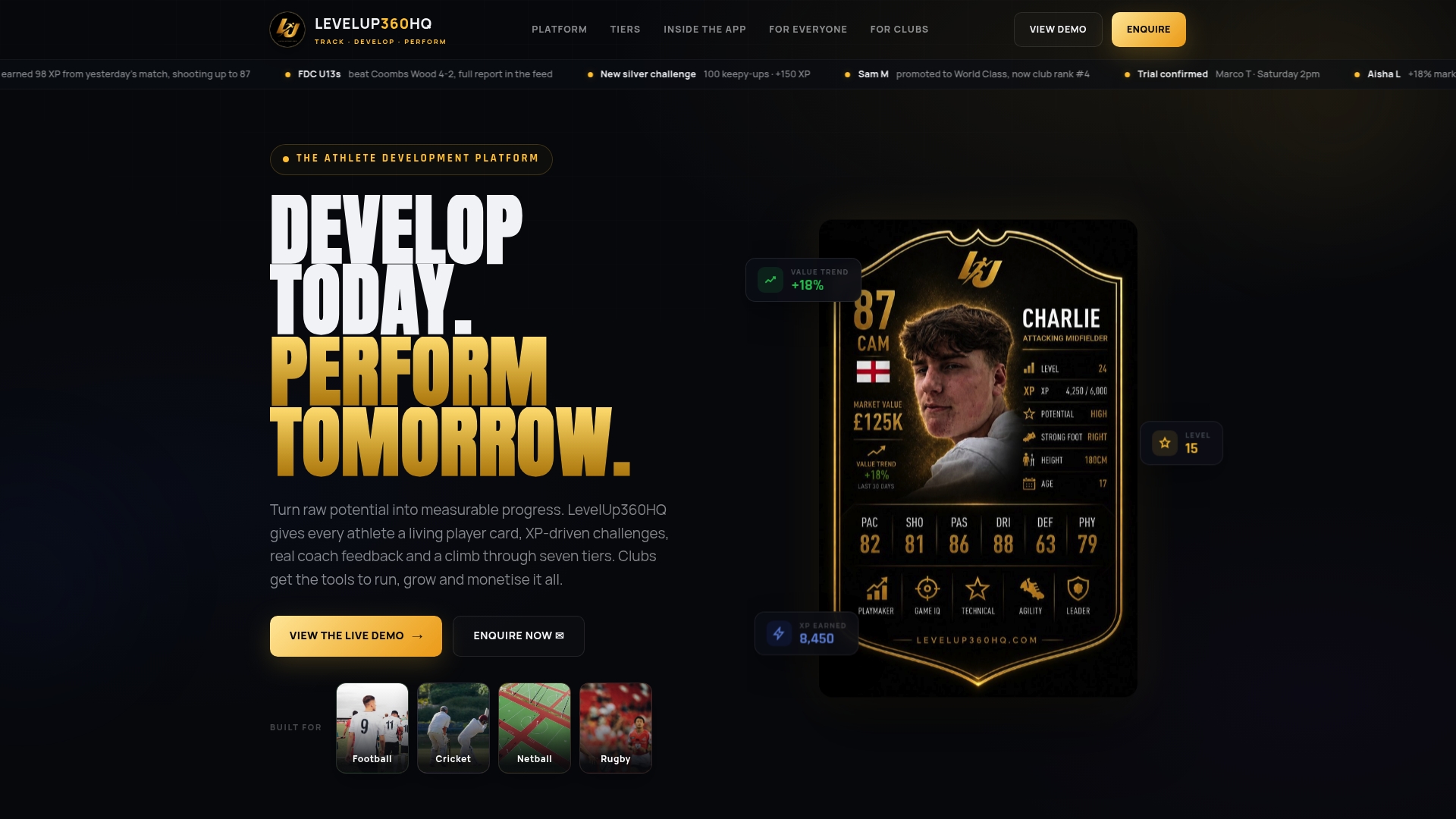
The published Pro plan is £49 per month, with an active athlete platform fee of £1.50 per month per active athlete. A revenue share applies to integrated payments and has no published price. You can see the details and the prototype on the LevelUp360HQ demo page, or read more about the platform on the LevelUp360HQ homepage.
FAQ
What is athlete data quality?
It is how far athlete records can be trusted for decisions: accurate, complete, current, consistent and properly governed. Good quality data tells coaches what is really happening, helps athletes be found by recruiters, and sits inside clear rules on who may see it.
Who owns athlete data in the US?
There is no single federal rule. In professional leagues, collective bargaining agreements give players ownership or deletion rights over wearable data. For college and youth athletes, ownership depends on state law, institutional policy and contracts, so ask for the rules in writing and check your state’s law.
How can I tell if self-reported athlete data is reliable?
Compare it with official results, timed tests or coach-recorded assessments, and label the source of each figure. Look for trends over several entries rather than one result. Verified data from schools or official events is generally trusted more by recruiters than unverified marks.
Can parents see, correct or delete their child’s data?
Often yes, but the route depends on who holds the data. Schools are bound by FERPA, and online services aimed at under-13s need verifiable parental consent under COPPA. Ask the club or app how to request corrections or deletion, and keep a copy of the answer.
Should coaches see an athlete’s sleep and recovery data?
Only if the athlete knows why and has agreed. Some collegiate athletes say they feel judged when staff see their sleep every night. Share the purpose, limit access to people who need it, and let athletes see their own data first.
Sources
- What is Athlete Data Management? (Sports First)
- Why Your Hudl Is Not Getting You Noticed (2aDays)
- Sports Data Operations In Athlete Education (CampTechWise)
- Getting Ahead of the Game: Athlete Data in Professional Sport (Australian Academy of Science)
- Recommendations for Assessment of Wearable Sensors (JMIR mHealth and uHealth)
- 10 Things to Look for in a Track & XC Recruiting Platform (Streamline Athletes)
- Which Platforms Provide Better Data Accuracy (Scorability)
- Wearables Are Changing Sports Employment (Fisher Phillips)
- Athletes and their Biometric Data (Mintz)
- Who Owns the Digital Athlete? (Colorado Technology Law Journal)
- Big Data, Big Problems (Indiana Journal of Law and Sport)
- Why athlete data could become the defining issue in college sports (Sports Business Journal)
- Virginia Code § 23.1-408.2
- U.S. Department of Education letter on FERPA and biometric records
- FTC press release on COPPA enforcement
- FTC prepared statement on health information
- NCAA student-athlete authorization form
- Mapping the Flow of Information from Continuous Wearables (University of Florida)
- Data Standards (Solstice FC)
Turn potential into a player card.
LevelUp360 tracks every match, builds your child's player card, and shows their development over time.
Get started free