Advance athlete tier progression: the coach's guide
Published 3 July 2026

Athlete tier progression is the process of moving athletes through defined performance levels by meeting validated physiological and skill-based benchmarks. The term you will encounter in sports science literature is structured periodised development, but “tier progression” has become the working shorthand for coaches and academies. To advance athlete tier progression effectively, athletes need more than effort. They need objective readiness criteria, appropriate training volumes, and a coach who knows when to push and when to wait. Platforms like Levelup360hq have built their entire architecture around this principle, making tier advancement visible, measurable, and motivating for every athlete in a programme.
What objective criteria determine advance athlete tier progression?
Tier advancement is not a reward for time served. It is a gate that opens only when an athlete meets specific physiological benchmarks.
The two most widely used readiness measures are the Limb Symmetry Index (LSI) and the Reactive Strength Index (RSI). LSI measures the strength or power output of one limb as a percentage of the other. An LSI of 90% or above is the accepted threshold for progressing from Tier 3 to Tier 4 in plyometric frameworks. RSI measures how explosively an athlete can absorb and redirect force. RSI ≥1.8 with contact times below 200ms is the benchmark for Tier 5 readiness. These numbers exist because connective tissue adapts more slowly than muscle, and rushing past them is the most common cause of overuse injury in developing athletes.

Tier progression also follows the weakest link principle. An athlete’s lowest domain dictates their overall tier level, not their strongest. A footballer with elite sprint speed but poor deceleration mechanics sits at the tier their deceleration earns them. This forces balanced development rather than lopsided specialisation.
Key readiness criteria coaches should assess before advancing an athlete:
- LSI ≥90% for bilateral strength and power symmetry
- RSI ≥1.8 with ground contact times below 200ms for reactive work
- Minimum residency time at the current tier, typically 8–12 weeks, regardless of performance scores
- Countermovement jump (CMJ) height relative to sport-specific norms
- Consistent velocity output across multiple sessions, not just a single peak performance
Pro Tip: Never advance an athlete based on one outstanding session. Require three consecutive sessions meeting the benchmark before signing off on progression.
How can coaches design training programmes for advanced tier athletes?
Advanced athletes are not simply fitter versions of intermediates. Their training demands are categorically different.
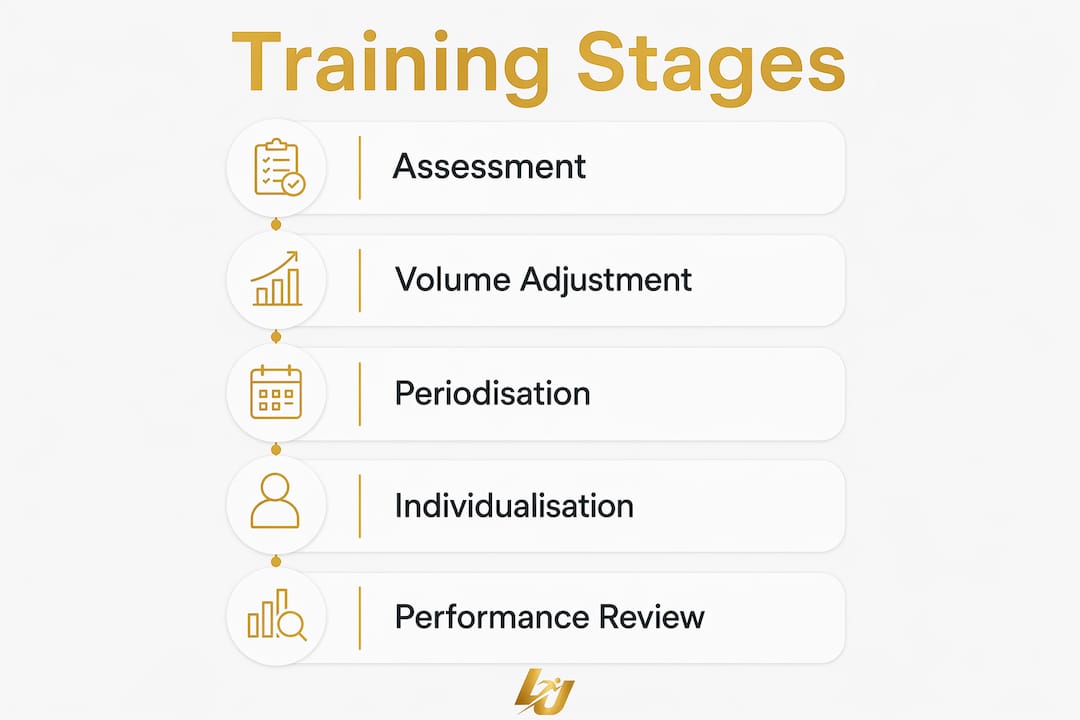
Advanced athletes with 3+ years of training age typically require 20–30+ sets per muscle group weekly. Strength gains slow to approximately 1% of one-rep max per month at this level. That means the margin for error in programme design is small, and the cost of poor periodisation is a plateau that can last months.
The two periodisation models best suited to advanced tier athletes are block periodisation and conjugate periodisation.
- Block periodisation concentrates training stress into focused mesocycles, typically three to four weeks of accumulation, followed by an intensification block, then a realisation block. Each block builds on the last. This model suits athletes preparing for a defined competitive season.
- Conjugate periodisation trains multiple physical qualities simultaneously but rotates the primary emphasis week to week. It suits athletes in year-round sports where maintaining multiple qualities at once is non-negotiable.
- Velocity-based training (VBT) sits across both models as a fatigue management tool. Terminating sets when velocity loss exceeds 20% prevents overreaching and keeps training quality high. Coaches should re-test load-velocity profiles every 2–3 weeks to track neuromuscular adaptation.
- Deload phases must be planned, not reactive. A scheduled reduction in volume every fourth week maintains long-term progress and reduces injury risk.
| Training age | Weekly sets per muscle group | Primary periodisation model |
|---|---|---|
| Beginner (0–1 year) | 6–10 sets | Linear |
| Intermediate (1–3 years) | 10–15 sets | Undulating |
| Advanced (3+ years) | 20–30+ sets | Block or conjugate |
Individualisation sits on top of the base programme. Coaches apply volume adjustments of plus or minus 20–30% to a shared base plan to account for individual recovery capacity, training history, and sport demands. This approach scales well for group coaching without losing the personalisation that advanced athletes need.
Pro Tip: Build your base programme for the median athlete in the group, then adjust volume up or down for outliers. This saves hours of individual programming while preserving adaptation quality.
What are the common mistakes when advancing athletes through performance tiers?
The most damaging mistake in athletic tier development is advancing an athlete before their connective tissue is ready.
Connective tissue adaptations require 8–12 weeks of consolidation at each tier, even when an athlete’s strength scores suggest they are ready to move on. Tendons, ligaments, and cartilage adapt more slowly than muscle. Bypassing this window increases injury risk significantly and often sets an athlete back further than the time saved by early advancement.
Common mistakes that compromise long-term development:
- Skipping minimum residency time because an athlete “looks ready” or is performing well in training
- Misreading plateaus as failure. A performance plateau at an advanced tier is often consolidation, not stagnation. The body is reinforcing adaptations before the next jump.
- Ignoring asymmetries. An LSI below 90% is a red flag that should pause progression regardless of other scores.
- Removing athlete input from the process. At advanced tiers, athletes who shift from passive recipients to assertive decision-makers in their training develop faster and sustain progress longer.
“The biggest error I see coaches make is treating tier advancement as a motivational tool rather than a safety mechanism. Readiness gates exist to protect the athlete, not to slow them down. When you respect the criteria, athletes trust the process and push harder within it.”
Athlete autonomy matters more at advanced tiers than at any other stage. Collaborative planning, where the athlete understands the criteria and contributes to session design, produces better adherence and better outcomes than top-down prescription.
How to integrate physiological profiling and tactical development in tier progression?
Physical benchmarks alone do not define an elite athlete. Tactical intelligence and sport-specific context are equally important in high-level athlete growth.
National-level youth handball players outperform non-selected peers on vertical jump (effect size d=1.408) and 20m sprint times. These numbers confirm that physical metrics are valid screening tools. But the same research shows that physical superiority does not guarantee selection. Tactical reading of the game, decision-making speed, and positional awareness all contribute to advancement at elite level.
Football players’ physical demands differ significantly by match possession phase and division. A winger in a high-press system needs different physical qualities than a winger in a possession-based system. Tier progression plans that ignore this context produce physically capable athletes who are tactically misaligned with their sport’s demands.
Coaches building integrated progression plans should track:
- Vertical jump height as a proxy for lower-body explosive power
- 20m sprint time as a marker of acceleration capacity
- Change-of-direction speed relative to sport-specific movement patterns
- Decision-making accuracy under physical fatigue, assessed through small-sided games or video analysis
Pro Tip: Run physiological profiling tests at the start of each new training block, not just at tier transition points. This gives you a trend line, not just a snapshot.
Balancing physical and tactical goals requires honest prioritisation. At Tier 4 and above, the physical ceiling is high enough that tactical development often produces faster competitive improvement than adding more physical load. Coaches who recognise this shift earlier tend to produce athletes who perform better under match conditions.
Key takeaways
Effective tier progression combines validated readiness benchmarks, structured periodisation, and athlete collaboration to produce safe, sustained performance development.
| Point | Details |
|---|---|
| Use objective readiness gates | LSI ≥90% and RSI ≥1.8 are the accepted benchmarks before advancing to higher tiers. |
| Respect minimum residency time | Connective tissue needs 8–12 weeks to consolidate at each tier, regardless of strength scores. |
| Match volume to training age | Advanced athletes need 20–30+ sets per muscle group weekly with block or conjugate periodisation. |
| Integrate tactical profiling | Physical metrics like vertical jump and sprint speed must be paired with sport-specific tactical demands. |
| Involve athletes in planning | Athletes who co-design their progression advance faster and sustain development longer. |
Why patience is the most underrated coaching skill
I have worked with coaches who treat tier advancement like a badge of honour. The faster they move athletes through the system, the more capable they appear. I understand the instinct. But after years of watching athletes break down in their second season because someone rushed them through Tier 3, I have come to believe that patience is the most underrated skill in coaching.
The shift from directive to collaborative coaching at advanced tiers is not optional. It is what the athlete needs. When an athlete understands why they are staying at a tier for another four weeks, they train with purpose rather than frustration. When they help set the criteria for their own advancement, they take ownership of the outcome. That ownership is what separates athletes who plateau at a good level from those who reach elite.
The readiness gates are not bureaucracy. They are the structure that makes trust possible between coach and athlete. Enforcing an LSI threshold is not a punishment. It is a promise that you will not let an athlete hurt themselves chasing progress they are not yet ready for.
Tiered programming also scales better than most coaches realise. A shared base plan with individual volume adjustments means you can coach a group of twelve advanced athletes without writing twelve separate programmes. Tiered coaching for groups is not a compromise. Done well, it is more effective than fully individualised plans because it creates a shared training culture alongside personal adaptation.
— Chris
How Levelup360hq supports tier progression tracking
Levelup360hq is built around the same principles this article covers. The platform gives athletes and coaches a live view of performance data, tier status, and readiness benchmarks in one place.

Coaches can track velocity metrics, monitor fatigue indicators, and apply tiered volume adjustments directly within the platform. Athletes see their own progression through XP-driven challenges, live player cards, and badge systems that make readiness criteria visible and motivating. For clubs managing multiple squads, the white-label CRM and session management tools mean tier progression is consistent across every coach and every athlete. Explore Levelup360hq to see how the platform turns the frameworks in this article into a daily coaching workflow. A live platform demo is available if you want to see the tier progression features in action before committing.
FAQ
What is the minimum residency time at each athlete tier?
Connective tissue adaptations require 8–12 weeks at each tier before advancement is safe. Strength scores alone are not sufficient to override this minimum.
What LSI score is required for plyometric tier advancement?
An LSI of 90% or above is the accepted threshold for progressing from Tier 3 to Tier 4. Scores below this indicate a bilateral imbalance that increases injury risk under high plyometric load.
How many sets per week do advanced athletes need?
Advanced athletes typically need 20–30+ sets per muscle group weekly. This is significantly higher than the 10–15 sets per week appropriate for intermediate athletes.
How does the weakest link principle affect tier placement?
An athlete’s overall tier is determined by their lowest-performing domain, not their strongest. This prevents lopsided development and ensures athletes build the balanced fitness required for competitive advancement.
Should coaches involve athletes in tier progression decisions?
At advanced tiers, athletes who participate in planning their own progression develop faster and sustain progress longer. Collaborative goal-setting produces better adherence than top-down prescription.
Recommended
Turn potential into a player card.
LevelUp360 tracks every match, builds your child's player card, and shows their development over time.
Get started free